Portable power stations: what 1 kWh runs in a caravan or a blackout
Portable power stations under €750
A caravan on a field, a workshop at the end of the garden and a house in a blackout meet the same wall: the appliances are ready and there is no socket. A petrol generator answers that with noise, fumes and a can of fuel. A portable power station answers it with a sealed block of lithium iron phosphate cells, a mains socket behind a flap and a fan most owners never notice. Four such stations stand in this article, and the largest of these stations holds two kilowatt-hours.
The listings make these stations look interchangeable, because three of the four print nearly the same pair of numbers: about 1,000 watt-hours of storage and 1,800 watts of output. Those two figures decide how long these power stations run and which appliances they can run, and they say nothing about the parts owners argue over. How fast the battery refills. How many sockets sit behind the flap. Whether these stations take a charge from a car. How many years of warranty stand behind these stations.
This portable power station comparison takes four of them: the expandable AFERIY P180 Pro, a FOSSiBOT F1800 with a charging dial, the compact DJI Power 1000 Mini and a 2,048 Wh AFERIY that covers a full weekend rather than an evening. All four sit in the same class — in most stores each one stays under $790, and the group sits near $620 — so the choice is about what each station does differently, not about budget. Every specification comes from the listings and every opinion from owners writing in the past year. Each card holds the parameters of one station and its price in each Amazon store.
Models in this comparison
Typical price across these models: about €587. Rough figures from store prices converted at fixed rates: what you pay also depends on the store and the region you order from. With our browser extension you can compare every Amazon store at once, right on the product page.
AFERIY P180 Pro: the 1 kWh power station that grows
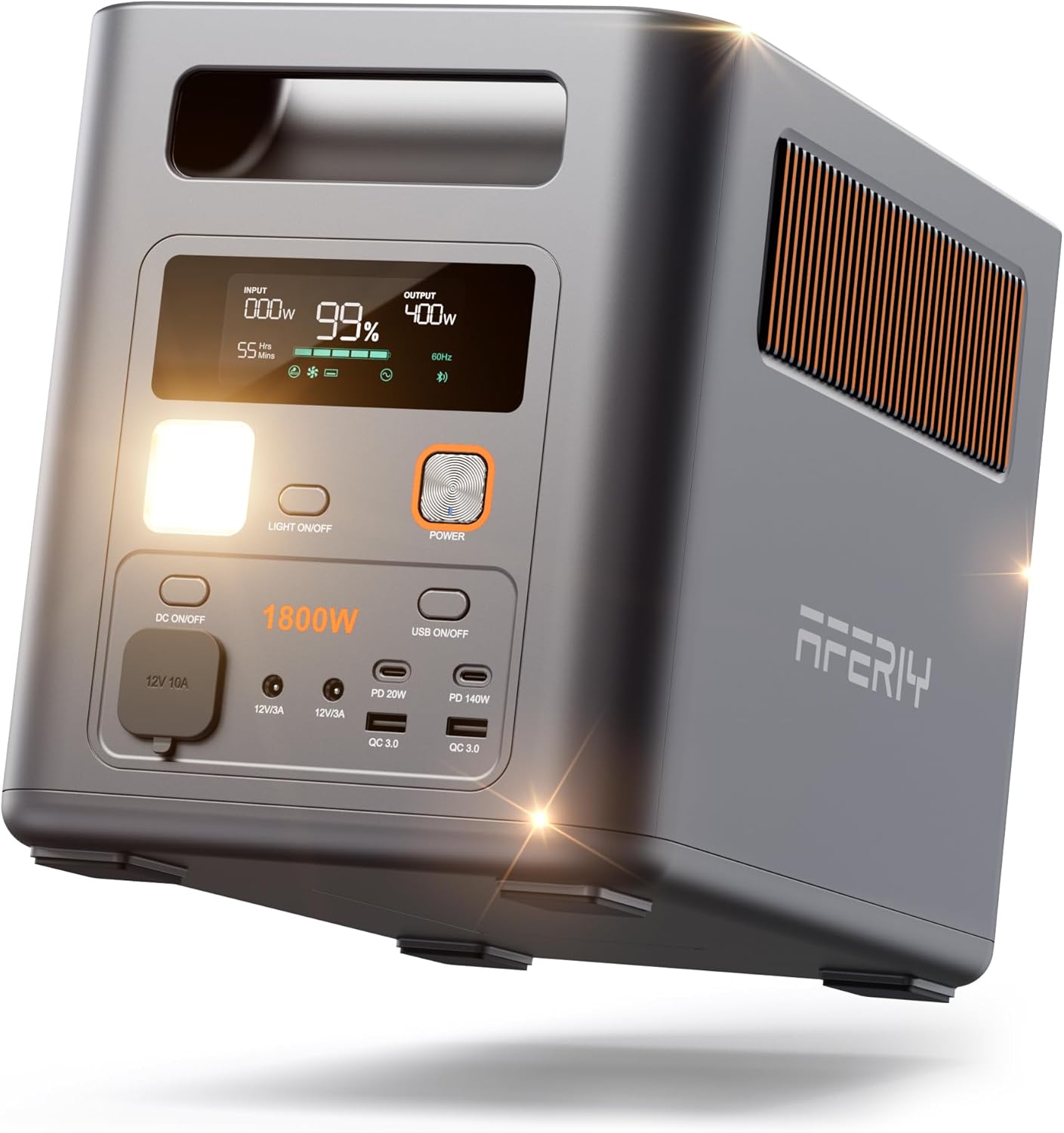
AFERIY 1800 W Portable Power Station, 1024 Wh, Expandable to 5120 Wh LiFePO4 Solar Generator & 1 Hour Quick Charge, 9 Outputs, with App, Pure Sine Wave 230 V, for Camping/Garden/Emergency
ASIN: B0GRHP57JJ
- ✓1,024 Wh that grows to 5,120 Wh with up to four expansion batteries
- ✓1,800 watts continuous, half again the output of the 1200 model it replaces, in a body 28% smaller
- ✓0 to 99% in one hour from the mains and a 500-watt panel together
- ✓Nine outputs, one of them a 140-watt USB-C port
- ✓Takes over in under 10 milliseconds when the mains fails
- ✓Seven-year warranty and consumption monitoring through the AFERIY app
- Capacity
- 1,024 Wh, expandable to 5,120 Wh
- Continuous output
- 1,800 watts (3,600 starting)
- Outputs
- 9, including USB-C PD 140 watts
- Cells
- LiFePO4, 4,000 cycles
- Fast charge
- 0 to 99% in 1 hour
- Weight
- 11.6 kg
- Size
- 35 × 26.3 × 22 cm
- Warranty
- 7 years (2 + 5)
Open this product on Amazon
Amazon prices change all the time, so check the current one on the store page. To compare every Amazon store at once, use our browser extension.
The P180 Pro is the one station here that does not stay the size you bought, and the reason is one port. On its own it holds 1,024 watt-hours. Up to four expansion batteries join it in parallel and lift the total to 5,120, so the same station serves a weekend in a tent and a week of outages at home. AFERIY quotes 1,800 watts continuous, half again the output of the 1200 generation before it, in a housing 28% smaller. Nine outputs sit behind the flaps, one of them a 140-watt USB-C socket, and the changeover to battery takes under 10 milliseconds. Both AFERIY stations carry FCC, CE, TELEC, UL2743 and UN38.3 approvals, the cells here are rated for 4,000 cycles, and the warranty runs two years with five more added on request.
Camping and motorhome trips fill most of the reviews of these stations. A German owner took the station away for several days in a camper. It ran a coffee machine, e-bike batteries, phones and tablets, and he praises the display that shows charge level, current draw and remaining time at once. Another owner keeps the station at home against outages and lists what it carried: fridge, coffee machine, toaster, hair dryer, fans, PC and TV, each for a short spell. A third keeps a freezer alive with this station and, on ordinary days, to run a window-cleaning robot where the socket is too far away.
The two handles come up almost as often as the electricity. An Italian owner calls the station easy to carry and says it runs quieter than the better-known stations he has owned. He would still light the AC and DC buttons and swap the front torch for a mains socket. A British owner puts the capacity in perspective: roughly half a 100 Ah battery, so you are paying for convenience. He finds the station convenient anyway — light, well supplied with ports, quiet under its fan, and easier to move than any station with a lead-acid battery inside. Against all that sits one German owner whose station would not charge, switched itself off and could not be revived while support kept postponing an answer.
Pros
- Expansion batteries take the same station from 1,024 to 5,120 watt-hours
- A full charge in about an hour from mains and sun together
- Display shows charge, draw and remaining time on one screen
- Two handles and 11.6 kg keep the station liftable by one person
- Quieter than rival brands, by an owner who has used both
- Seven years of warranty and lifetime technical support
Cons
- One owner received a unit that would not charge and got slow support
- The app talks over Bluetooth, so there is no monitoring from a distance
- The AC and DC buttons are not lit, which is awkward after dark
- Expansion batteries are a separate purchase, not part of the box
This is a portable power station for camping trips, caravans and households that want a fridge and a kettle to survive a power cut. Somebody who only charges phones and a laptop is buying far more energy than the trip will use.
What portable power stations really run
Each of these four is a LiFePO4 solar generator: lithium iron phosphate cells in a box, a panel input on the side and a mains socket on the front. What separates one LiFePO4 power station from another are the two numbers on the listing, and buyers routinely read only one of them. Watt-hours are the size of the tank: 1,024 in the P180 Pro, the same in the F1800 and, near enough, 1,008 in the DJI, against 2,048 in the largest station here. Watts are the width of the pipe: 1,800 from both 1800 stations, 1,000 from the DJI, 2,400 from the biggest station. A kettle that draws 2,000 watts will not start on a 1,000-watt station, whatever its battery holds. A 5-watt router will empty the largest of these stations eventually.
Owners show what those limits mean once the stations leave the shelf. A FOSSiBOT owner ran an induction hob and a small oven in a caravan. Another lived three weeks off two 200-watt roof panels with a coffee machine, toaster, kettle, TV and e-bike charging, and moved only the fridge back onto gas. An owner of the 2,048 Wh station ran a 2 kW induction hob, an air fryer and an electric grill in a garden hut, and another put a 60-degree and a 40-degree wash cycle through it. The DJI, with its lower ceiling, still took a circular saw, a jigsaw and a drill into the forest for one owner who used to carry a petrol generator instead.
Portable power station charging time is the third number, and it separates these stations more than capacity does. The P180 Pro claims 0 to 99% in an hour with the mains and a 500-watt panel working together. The F1800 reaches 80% in 45 minutes and the DJI needs 58 minutes for the same 80%. The largest station wants 1.7 hours from both sources, or two hours from its 1,100-watt socket. Solar alone is another scale entirely. One F1800 owner says panels need a long time to bring it to 100%, and an owner of the big AFERIY counts about five hours with a 400-watt panel.
FOSSiBOT F1800: the same capacity, with a charging dial
This station is the one to pick when charging noise and battery care matter as much as speed. A rotary wheel sets the mains input anywhere between 200 and 1,000 watts, so the same box can fill at full speed before a trip or trickle quietly overnight. The two 1800 stations match on paper, at 1,024 watt-hours and 1,800 watts, the cells are rated beyond 4,000 cycles, and seven outputs cover AC, USB-C at 100 watts, USB-A and DC. The box arrives fuller than most: mains cable, car charger, XT60 solar cable, accessory bag and manual, with five years of warranty behind it.
Owners describe a compact station that behaves like a much larger station. One ran two hair dryers at the same time and calls the app clear and useful; another spent three weeks in a caravan with it and needed no external supply. The complaints are specific rather than fatal. The casing creaks and does not feel premium, says a four-star owner, who also failed to find a plug that fits the unusual second 12-volt output. That car socket gets quite hot, reports another. A Dutch owner running it as a permanent UPS found it switches off below a 3-watt load and will not restart itself, which the manual does admit. He also saw it drop the UPS output once after reaching 100% on solar. Several German buyers waited longer for delivery than the listing promised.
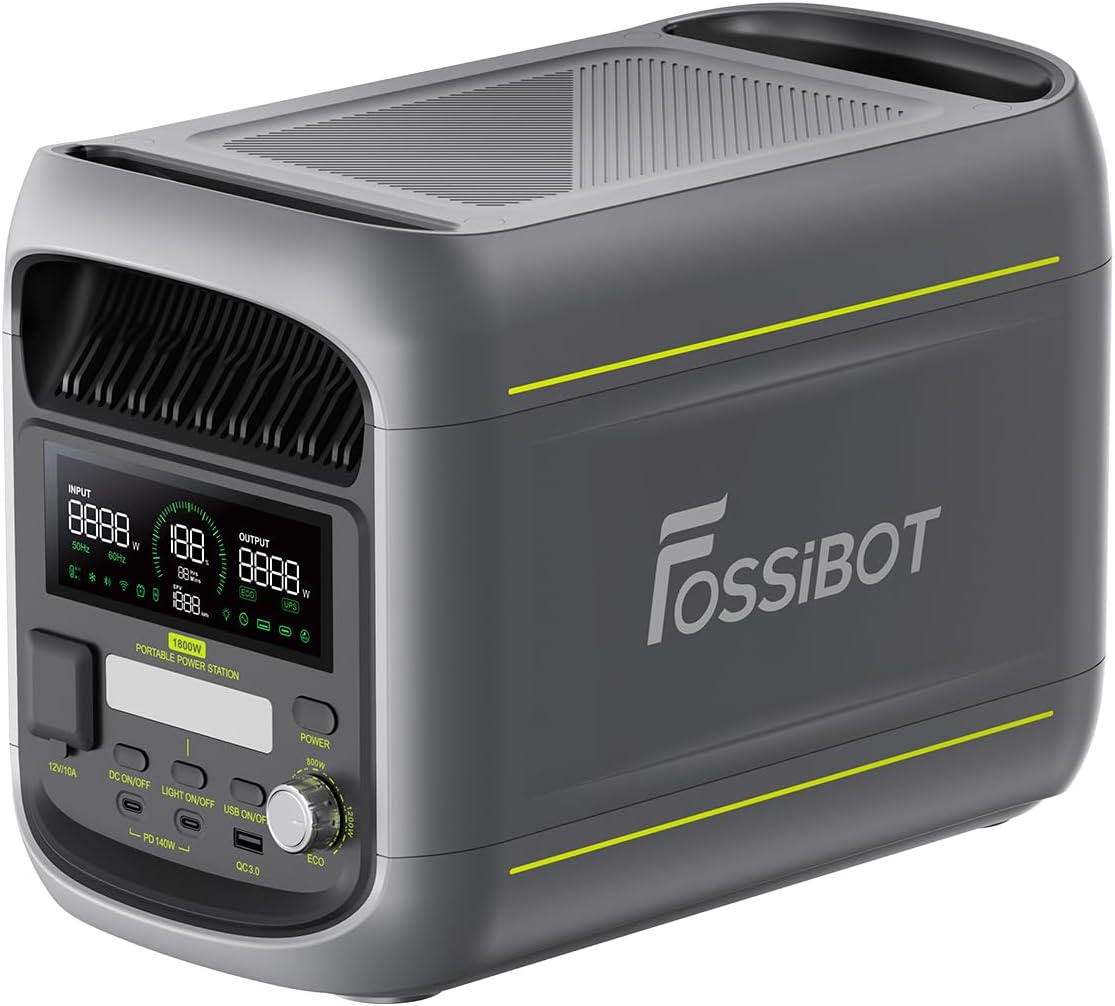
FOSSIBOT F1800 Portable Power Station 1800W, 1024Wh LiFePO4 Solar Generator, 100W USB-C, 0-80% Fast Charging in 45 Mins, for Camping, Travel & Home Use
ASIN: B0GJBJQQG8
- ✓A wheel that sets mains charging anywhere from 200 to 1,000 watts
- ✓0 to 80% in 45 minutes at full input
- ✓Seven outputs including a 100-watt USB-C socket
- ✓Pure sine wave and UPS changeover in under 10 milliseconds
- ✓Car charger, solar cable and accessory bag in the box
- ✓Five-year manufacturer warranty
- Capacity
- 1,024 Wh
- Continuous output
- 1,800 watts
- Outputs
- 7 (AC, USB-C, USB-A, DC)
- Cells
- LiFePO4, over 4,000 cycles
- Fast charge
- 0 to 80% in 45 minutes
- Mains input
- Adjustable, 200 to 1,000 watts
- Weight
- 11 kg
- Warranty
- 5 years
Open this product on Amazon
Amazon prices change all the time, so check the current one on the store page. To compare every Amazon store at once, use our browser extension.
Pros
- A dial that sets mains charging between 200 and 1,000 watts
- Full 1,800 watts ran two hair dryers at once for one owner
- Three weeks in a caravan on roof panels, with no external supply
- Car charger, solar cable and accessory bag included
- Clear app for checking and controlling the station
Cons
- The casing creaks and does not feel expensive
- The second 12-volt output takes an unusual plug that owners cannot find
- The 12-volt car socket gets quite hot in use
- As a permanent UPS it shuts off below a 3-watt load and stays off
- Several German buyers waited far longer for delivery than promised
DJI Power 1000 Mini: a cube that refills from the car
Here the argument is packing space, and this is the most compact of these stations. A kilowatt-hour of LFP cells sits inside a 25-centimetre cube. Two things normally sold as accessories are already built in: a 400-watt car charger and a 400-watt MPPT solar module. A panel or a cigarette-lighter lead plugs straight in. A 100-watt USB-C cable pulls out of the body and retracts again. The trade is output — 1,000 watts against 1,800 from the two stations above, with selected 1,200-watt appliances allowed — and 80% arrives in 58 minutes.
The reviews reward that design. A German owner drives into the forest with it and runs a circular saw, jigsaw and drill, then makes coffee. The real gain over other stations, he says, is silence, where his petrol generator was deafening. Another powers camera batteries and lights on a film set. An Italian owner keeps it under the home-office desk for the router, PC and lights, then takes it away at weekends for a coffee maker, the children's devices and a small projector. A French owner cooked a risotto in a Thermomix for 20% of the battery. Two warnings recur: the cube needs about 33 cm of shelf once the plugs stand proud, and first-time setup demands a firmware update explained only in unofficial videos. One German buyer had a unit stop charging after a single weekend.
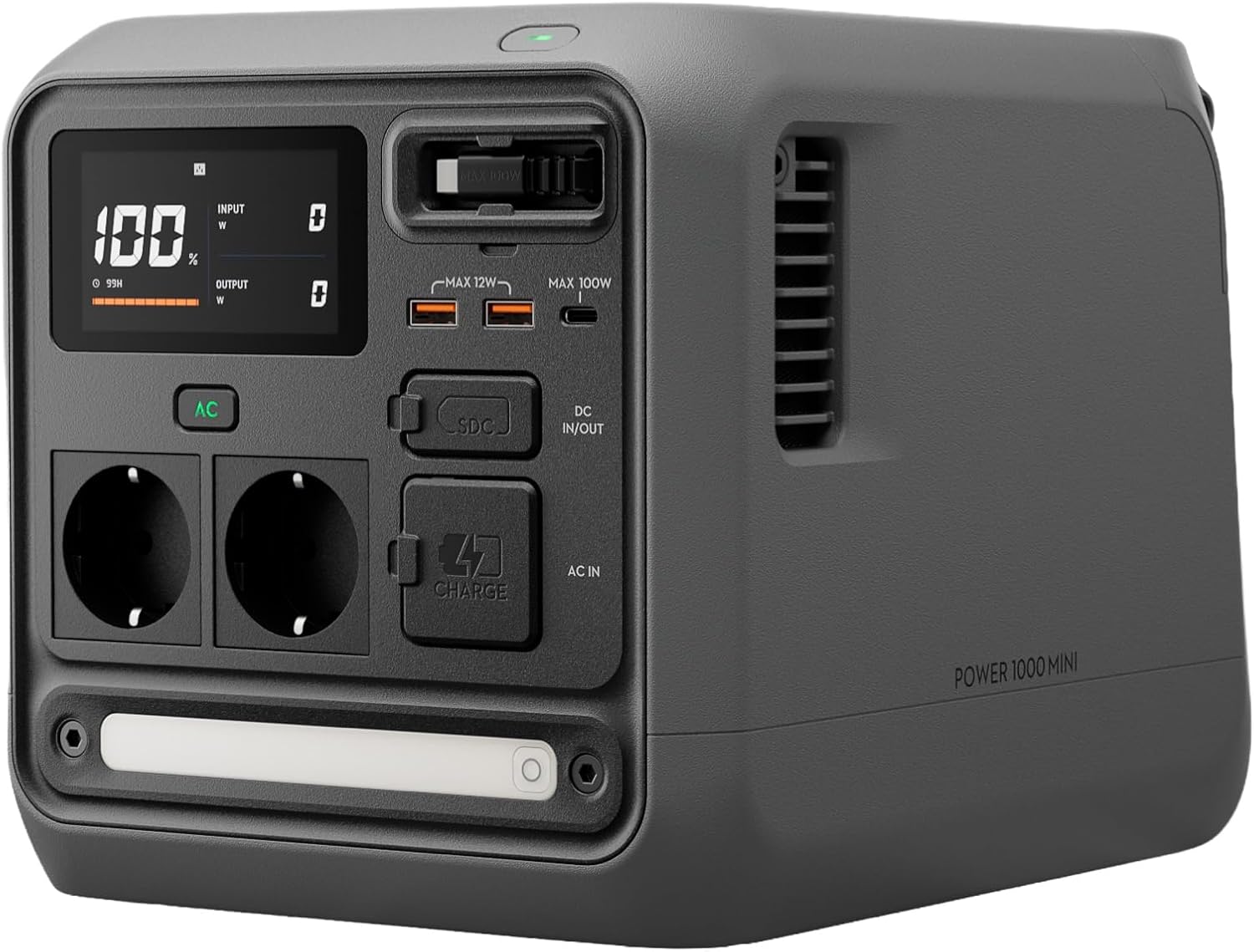
DJI Power 1000 Mini Portable Power Station Solar 1008Wh LFP Battery, Compact Size, Maximum Output 1000W, Charged in 58min from 0% to 80%
ASIN: B0GJC2M84T
- ✓One kilowatt-hour inside a 25-centimetre cube
- ✓400-watt car charger and 400-watt MPPT solar input, both built in
- ✓Retractable 100-watt USB-C cable in the housing
- ✓0 to 80% in 58 minutes
- ✓UPS function, adjustable LED lamp and quiet running
- Capacity
- 1,008 Wh, LFP cells
- Maximum output
- 1,000 watts (selected 1,200-watt devices)
- Fast charge
- 0 to 80% in 58 minutes
- Car charging
- 400 watts, built in
- Solar
- 400-watt MPPT, built in
- USB-C
- Retractable 100-watt cable
- Weight
- 11.5 kg
- Size
- 25 × 25 × 25 cm
Open this product on Amazon
Amazon prices change all the time, so check the current one on the store page. To compare every Amazon store at once, use our browser extension.
Pros
- The smallest station here, chosen by owners for the space it saves in a car
- Car and solar charging built in, so a lighter socket lead is enough
- Quiet where a petrol generator was deafening, says a forest user
- Steady enough for a home office: router, PC and lights
- Ran a Thermomix risotto on 20% of the battery
Cons
- 1,000 watts is the lowest ceiling of these four stations
- Needs about 33 cm of shelf once the plugs stand proud
- First setup needs a firmware update explained only in unofficial videos
- One station stopped charging after a single weekend
- Solar panels and car leads for other tasks are bought separately
AFERIY 2048 Wh: twice the battery in one station
The last of these stations stops arguing about kilowatt-hours and simply carries two of them. 2,048 watt-hours and 2,400 watts continuous put a 2 kW induction hob and a washing cycle within reach. Thirteen outputs sit behind the flaps, more than any of the other stations here. Charging follows the same generous pattern: 1.7 hours from mains and solar together, two hours from the 1,100-watt socket alone, up to 500 watts of panel through the MPPT input. The cells keep above 85% of their capacity after 3,500 cycles, the warranty is seven years, EU spare parts are promised for the same period, and a dust- and waterproof bag comes in the box.
This station has the largest crowd behind it: 4.6 from 328 ratings, the highest average of the four. Owners treat it as a small mains supply rather than a camping accessory. One runs an outdoor kitchen in a garden hut — air fryer, induction hob and electric grill — and praises how the sockets hide behind flaps. Another put two washing cycles through the station and refills it in about five hours from a 400-watt panel. A stable owner drives a well pump with it. The noise report is the most precise of any review here: fans stay calm at a 700-watt charge and become clearly audible at 1,100, so the fast setting is not a night-time choice. A French buyer, sceptical of unknown makers, bought a second station for a converted van. AFERIY support had walked him through a freezer-and-lighting setup for a household abroad where cuts last a week.
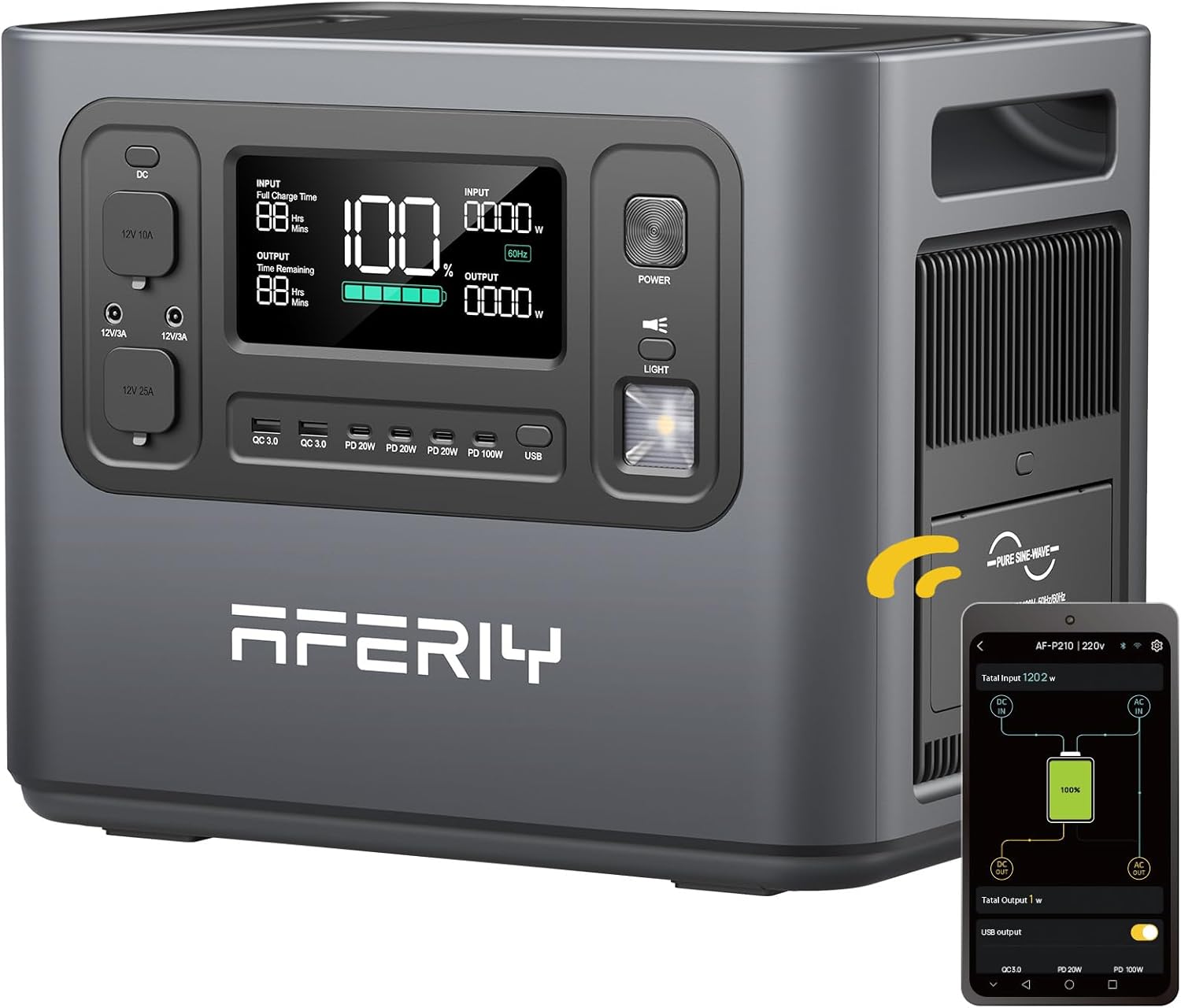
AFERIY 2400W Portable Power Station, 2048Wh LiFePO4 Battery, 1.5 Hour Quick Charge, 13 Ports, Sine Wave 230V, UPS Mobile Power Supply for Outdoor Camping
ASIN: B0CDGLT8JK
- ✓2,048 watt-hours and 2,400 watts, twice the battery of the 1 kWh models here
- ✓Thirteen outputs, all behind protective flaps
- ✓Full in 1.7 hours from mains and sun together
- ✓Large LED display readable across a room
- ✓Cells hold over 85% of capacity after 3,500 cycles
- ✓Seven-year warranty and a waterproof storage bag
- Capacity
- 2,048 Wh
- Continuous output
- 2,400 watts (4,000 starting)
- Outputs
- 13
- Cells
- LiFePO4, 85% after 3,500 cycles
- Fast charge
- 1.7 hours, mains plus solar
- Solar input
- Up to 500 watts, MPPT
- Size
- 39.2 × 27.9 × 32.3 cm
- Warranty
- 7 years (2 + 5)
Open this product on Amazon
Amazon prices change all the time, so check the current one on the store page. To compare every Amazon store at once, use our browser extension.
Pros
- Enough output for a 2 kW induction hob, an air fryer and an electric grill
- Carried a 60-degree and a 40-degree wash cycle in one owner's test
- Thirteen outputs, all behind protective flaps
- Fans stay calm while charging at 700 watts
- Highest average rating here, on the largest number of ratings
Cons
- The heaviest and bulkiest station of the four
- Clearly audible when charging at the full 1,100 watts, so not a night setting
- About five hours from a 400-watt panel in good weather
- No expansion battery and no adjustable mains input
Portable power stations by the numbers
The four stations are easier to weigh when their figures stand in one place.
| Parameter | AFERIY P180 Pro | FOSSiBOT F1800 | DJI Power 1000 Mini | AFERIY 2048 Wh |
|---|---|---|---|---|
| Capacity | 1,024 Wh | 1,024 Wh | 1,008 Wh | 2,048 Wh |
| Continuous output | 1,800 watts | 1,800 watts | 1,000 watts | 2,400 watts |
| Expandable | To 5,120 Wh | — | — | — |
| Outputs | 9 | 7 | — | 13 |
| Fastest charge | 0 to 99% in 1 h | 0 to 80% in 45 min | 0 to 80% in 58 min | Full in 1.7 h |
| Adjustable mains input | — | 200 to 1,000 watts | — | — |
| Car charging built in | — | — | 400 watts | — |
| Weight | 11.6 kg | 11 kg | 11.5 kg | — |
| Size | 35 × 26.3 × 22 cm | 29 × 23 × 25 cm | 25 × 25 × 25 cm | 39.2 × 27.9 × 32.3 cm |
| Warranty | 7 years | 5 years | — | 7 years |
| EU spare parts | — | — | 5 years | 7 years |
| Customer rating | 4.4 (287) | 4.5 (141) | 4.4 (205) | 4.6 (328) |
Read the averages of these stations together with the crowd behind them. The 2,048 Wh station rests on 328 ratings and the P180 Pro on 287, so both figures are settled, and the 205 behind the DJI count for as much. The 4.5 of the FOSSiBOT comes from 141 buyers, the thinnest record here, and several of them were writing about delivery rather than the stations themselves.
A power station for home backup, not only for the road
Half the owners here never take their station outdoors. A power station for home backup does a quieter job: it stands under a desk or in a hallway and waits. As a UPS power station it takes over in under 10 milliseconds when the mains drops, so a computer never restarts and a freezer never thaws. Owners describe exactly that — a router, a PC and lights in an Italian home office, a freezer kept alive during cuts, a rented flat where the supply was not yet connected.
The other half of the reviews are camping and caravans, and both halves agree on noise. Fans stay quiet in normal use across all four stations, and the two owners who found the exception found the same cause: charging at full input. The largest station is audible at 1,100 watts and calm at 700, which is exactly what the FOSSiBOT dial is for.
Failures cluster in two places. Individual units are the first: one dead P180 Pro and one DJI that stopped charging after a weekend, a handful among 961 ratings across these stations, but enough to make the warranty column worth reading. Connectors are the second: an unusual 12-volt socket on the FOSSiBOT that fits no standard plug, a car lead that runs hot, and a French owner who expected his station to refill from a car and found it would not.
How to choose a portable power station
- Start from the appliance, not from the capacity. Watts decide what will switch on at all, so a 2 kW induction hob or a kettle rules out a 1,000-watt station immediately, whatever its battery holds. Only then does the kilowatt-hour figure decide how long the evening lasts.
- Count the hours between charges, then add the sun. A weekend in a tent is comfortable on one kilowatt-hour; a week of outages or an outdoor kitchen wants two, or a station that takes expansion batteries.
- Look at how the battery refills, not only how fast. An hour from a wall socket is normal among these stations now, but solar alone takes most of a day, and owners who live off panels say so plainly.
- Check the input you will actually use. A built-in car charger matters on a road trip, an adjustable mains dial matters when the station charges overnight in a bedroom, and one of these stations offers neither.
- Count and name the outputs. Nine, seven or thirteen sockets is a real difference when a fridge, a laptop and two phones share one station, and a single unusual DC connector can strand an output.
- Read the warranty line. Seven years, five years and an unstated term sit side by side among these stations, and with makers most buyers have never heard of, that number says more about confidence than any wattage on the box.
- Treat the display as equipment, not decoration. Owners of three of these stations mention reading charge level, draw and remaining time off the screen; it is how you learn what your own kit consumes.
Frequently asked questions
- What can an 1,800-watt station actually run?
- Owners report coffee machines, toasters, kettles, TVs, induction hobs, e-bike chargers and mains power tools. One buyer ran two hair dryers at once from the FOSSiBOT, and another kept a fridge, toaster, PC and TV going during a blackout with the AFERIY P180 Pro.
- Can one of these work as a UPS for a computer?
- Yes. The P180 Pro, the F1800 and the 2,048 Wh AFERIY all switch over in under 10 milliseconds, and the DJI has a UPS function too. One Italian owner runs router, PC and lights from the DJI at home. A Dutch owner warns that the F1800 shuts down below a 3-watt load and does not restart itself.
- How long does a full charge take?
- From the mains and a panel together, AFERIY quotes an hour to 99% for the P180 Pro and 1.7 hours for the 2,048 Wh model. The F1800 reaches 80% in 45 minutes and the DJI in 58. From solar alone it is a different scale: one owner counts about five hours with a 400-watt panel in good weather.
- Can I recharge from the car?
- The DJI has a 400-watt car charger built into the body. The FOSSiBOT box lists a car charger among its accessories, although one French owner reports it will not refill directly from a car. The two AFERIY listings describe mains and solar input.
- How long do the batteries last?
- All four use lithium iron phosphate cells. AFERIY rates the P180 Pro at 4,000 charge cycles and about ten years, and says the 2,048 Wh model keeps more than 85% of its capacity after 3,500 cycles. FOSSiBOT quotes over 4,000 cycles at 80% capacity.
Verdict
Every model on the same criteria
Score against price
- AFERIY P180 Pro4.3 at about €629
- FOSSiBOT F18004.3 at about €469
- DJI Power 1000 Mini4.2 at about €526
- AFERIY 2048 Wh4.5 at about €725
The overall score divided by the typical price, with the best in the group as the full bar. A rough guide, not a verdict — a cheap model that misses the feature you need is no bargain.
These four stations differ less in electricity than in the life they are built for. The P180 Pro is the flexible everyday station, the one that grows when your needs do. The FOSSiBOT answers the charging question with a dial and arrives with the accessories the others sell separately. The DJI is the traveller's station: smaller in output, built to refill from a car, quiet enough for a home office. The 2,048 Wh AFERIY is a small mains supply for a garden kitchen, a stable or a week without electricity.
The mistake worth avoiding is buying by capacity alone. Check that the appliance you care about will start. Then pick the smallest station that carries it through the evening, because the power station you actually lift into the car is worth more than the one left in the garage.