Smartwatch comparison: four AMOLED models with GPS and long battery
Smartwatches under €150
A smartwatch used to be a phone accessory that begged for a charger every second night. The current generation changed that. A modern smartwatch runs one to three weeks on a charge, keeps an AMOLED screen readable in direct sunlight, finds satellites without a phone in your pocket and counts heartbeats around the clock. The shelf that once held one expensive brand now holds dozens of smartwatches that look nearly the same in a listing.
That similarity is the problem. Two smartwatches can share the same square shape, the same AMOLED panel and the same list of sports modes and still suit completely different people. The real split runs through five things: how much smartwatch sits on your wrist, how many days the battery survives real use, whether the smartwatch pays at a terminal, how deep the health sensors go, and — the part nobody reads on the box — how good the phone app is.
This smartwatch comparison sets four wearables side by side: the Redmi Watch 6 NFC with contactless payment, a slim band from the same maker, a sportier smartwatch from Amazfit and a budget health smartwatch stuffed with sensors. They sit in one class rather than in four price brackets — in most stores each one stays under $150, and the group sits near $105 — so the choice is about what each one does differently. Every specification below comes from the product listings, and every opinion comes from buyers who already wear these smartwatches.
Models in this comparison
Typical price across these models: about €93. Rough figures from store prices converted at fixed rates: what you pay also depends on the store and the region you order from. With our browser extension you can compare every Amazon store at once, right on the product page.
Redmi Watch 6 NFC: a big AMOLED smartwatch with contactless payment
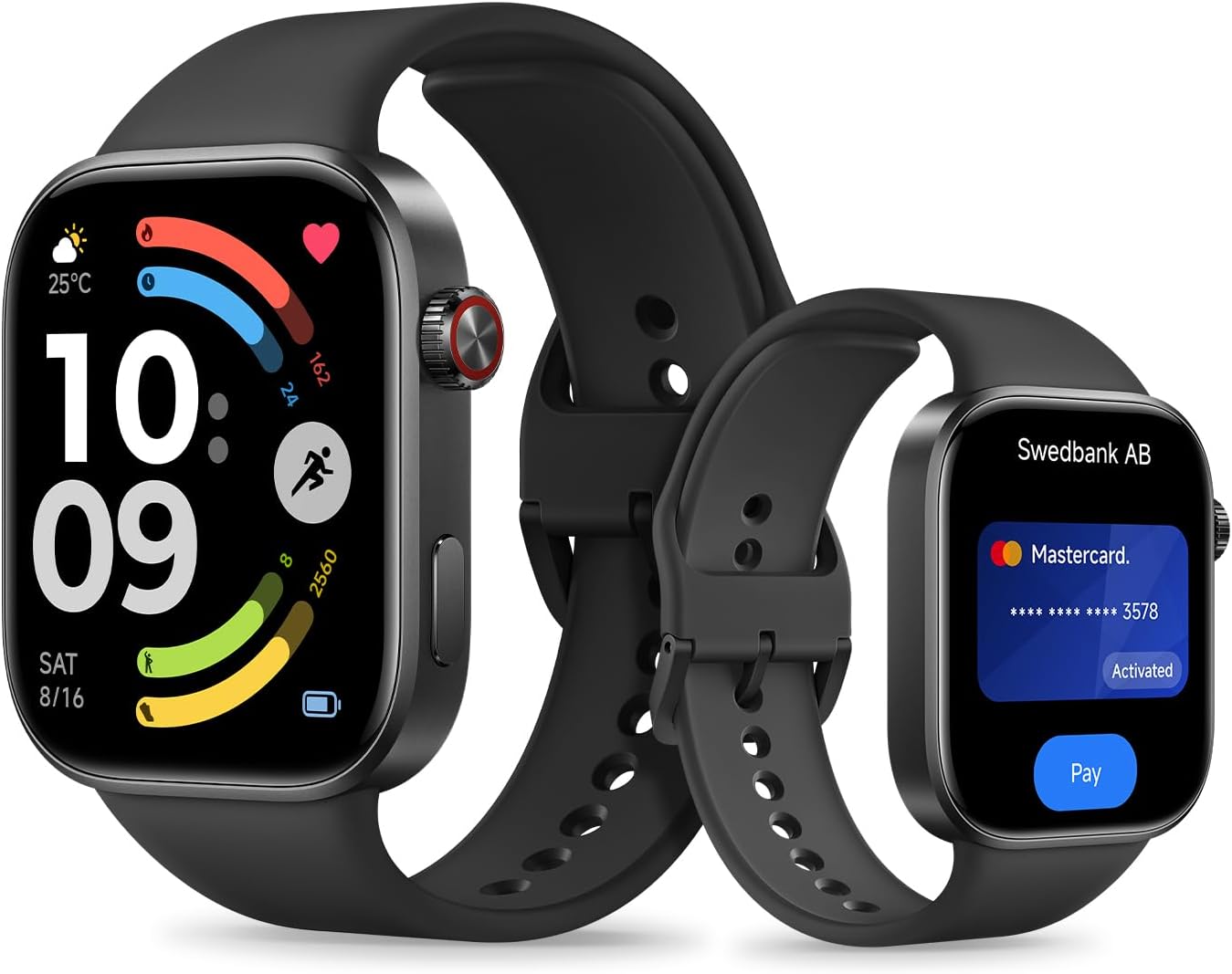
XIAOMI Redmi Watch 6 NFC, Smartwatch for Men and Women, 2.07 Inch AMOLED, 150+ Sports Modes, 24 Days Battery Life, 5ATM, GPS
ASIN: B0GQLQF6GH
- ✓Large 2.07-inch AMOLED screen with 2 mm bezels on both sides
- ✓Up to 24 days of light use from the 550 mAh battery
- ✓NFC on board for contactless payment at a terminal
- ✓Dual-band five-system satellite receiver for outdoor tracking
- ✓Aluminium unibody case only 9.9 mm thick
- Screen
- 2.07 in AMOLED, 432 × 514
- Battery
- 550 mAh, up to 24 days
- Case
- Aluminium, 9.9 mm
- Water resistance
- 5 ATM, 50 m
- Sports modes
- 150+
- Software
- Xiaomi HyperOS 3.0
Its 2.07-inch AMOLED panel is the largest in this smartwatch comparison, and the display materials were rebuilt so the picture holds up outdoors. The aluminium unibody is 1.4 mm slimmer than the previous generation, and the 550 mAh cell behind it is the biggest of these smartwatches by a wide margin — up to 24 days of light use, says the maker. A raised steel crown and a second button drive the menus, the dual-band satellite chip records a route without a phone, and over 150 sports modes track running, cycling and hiking with live heart rate. NFC is the feature in the name: tap the smartwatch on a payment terminal instead of reaching for a card. Two years of manufacturer warranty stand behind it.
The battery claim survives contact with reality, which is rare. One German owner measured about 18 days with continuous vital-sign monitoring, no always-on display and no workouts; another gets over a week while training two or three times a week; a Japanese buyer running heart rate, sleep, blood oxygen and stress tracking at once reports roughly two weeks. Several people describe the screen as bright at midday and large enough to show the real text of a message rather than a truncated line. Setup takes minutes, the connection holds, and the straps come off so easily that one owner has collected about thirty of them.
The complaints matter more than the star average suggests. Payment is the sore point: a German buyer could not add a single Visa or Mastercard and returned the smartwatch, while a Spanish owner got payments working only after setting up a free Curve account that issues a virtual card. Software is the second theme. You cannot install apps on this smartwatch, the font size is fixed, the buttons cannot be reassigned, messages cannot be answered from the wrist, and many downloadable faces look amateurish. One owner who came from the previous model in the line saw too little progress to justify the move, and a Japanese reviewer adds that on a slim wrist this body looks bulky.
Pros
- Battery life that owners measure in weeks, not days
- Big, bright AMOLED screen that stays readable in sunlight
- Fast satellite lock and route tracking without a phone
- Straps swap in seconds and cost very little
- Simple setup and a stable connection to the phone
Cons
- NFC payment supports few banks and may need a virtual card workaround
- No app installation and no replies to messages from the wrist
- Font size fixed and buttons not reassignable
- Many watch faces look unfinished
- Large body on a slim wrist
This smartwatch suits someone who wants a big readable screen, forgets chargers and treats notifications as something to glance at. Anyone buying mainly for contactless payment should check their bank first, and anyone who wants a smartwatch that runs proper apps should look at a different class.
Smartwatch or fitness band: what the shape changes
Three of these four wearables are full-size smartwatches and one is a narrow band, and that difference decides more than any specification. A 2-inch smartwatch panel shows a whole message, a map fragment and a readable dial, which is why buyers who moved up from a band mention the screen first. Large smartwatches also sit high on the wrist and make themselves known at night. A band gives that space back: the Smart Band 10 Pro is 9.7 mm thick and weighs 21.5 grams, and its owners keep saying they stop noticing it. The cost is fewer characters per screen, no calls from the wrist and a smaller battery than a full smartwatch carries. One warning no specification predicts: an owner returned an earlier, narrower band because the slim case left marks on a thicker forearm, and found the wider model far more comfortable.
Xiaomi Smart Band 10 Pro: the slim alternative with a huge following
This is the smallest of these smartwatches and the most popular by a distance: 12,508 ratings at 4.4 stars, and the top seller in its category. The 1.74-inch AMOLED panel reaches 1,500 nits and sits in a 9.7 mm aluminium case built with vacuum encapsulation, so the frames stay thin and symmetrical. The 350 mAh battery is quoted at 21 days of low use, 15 days of normal use and 8 days with the always-on display, and a full charge takes 80 minutes. Five satellite systems track a route without the phone, sleep tracking averages heart rate variability to estimate recovery, and notifications can arrive from two phones at once, which is unusual at this level.
Owners of this smartwatch are close to unanimous about the battery: one describes 14 days of round-the-clock use dropping the charge from 100% to 35%, another gets 10 to 12 days with sleep and fitness tracking on. Step counting reads as plausible rather than optimistic, and the recently used sport modes surface first instead of hiding in a menu. Two people arrived here from a Fitbit Charge 5 and a Galaxy Watch and rate the display, the strap choice and the runtime higher than the smartwatches they left behind. The limits are honest: no calls from the band, automatic workout detection that one owner never managed to switch on, a strap-release button that started sticking for another, and, on the NFC version, payment support that a German buyer calls barely usable in his country — though he points out the bank list is published before you buy.
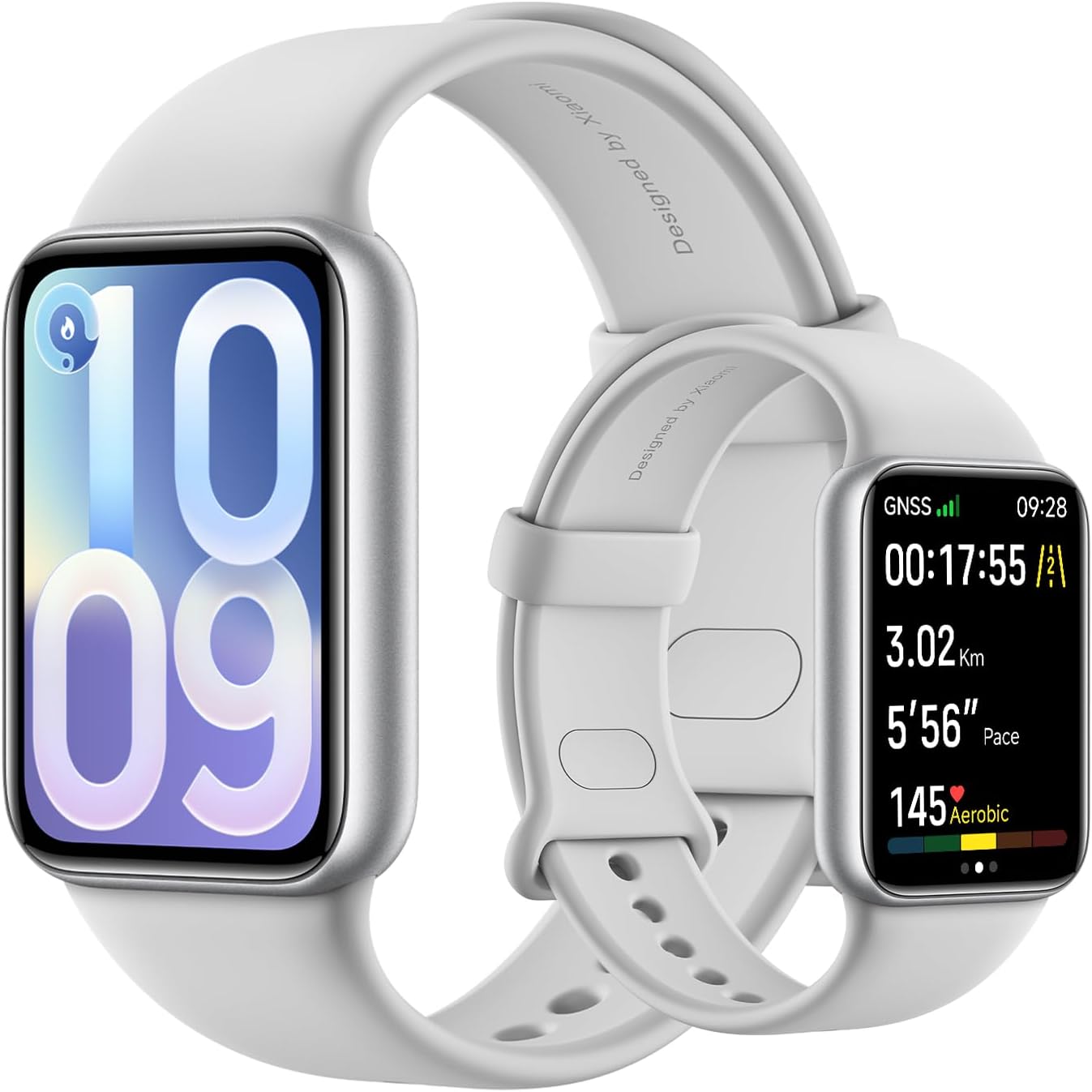
XIAOMI Smart Band 10 Pro Fitness Wristband Silver, 1.74 AMOLED, sleep algorithm, 21 day battery, 150+ sports, 5ATM
ASIN: B0GQ3FLTL5
- ✓1.74-inch AMOLED at 1,500 nits in a 9.7 mm aluminium case
- ✓21.5 grams on the wrist, light enough to forget
- ✓Five satellite systems for phone-free route tracking
- ✓Sleep tracking with heart rate variability and a recovery estimate
- ✓Notifications from two phones on one band
- Screen
- 1.74 in AMOLED, 1,500 nits
- Battery
- 350 mAh, up to 21 days
- Charge time
- 80 minutes
- Weight
- 21.5 g
- Water resistance
- 5 ATM, 50 m
- Warranty
- 2 years from the maker
Pros
- Ten days and more between charges in owner reports
- So light on the wrist that owners forget it is there
- Bright screen and a wide choice of straps and faces
- Step and workout data that owners call plausible
- Twelve thousand ratings behind a 4.4 average
Cons
- No calls from the wrist and less text per screen
- Automatic workout detection one owner never got to start
- Strap-release button began to stick for another owner
- Sleep records ignore some waking periods
- On the NFC version, payment barely works in some countries
Amazfit Active 2: the sportier smartwatch with offline maps and GPS
The Amazfit is the smartwatch built for people who train seriously. It is the only smartwatch in this comparison with a polished stainless steel case and scratch-resistant sapphire glass, and its 1.75-inch AMOLED panel peaks at 2,000 nits, the brightest figure here. Maps download to the smartwatch through the Zepp app and give turn-by-turn voice directions through the speaker or Bluetooth headphones, which none of the other smartwatches can do. Zepp Coach builds training plans that adapt as you recover, with running programmes from 3 km to a marathon, and an official HYROX race mode sits beside roughly 130 sports modes. The 260 mAh battery is the smallest of these smartwatches: 10 days of typical use, 5 days of heavy use, 21 hours of continuous satellite tracking and about two hours to refill.
Buyers of this smartwatch confirm the build and the fit — several mention that it looks right on a small or medium wrist instead of sitting there like a laptop, and two straps come in the box. Real battery figures land at 6 to 9 days. The Zepp app draws praise for its depth, including a feature that photographs a meal and estimates the calories. The criticism is specific. One owner rates sleep tracking as poor, because the smartwatch logs a nap whenever he sits still watching television, and calls the satellite accuracy weak; a Belgian buyer says distances are sometimes overstated. The silicone strap tucks its end underneath and irritated one owner's skin, and automatic detection once logged a motorcycle ride as cycling. One buyer had the speakers die after six weeks with no useful help from support, against a 12-month warranty — the shortest cover among the branded smartwatches here.
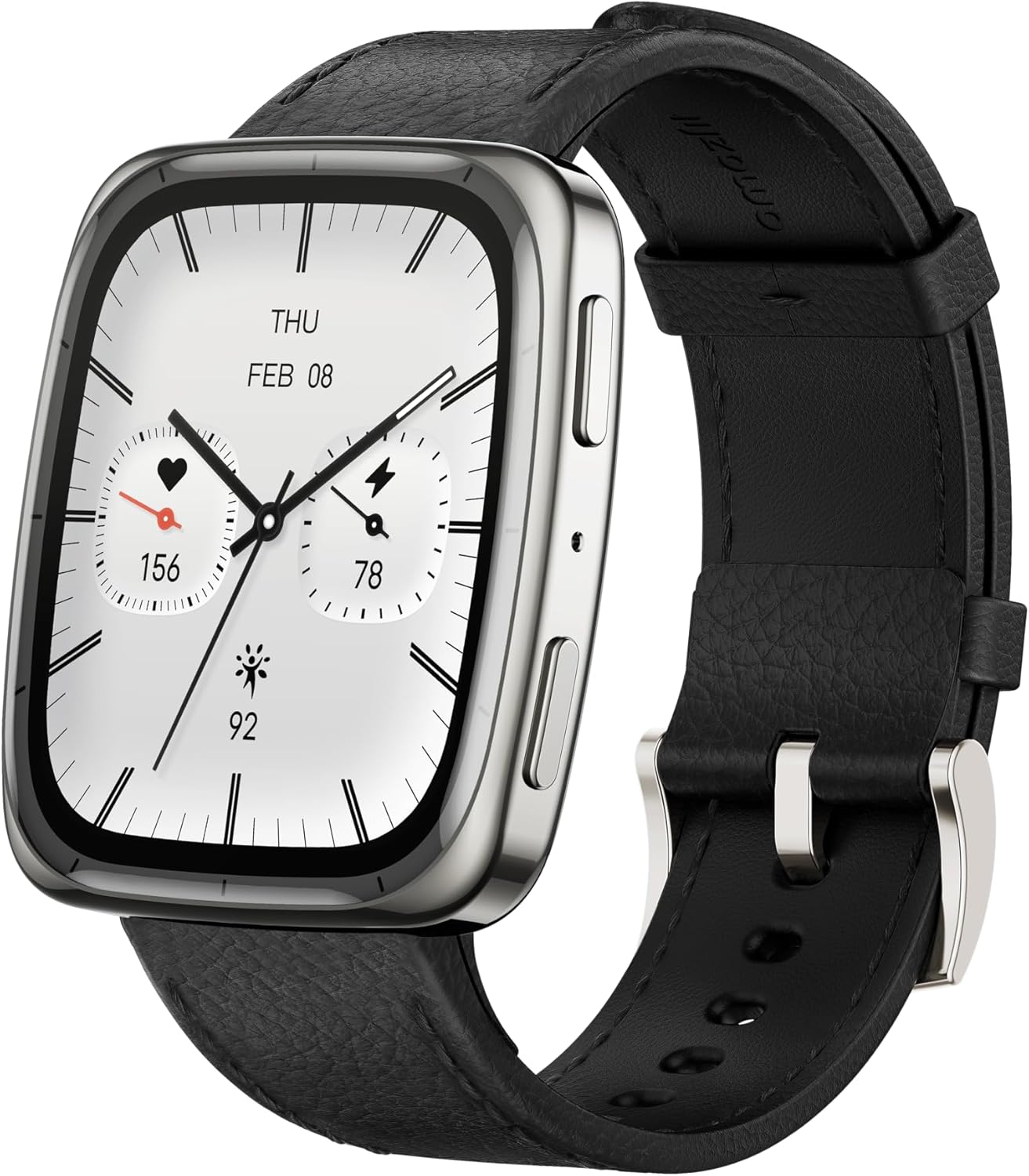
Amazfit Active 2 Smartwatch 43 mm, 1.75 Inch AMOLED Display, Offline Maps with GPS, 10 Day Battery, Waterproof
ASIN: B0F8B2776S
- ✓Stainless steel case with scratch-resistant sapphire glass
- ✓1.75-inch AMOLED at 2,000 nits, the brightest screen in this group
- ✓Offline maps with turn-by-turn voice directions
- ✓Zepp Coach training plans from 3 km to a marathon
- ✓Repetition counting for strength work and an official HYROX mode
- Screen
- 1.75 in AMOLED, 390 × 390
- Brightness
- 2,000 nits
- Battery
- 260 mAh, up to 10 days
- Satellite tracking
- Up to 21 hours continuous
- Water resistance
- 50 m
- Warranty
- 12 months
Pros
- Steel case and sapphire glass, the sturdiest smartwatch here
- Offline maps with spoken turn-by-turn directions
- Zepp app with training plans and meal-photo calorie counting
- Fits a small or medium wrist, with two straps in the box
- Six to nine days of real use between charges
Cons
- Sleep tracking logs a nap whenever you sit still
- Route distances sometimes come out too long
- The silicone strap end rubs the skin underneath
- Automatic detection once logged a motorcycle ride as cycling
- Twelve-month warranty and slow help when speakers failed
Marsyu health smartwatch: many sensors, modest expectations
The fourth smartwatch plays a different game. It comes from a small brand, carries a 1.97-inch AMOLED screen at 390 × 450 and is the only smartwatch with ECG in this group: a 60-second report lands in the app, next to heart rate variability, blood pressure, blood oxygen, skin temperature, stress, uric acid and body composition readings the branded smartwatches above do not offer at all. Bluetooth calling works from the wrist, an SOS function calls an emergency contact, and 50 sports modes cover the basics. Two straps come in the box, soft silicone and gold Milanese steel. Protection is IP67 rather than the 5 ATM of the others, so this smartwatch stays out of the pool.
Buyers are surprised by what the smartwatch packs in. An American owner calls the metal build as good as a first-generation Apple Watch, praises the always-on display and finds the small torch in the case unexpectedly useful. This smartwatch runs about a week with every measurement switched on, and one owner says his readings landed close to the results of a blood test — his words, not a guarantee. The maker states that all values are for reference and do not replace medical equipment, and that framing is the right one. The app is where this smartwatch loses ground: the Bluetooth link is unstable and sleep tracking is a lottery, in one owner's phrase. The SOS feature and the voice assistant are buried in menus, which defeats their purpose for an elderly wearer. One buyer's smartwatch failed after roughly two months and he could find nobody to contact. The warranty runs six months and the score rests on 41 ratings.
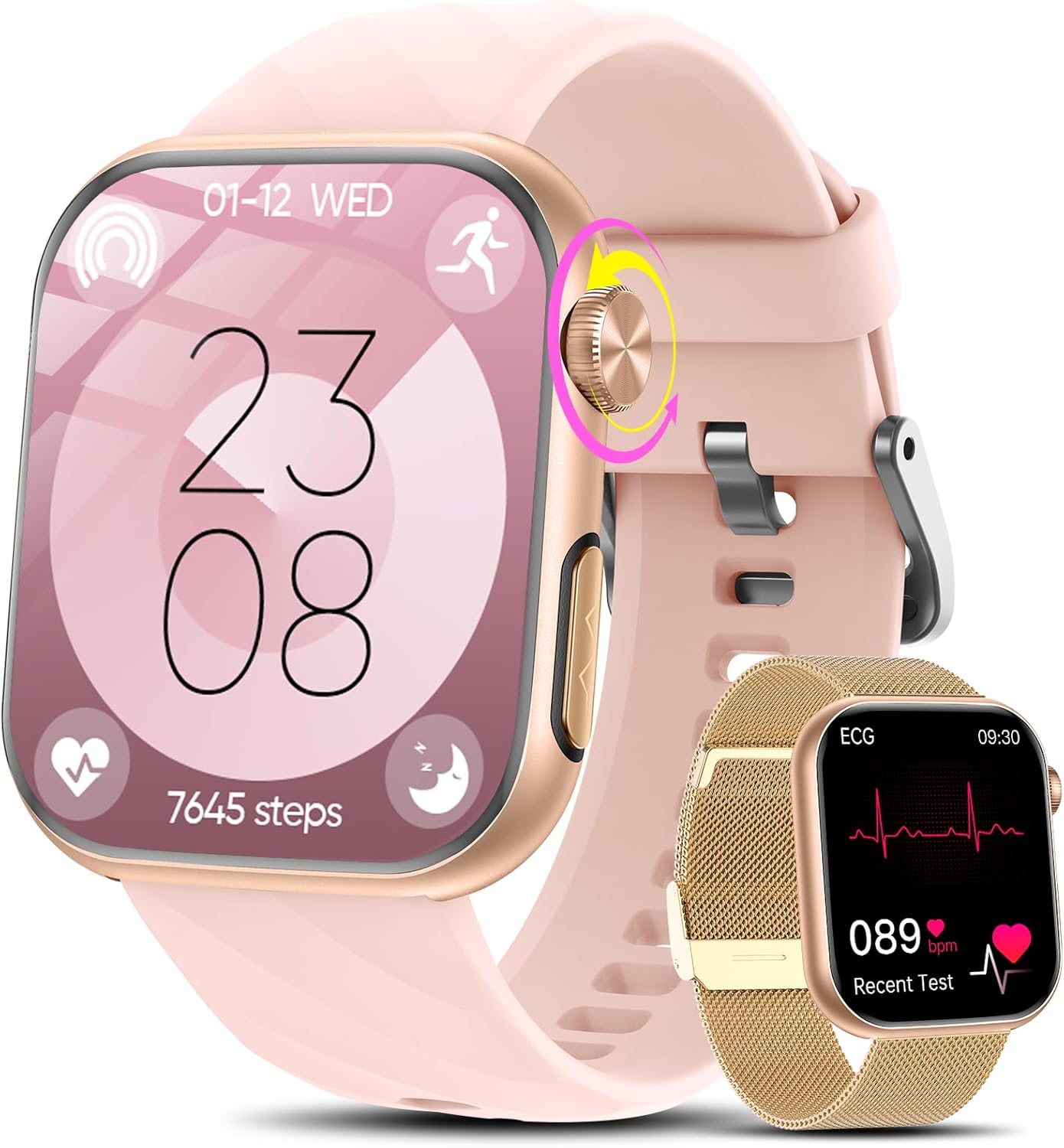
Marsyu Smartwatch for Women with ECG, HRV, Blood Pressure and Sleep Tracking, 1.97 Inch AMOLED, Bluetooth Calling
ASIN: B0H14L4ZCH
- ✓60-second ECG and HRV report through the companion app
- ✓Blood pressure, blood oxygen, temperature and stress readings
- ✓Bluetooth calling and an SOS button for an emergency contact
- ✓Two straps in the box and over 200 selectable faces
- Screen
- 1.97 in AMOLED, 390 × 450
- Battery
- 350 mAh lithium polymer
- Water resistance
- IP67, not for swimming
- Sports modes
- 50+
- App
- H-Band, Android and iOS
- Warranty
- 6 months
Open this product on Amazon
Amazon prices change all the time, so check the current one on the store page. To compare every Amazon store at once, use our browser extension.
Pros
- Metal case one owner rates alongside a first-generation Apple Watch
- ECG, blood pressure and body composition on a budget smartwatch
- Always-on display and a small torch built into the case
- Clear Bluetooth calls and an SOS call to an emergency contact
- About a week of use with every measurement switched on
Cons
- H-Band app with an unstable Bluetooth link
- Sleep tracking that one owner calls a lottery
- SOS and voice assistant buried several menus deep
- One smartwatch failed after two months with nobody to contact
- Six-month warranty, IP67 only, and 41 ratings so far
Smartwatch comparison by the specifications
The numbers behind the four smartwatches sit together here, and the trade-offs become visible in a single pass.
| Parameter | Redmi Watch 6 NFC | Smart Band 10 Pro | Amazfit Active 2 | Marsyu health watch |
|---|---|---|---|---|
| Screen | 2.07 in AMOLED | 1.74 in AMOLED | 1.75 in AMOLED | 1.97 in AMOLED |
| Resolution | 432 × 514 | — | 390 × 390 | 390 × 450 |
| Peak brightness | — | 1,500 nits | 2,000 nits | — |
| Battery | 550 mAh | 350 mAh | 260 mAh | 350 mAh |
| Stated runtime | Up to 24 days | Up to 21 days | Up to 10 days | — |
| Case | Aluminium, 9.9 mm | Aluminium, 9.7 mm | Steel with sapphire glass | — |
| Water resistance | 5 ATM, 50 m | 5 ATM, 50 m | 50 m | IP67 |
| Satellites | Dual-band, five systems | Five systems | Five systems | — |
| Contactless payment | Yes, NFC | — | — | — |
| Sports modes | 150+ | 150+ | 130+ | 50+ |
| Warranty | 2 years | 2 years | 12 months | 6 months |
| Rating | 4.2 (797) | 4.4 (12,508) | 4.2 (743) | 4.3 (41) |
Read the ratings of these smartwatches together with the number of people behind them. The Band 10 Pro carries more than twelve thousand opinions, which makes its 4.4 the most solid figure on the page. The two 4.2 scores rest on several hundred ratings each — enough to trust. The 4.3 of the Marsyu comes from 41 buyers, a first impression rather than a track record.
What buyers say about these smartwatches
Across the reviews of all four smartwatches one thing draws no complaints: the screens. Every AMOLED smartwatch here is called bright, readable outdoors and rich in faces. That was not true of these smartwatches two generations ago. Battery life is the second point of agreement, and the measured numbers sit close to the promised ones for the two Xiaomi models and a little below for the Amazfit.
The complaints about these smartwatches cluster in software and service. Apps hide useful functions in submenus, sleep tracking is the least reliable measurement on all four smartwatches, and automatic workout detection either fails to start or misreads what you are doing. Contactless payment works only if your bank sits on a short list. And two owners in this group had hardware fail inside two months — a set of speakers and a whole smartwatch — with support that ranged from slow to unreachable, so keep the invoice.
How to choose a smartwatch
- Wrist first, screen second. Weigh what you want to read against what you want to carry. A 2-inch smartwatch shows whole messages; a narrow band disappears under a sleeve and stays comfortable in bed. Neither choice is wrong, but people rarely change their mind twice.
- Read battery figures as a ceiling. Every quoted runtime assumes light use. A smartwatch with long battery life on the box turns into half that once the always-on display, continuous heart rate and daily satellite tracking are running. Owner reports are the better guide: weeks for the Xiaomi pair, about a week for the Amazfit.
- Check payment before you buy, not after. A smartwatch with NFC payment is useless if your bank is not supported in your country. The card lists are published, and the workaround through a virtual card account works but adds a step.
- Treat smartwatch health sensors by class. Heart rate, steps and blood oxygen are mature on any of these smartwatches. Blood pressure, ECG and body composition on budget smartwatches are indicative readings, and the makers say so themselves in the small print.
- Decide whether you need a smartwatch with GPS. Three of these four smartwatches record a run or a hike without the phone. If your route data matters, the fourth one is out before anything else is weighed.
- The app is half the product. You will open it every week and it decides whether your data is usable. Zepp is the most capable app here; H-Band is the weakest link of an otherwise decent smartwatch.
- Weigh the warranty. Cover across these smartwatches runs from six months to two years. With smaller brands that gap matters more than an extra sensor, because a smartwatch that dies in month three is the whole outlay lost.
Frequently asked questions
- How long do these smartwatches really last on a charge?
- Owners of the Redmi Watch 6 NFC report roughly 14 to 18 days with heart rate and sleep tracking running. Smart Band 10 Pro owners report 10 to 14 days. Amazfit Active 2 owners report 6 to 9 days. The figures on the box assume light use and no always-on display.
- Can I pay with a smartwatch at a shop terminal?
- Only the Redmi Watch 6 NFC in this group has the hardware for it. Whether it works depends on your bank and country: some buyers could not add a Visa or Mastercard at all, while one owner in Spain pays without trouble through a free Curve virtual card.
- Do these smartwatches work with an iPhone?
- All four list support for both Android and iOS. The companion app differs by maker: Mi Fitness for the two Xiaomi models, Zepp for the Amazfit and H-Band for the Marsyu.
- Is a fitness band enough instead of a full smartwatch?
- For steps, heart rate, sleep and notifications, yes — the Smart Band 10 Pro tracks the same things as the larger smartwatches here. You give up calls from the wrist, a big readable screen and contactless payment.
- Can a smartwatch measure blood pressure or take an ECG?
- The Marsyu offers both and produces a report in about a minute. The manufacturer states plainly that the values are for reference only and do not replace medical equipment, so treat them as a trend rather than a diagnosis.
- Do I need my phone with me for route tracking?
- No, for three of the four. The Redmi Watch 6 NFC, the Smart Band 10 Pro and the Amazfit Active 2 all carry their own satellite receivers and record a run or a hike on their own.
- Which of these smartwatches can I swim with?
- The Redmi Watch 6 NFC and the Smart Band 10 Pro are rated 5 ATM, and the Amazfit Active 2 is rated for 50 metres. The Marsyu is IP67, which covers splashes and rain but not swimming.
Verdict
Every model on the same criteria
Score against price
- Redmi Watch 6 NFC4.2 at about €107
- Smart Band 10 Pro4.4 at about €80
- Amazfit Active 24.3 at about €125
- Marsyu health watch3.6 at about €60
The overall score divided by the typical price, with the best in the group as the full bar. A rough guide, not a verdict — a cheap model that misses the feature you need is no bargain.
Read the bars as trade-offs, not as a ranking. Every smartwatch here wins one row and loses another: the largest screen comes with the bulkiest body, the lightest band gives up calls and characters, the best app sits on the smallest battery, and the deepest set of sensors runs on the weakest software with the shortest warranty. Three of the four rest on hundreds or thousands of ratings, and none of those averages falls below 4.2.
So choose a smartwatch by the way you will actually wear it. The mistake worth avoiding is buying a smartwatch for a feature you have not verified. Contactless payment, ECG readings and automatic workout detection all sound decisive in a listing, and all three disappoint the buyers who counted on them without checking. Pick a smartwatch for the screen you will read every day and the battery you will forget about, and treat the rest as a bonus you confirm before the return window closes.