How loud should a portable Bluetooth speaker be? Four sizes from 8 W to 160 W
Portable Bluetooth speakers under €300
Music sounds fine on a phone until you take it outdoors. Open air swallows the volume, a breeze takes the top end, and the first conversation two metres away wins. That is the whole reason a portable Bluetooth speaker exists: real drivers, its own battery, and a shell that survives rain.
The trouble is how much ground those three words cover. One speaker here weighs three kilograms, puts out 70 watts of continuous power and ships with a radio microphone for karaoke. The next fits in a palm, draws 8 watts and is built for the edge of a bath. Both speakers sit in the same Amazon category, under nearly the same words, and both listings sound equally sure of themselves. Portable speakers now span that whole distance.
So the useful question is not which of these portable speakers is best. It is which size fits the place you will play it. This comparison takes four speakers — 8 W, 80 W, 120 W peak and 160 W — and works out what each speaker really does, from the specifications on the listings and from what owners wrote over the past year. They are ordinary shelf models rather than premium audio: in most stores each one stays under $290, and the group sits near $180.
Models in this comparison
Typical price across these models: about €205. Rough figures from store prices converted at fixed rates: what you pay also depends on the store and the region you order from. With our browser extension you can compare every Amazon store at once, right on the product page.
W-KING D10: the loud Bluetooth speaker with a microphone
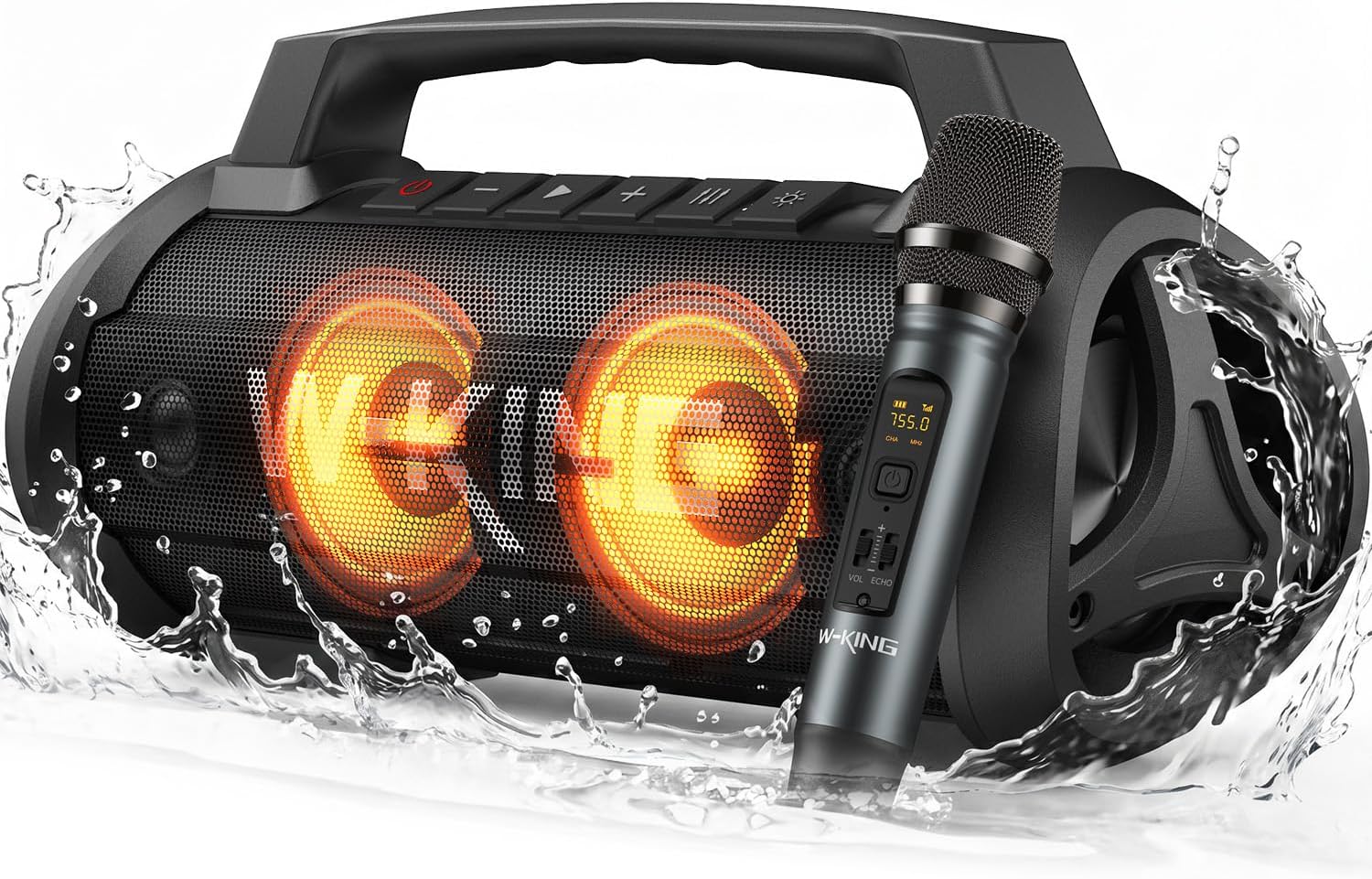
W-KING Portable Bluetooth Speaker with Wireless Microphone, 120W Peak 70W RMS Waterproof Outdoor Bluetooth Speakers, 110dB Loud Bass Up, 42H/BT5.4/DSP/RGB, Stereo Pairing for Camping/Beach Essentials
ASIN: B0CKMD8V34
- ✓Rechargeable radio microphone in the box, with reverb and its own volume and echo dials
- ✓Four drivers — two subwoofers and two tweeters — rated 70 W RMS and 120 W peak
- ✓One button switches in a bass boost; two units pair wirelessly for stereo
- ✓IPX6 shell, 42 hours of quiet playback and a USB port that charges a phone
- ✓Lies flat or stands on its side, where it tilts 30 degrees and spreads the sound wider
- Output power
- 70 W RMS, 120 W peak
- Maximum level
- 110 dB
- Frequency response
- from 45 Hz
- Battery
- 7,650 mAh, 42 h, 7.5 h to charge
- Size and weight
- 36.9 × 19.1 × 15.3 cm, 3 kg
- Connections
- Bluetooth 5.4, AUX, TF card, 6.35 mm mic
The D10 is a party speaker first and a music system second. Inside sit four drivers: two subwoofers of 3.67 inches and two tweeters of 2.08 inches, rated together at 70 W RMS and 120 W peak. Response starts at 45 Hz, the signal-to-noise figure is quoted at 90 dB, and the top level is 110 dB. A single button on the panel adds a bass boost, and two of these speakers link up for stereo across a garden.
The microphone is what sets this speaker apart from the rest of the group. A rechargeable UHF handheld comes in the box with built-in reverb and separate volume and echo dials, so karaoke needs nothing else on the table. There is a 6.35 mm socket for a wired mic as well, and the listing is unusually honest about its limit: dynamic microphones only, because the jack supplies no phantom power for a condenser.
Everything else is outdoor kit. The ABS body of the speaker is rated IPX6, so rain and splashes are fine. A 7,650 mAh cell is quoted at 42 hours at minimum volume and takes 7.5 hours to fill. A USB port sends power back out to a phone, AUX and a TF card slot play music with no phone in the picture, and Bluetooth 5.4 covers the wireless side at up to ten metres. Seven-colour lighting on the speaker pulses with the beat.
This is a loud Bluetooth speaker for parties, bought by whoever runs the music and now and then has to talk over it — a coach, a market trader, a family that takes birthdays seriously. Skip this speaker if you want something to carry all day: three kilograms and a 37 cm body are luggage rather than pocket kit.
Praise lands on the microphone first, which is rare among portable speakers at this money. A buyer in the United Kingdom already owned the W-KING speaker without a mic and says the handheld is crisp and clear enough to address customers in a shop. An owner in Canada calls the mic adjustable and easy to live with, and points out that a second, wired mic can go in beside it. In Spain and Italy the notes match: powerful sound, a mic that carries outdoors, and build quality better than the badge suggested.
The complaints split into three. Two owners in the United States found the battery well short of the headline number — good sound, they say, but nowhere near the runtime on the box. One of those two had a worse time still: the speaker stopped charging and turning on before six months were up, and never played loudly even while it worked. The Spanish review adds a physical gripe that matches the shape of the thing — the speaker is heavy, and its base wobbles unless the surface under it is properly flat. Heavy speakers with a small footprint often behave that way.
Pros
- Radio microphone included, with reverb and its own controls
- Loud and clean enough for a full garden or a small hall
- Second socket for a wired dynamic mic
- Charges a phone from its own battery
- Owners rate the build above the price they paid
Cons
- Real battery life falls short of the quoted 42 hours
- One owner had the unit fail dead inside six months
- Three kilograms, and the base is unsteady on uneven ground
- No condenser microphones — the jack has no phantom power
- Only 261 ratings so far, so the record is still thin
Musibaby M1: the 80 W speaker with the best battery life
The M1 is the strongest all-rounder of the four speakers on paper. Its 80 W come from dual woofers and dual tweeters, with an 8.9 cm bass driver, inside a metal case rather than plastic. The battery is the headline: 12,000 mAh for a quoted 24 hours, plus a USB output for a phone. Bluetooth 5.3 reaches about 30 metres, and USB sticks, TF cards and AUX all play. Two of these speakers pair for 160 W of stereo. The M1 is 36.5 cm wide with a handle and an adjustable strap, and it is IPX6 rather than fully sealed — the listing tells you plainly not to submerge it and to dry the port before charging.
Owners are the warmest in this comparison, and this speaker holds the highest rating here on the largest number of votes. One describes carrying it everywhere, pairing it to a projector for film nights and dropping it from a height on party evenings without cracking the case. Another confirms the sound holds up at high volume in an open room. The two criticisms are small and honest: the speaker is heavy enough to notice, and on the dark finish the buttons on top are hard to find in dim light. Nobody counts it among the truly travel-sized speakers.
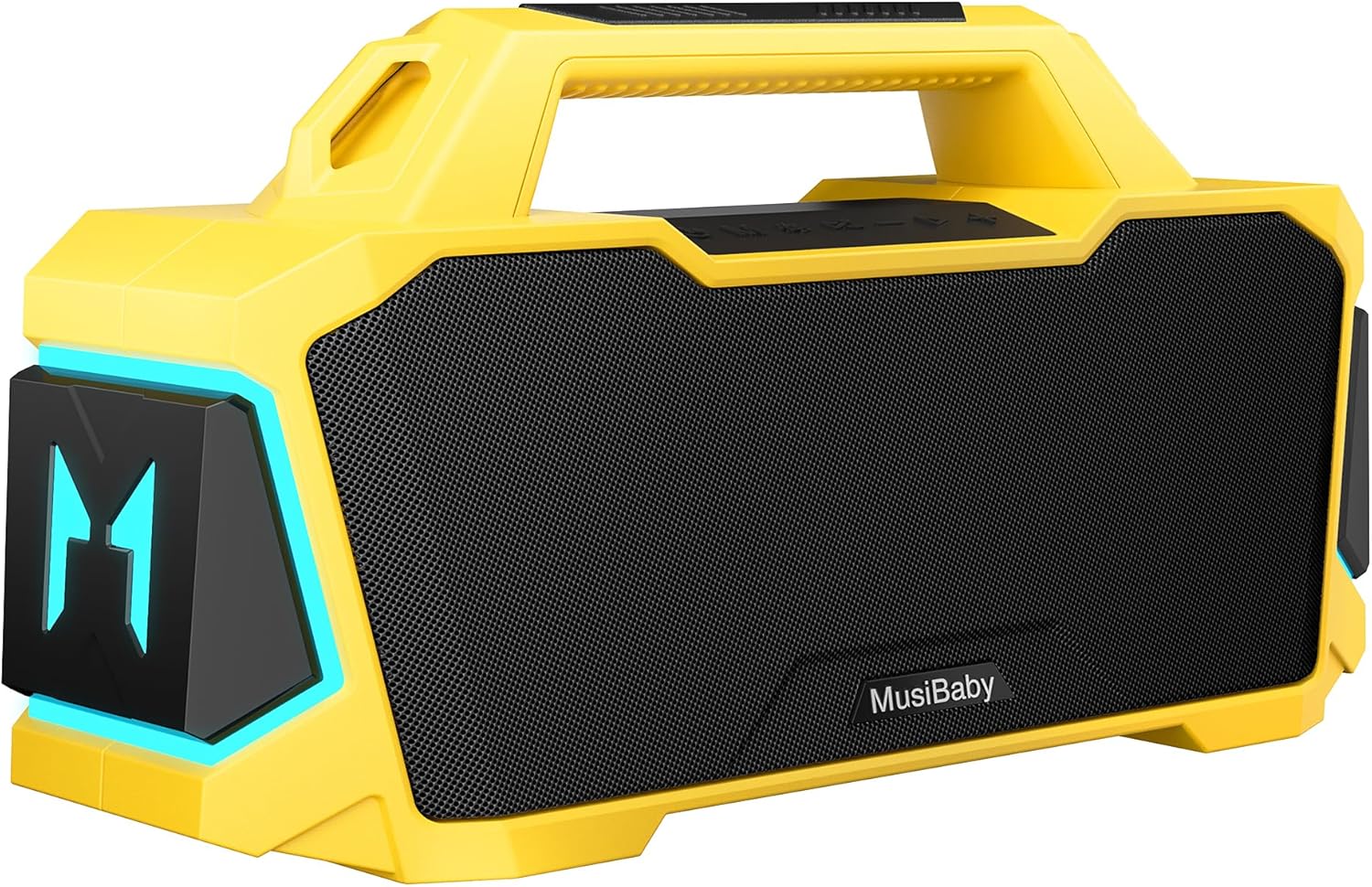
Musibaby 80W Portable Bluetooth Speaker, Loud Bass, IPX6 Waterproof, Yellow
ASIN: B0FJ6GHB65
- ✓12,000 mAh battery quoted at 24 hours, with a USB output for a phone
- ✓Metal case with a carry handle and an adjustable shoulder strap
- ✓Dual woofers and dual tweeters; two units pair for 160 W of stereo
- ✓Plays from USB sticks and TF cards as well as Bluetooth 5.3
- ✓Bright yellow finish that is easy to spot on a campsite
- Output power
- 80 W
- Battery
- 12,000 mAh, 24 h
- Water resistance
- IPX6
- Bluetooth range
- 30.5 m
- Size
- 36.5 × 18.2 × 13.5 cm
- Warranty
- 12 months
RWN 160 W: the waterproof Bluetooth speaker for outdoors
It is the only one of these four speakers rated IP67, which means dust-tight and safe under water for a while, not merely splash-proof. The power comes from two 3.5-inch 60 W woofers and two 20 W tweeters with a DSP crossover, and two sound modes route the work differently: an outdoor setting that pushes the tweeters and vocals forward, and a bass setting for the low end. A 30 W charger fills it fast, the quoted runtime is 24 hours, and a USB output turns it into a power bank. Six light shows run off the beat, and a strap and handle come with the speaker. Bluetooth 5.3 reaches roughly 30 metres.
Owners like the sound and are sceptical about the number on the box. Several describe clarity that survives high volume, instant pairing with no dropouts, and a shape somewhere between modern and vintage boombox. One long review works out that 160 W has to be a peak figure and estimates 30 to 50 watts of real continuous output for battery speakers this size — which, as that owner notes, is still plenty outdoors. Two others found the bass thinner than 160 watts implies. A fourth had a speaker that would not charge a phone and got a replacement quickly. Weight is the recurring practical note: fine to carry to a garden, bulky on a hike.
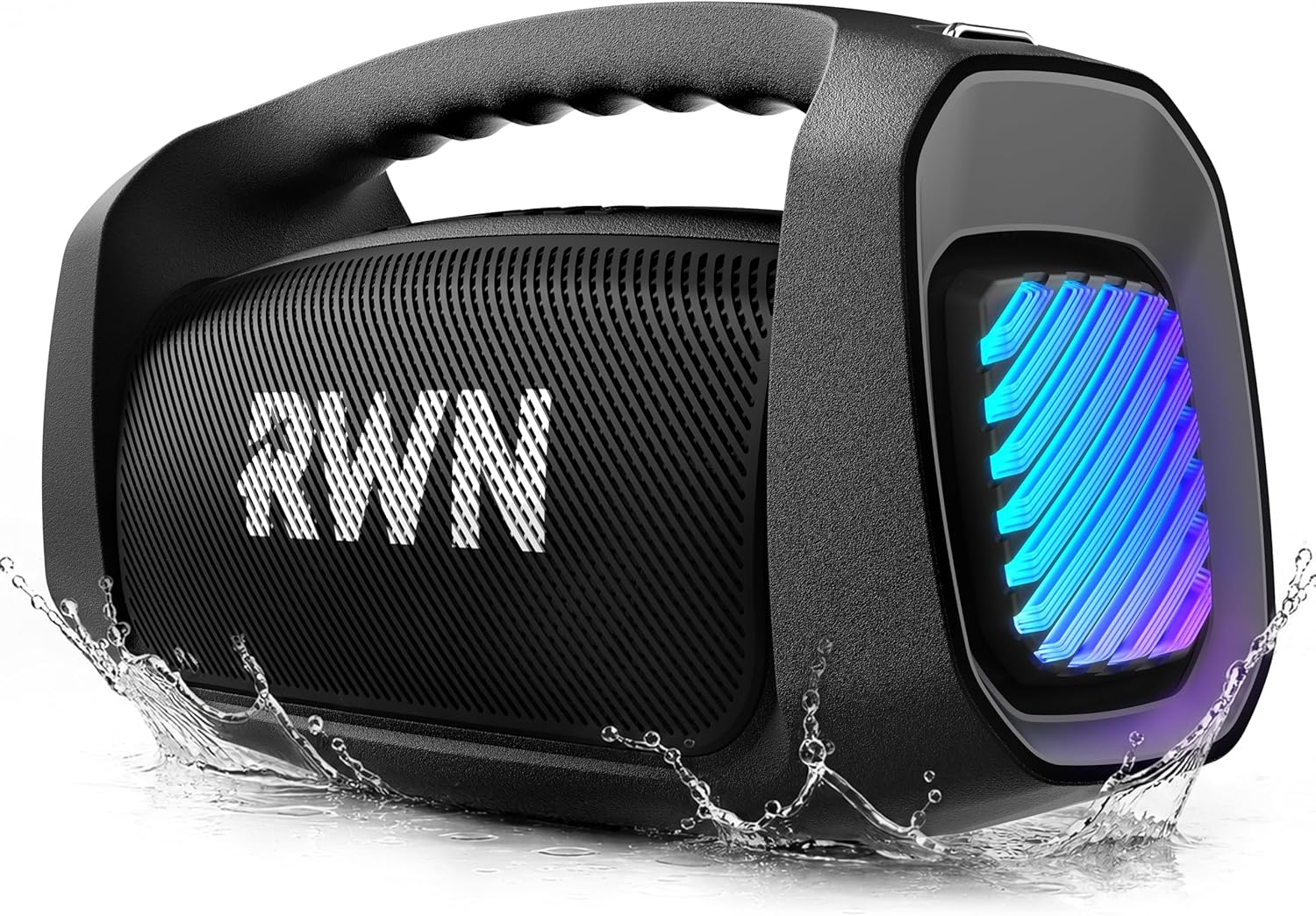
RWN Outdoor Bluetooth Speaker: 160W Loud Sound, IP67 Waterproof with 24H Playtime, Fast Charge, Bass, TWS, Portable Wireless Speakers with Light Show for House, Party, Projector, Beach (Black)
ASIN: B0G6Z8K1CD
- ✓IP67 rating — dust-tight and safe in water, not just against splashes
- ✓Two 60 W woofers and two 20 W tweeters with a DSP crossover
- ✓Outdoor and bass modes that use different drivers instead of one EQ curve
- ✓30 W fast charging and a USB output that recharges a phone
- ✓Six light shows, plus a shoulder strap and a handle in the box
- Output power
- 160 W
- Water resistance
- IP67
- Battery
- 24 h, 30 W fast charge
- Bluetooth range
- 30 m
- Size
- 39.6 × 22.9 × 12.4 cm
- Warranty
- 1 year
Gladorn M18-P: the small shower speaker
At 8 watts and 9 cm on a side, this speaker belongs to a different job entirely. It is a bathroom and kitchen speaker: 1,800 mAh for a quoted 20 hours, IPX6 against splashes from any direction, nine lighting modes, Bluetooth 5.3 reaching about 50 metres, and pairing with a second unit for stereo. An 18-month warranty is the longest of these four speakers.
The reviews are the most useful part of this listing, and also the least dependable — none is marked as a verified purchase, so read them as impressions rather than proof. Owners agree the speaker punches above its size: clear enough for podcasts, loud enough to beat a running tap in a kitchen, days of use between charges. They also agree on the limits. One measures the honest trade-off — keep the lights on and 20 hours becomes about 12. Another finds the lows weak and the highs a little tinny, and says the speaker sounds best lying on its side in a corner where the walls help. The sharpest warning is about the water rating: the USB-C port has no cover, and the manual says to keep water away from it, which is an odd instruction on a shower speaker.
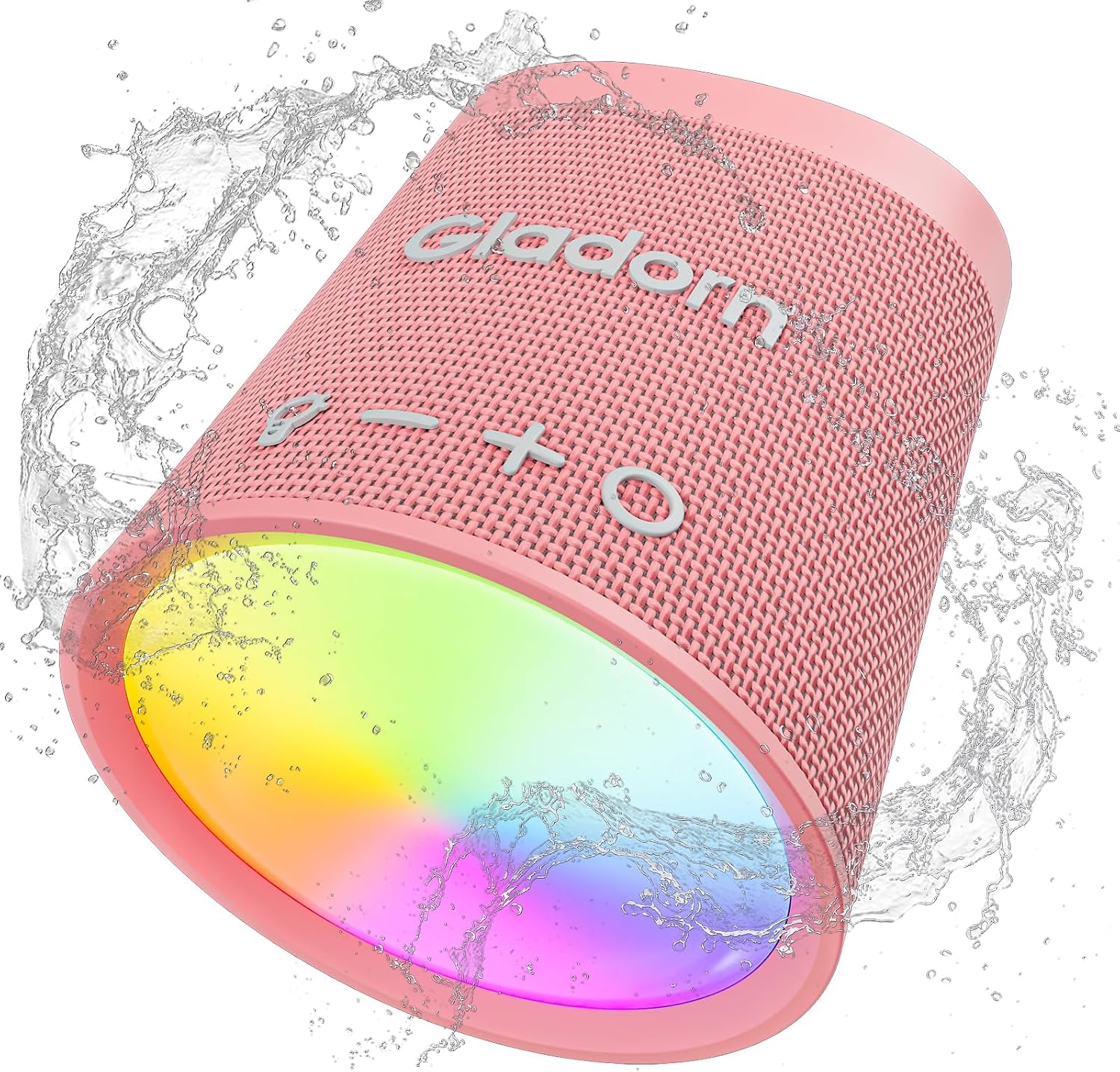
Bluetooth Speaker Wireless, Bluetooth 5.3 Shower Speaker with 9 RGB Lights & 20H Playtime, IPX6 Waterproof Speaker with TWS Pairing, Portable Speaker for Home, Beach, Travel & Birthday Gifts
ASIN: B0GST3LRMC
- ✓Fits in one hand — 9 cm on a side and light enough to hang anywhere
- ✓1,800 mAh battery quoted at 20 hours of playback
- ✓IPX6 against splashes from any direction, for bathroom and kitchen use
- ✓Nine lighting modes that follow the music
- ✓Pairs with a second unit for stereo; 18-month warranty
- Output power
- 8 W
- Battery
- 1,800 mAh, 20 h
- Water resistance
- IPX6
- Bluetooth range
- 50 m
- Size
- 9.1 × 9.1 × 9.6 cm
- Warranty
- 18 months
Open this product on Amazon
Amazon prices change all the time, so check the current one on the store page. To compare every Amazon store at once, use our browser extension.
Portable Bluetooth speaker comparison by the numbers
Every value below comes from the four Amazon listings, so the gaps between these speakers are the manufacturers' own claims. Where a row is blank, the listing simply does not publish that figure.
| Parameter | W-KING D10 | Musibaby M1 | RWN 160 W | Gladorn M18-P |
|---|---|---|---|---|
| Output power | 70 W RMS, 120 W peak | 80 W | 160 W | 8 W |
| Drivers | 2 woofers + 2 tweeters | 2 woofers + 2 tweeters | 2 × 60 W woofers + 2 × 20 W tweeters | — |
| Water resistance | IPX6 | IPX6 | IP67 | IPX6 |
| Battery | 7,650 mAh | 12,000 mAh | — | 1,800 mAh |
| Quoted playtime | 42 h at low volume | 24 h | 24 h | 20 h |
| Charge time | 7.5 h | — | 30 W fast charge | — |
| Microphone in the box | Yes, wireless UHF | No | No | No |
| Charges your phone | Yes | Yes | Yes | No |
| Bluetooth | 5.4, 10 m | 5.3, 30.5 m | 5.3, 30 m | 5.3, 50 m |
| USB and card playback | TF card, AUX | USB, TF card, AUX | USB, AUX | — |
| Stereo pairing | Yes, 240 W peak | Yes, 160 W | Yes | Yes |
| Weight | 3 kg | — | — | — |
| Warranty | 12 months | 12 months | 1 year | 18 months |
| Customer rating | 4.4 (261) | 4.6 (594) | 4.4 (97) | 4.6 (52) |
Read the last row together with the count in brackets, because those are not equal evidence. The Musibaby is the only speaker here whose score rests on several hundred votes; the other three sit between 52 and 261, which is a promising start rather than a settled reputation. On the 8 W speaker, none of the reviews is even a verified purchase. Ratings on portable speakers firm up slowly, and three of these four are not there yet.
What the watt number on a speaker actually tells you
Almost nothing, on its own. Portable speakers run on batteries, and a battery sets a hard ceiling on continuous output that no marketing figure can lift. The owner of the 160 W speaker here did the arithmetic in public and landed on 30 to 50 watts of sustained power — and still called it loud enough for a garden. Meanwhile the D10 quotes 70 W RMS, a smaller number measured a stricter way, and its owners describe it filling open ground.
Three figures tell you more about these speakers. The first is the driver layout: two woofers and two tweeters, with sizes given, means bass and treble are handled separately, which is why every one of these speakers except the 8 W unit keeps voices clear as the volume climbs. The second is battery capacity in mAh, the honest measure of Bluetooth speaker battery life: 12,000 mAh will outlast 1,800 mAh, while quoted hours are always measured at a volume nobody uses. The third is the water rating, where the letters matter: IPX6 survives splashes and rain, IP67 survives being dropped in the pool. Those three rows separate these speakers far better than the wattage does.
The last of those is where listings get slippery. One of these speakers is sold for the shower with an uncovered charging port and a manual that says to keep water away from it. If you plan to take a wireless speaker anywhere genuinely wet, look for IP67 and check whether the port has a flap. Speakers that die of a wet socket are no bargain at any size.
How to choose a portable Bluetooth speaker
Start from the room, not the specification sheet. These four speakers cover four different distances, and picking the wrong one is a matter of scale rather than quality.
- Decide where the speaker will spend most of its life. A bathroom, a kitchen counter or a desk needs 8 to 20 watts and nothing more; a garden, a beach or a building site needs at least 70. A palm-sized speaker in a garden sounds thin, and a three-kilogram speaker in a bathroom is comic.
- Weigh it before you love it. Two owners of these speakers praise the sound and mention the weight in the same sentence. Three kilograms is easy to carry from a car to a table, and tiring on a hiking trail.
- Check whether you need a microphone at all. Only one of these speakers includes one, and that is the reason to buy it. If nobody in your house sings or makes speeches, the money buys more battery and better waterproofing instead.
- Halve the quoted playtime in your head. Every hour figure in the table is measured at low volume with the lights off. Owners of two of these speakers report exactly that gap, and one review puts the light show alone at eight hours of lost runtime.
- Match the water rating to the risk. Rain and splashes are IPX6 territory. A pool, a boat deck or a shower shelf is IP67 territory, and one of these four speakers qualifies.
- Look for a USB output if you camp. In an outdoor Bluetooth speaker for camping this matters more on a two-day trip than any sound mode does, and three of these four can top up a phone from their own battery.
Buyers of portable speakers get caught out in three predictable ways. They buy on the watt figure, which measures a burst rather than an evening. They believe the battery hours, then find those were measured with the volume near zero. And they buy a party speaker for a room where they mostly listen to podcasts, then leave it in a cupboard.
Frequently asked questions
- How many watts do I need for a garden party?
- Roughly 70 watts of continuous output or more is enough for open ground, and every model here except the 8 W unit clears that bar on paper. Treat peak figures such as 120 W or 160 W as bursts, not as the level the unit holds all evening.
- Is IPX6 enough for the shower or the pool?
- IPX6 covers splashes and rain from any direction, which suits a bathroom shelf or a rainy campsite. It does not cover immersion. For a pool or a boat deck, look for IP67, which one of these four models carries.
- Will these models really run for the hours on the box?
- No. The quoted 42, 24 and 20 hours are all measured at low volume with lighting off. Owners here report shorter runtimes at real listening levels, and one review measures the light show alone at about eight hours of the total.
- Can I use one for karaoke?
- One of the four ships with a rechargeable radio microphone that has reverb and its own volume and echo controls, and it also takes a wired dynamic mic. The other three list no microphone input at all.
- Can two of them play together as a stereo pair?
- Yes, all four support pairing with a second identical unit. The W-KING quotes 240 W peak for a pair and the Musibaby 160 W. It is the cheapest way to widen the sound rather than buying one bigger box.
- Do any of them charge a phone?
- Three do. The W-KING, the Musibaby and the RWN all have a USB output that draws on the internal battery, which is useful on a camping trip. The palm-sized model does not.
- Which one is best for film nights outdoors?
- The larger three all accept an AUX cable, and one owner streams to a projector over Bluetooth without trouble. Pick on water rating and battery, since a garden screening runs for hours after dark.
Verdict
Every model on the same criteria
Score against price
- W-KING D104.0 at about €126
- Musibaby M14.4 at about €205
- RWN 160 W4.1 at about €284
The overall score divided by the typical price, with the best in the group as the full bar. A rough guide, not a verdict — a cheap model that misses the feature you need is no bargain.
Read the bars as four different jobs rather than as a league table. Nothing here wins across the board: the speaker with the microphone has the weakest battery of the group, the one that survives a pool is the heaviest to carry, and the only speaker you can slip into a bag plays at a volume the other three would drown. The three larger models sit close on sound, and their owner ratings rest on very different numbers of votes — several hundred for one of them, under a hundred for another.
So the specification sheet decides less than the room does. Name the place the speaker will live, then the volume that place needs, then the water risk it faces. Answer those three and this portable Bluetooth speaker comparison narrows to one model long before the price of any store comes into it.