Robot vacuum and mop: why the dock matters more than pascals
Robot vacuums under €650
A robot vacuum used to be a toy that pushed crumbs around the kitchen. A robot vacuum and mop of 2026 cleans the floor and then cleans itself: the dock empties the bin, rinses the mop pads in hot water and dries them so they do not start to smell. That changes what you are buying. You are not buying a small robot on wheels any more, you are buying a station that stands in the hallway and takes the floor off your list for weeks at a time.
The catch is that four robots on the same shelf can look identical and behave nothing alike. One robot lifts the mop before it reaches a carpet, another drags a wet pad straight across it. One reads the room with a camera and slows down when the cat walks past, another only knows where the walls are. The suction figure printed on the box — 19,000 Pa, 30,000 Pa — tells you far less about the finished floor than the brush, the mop and the navigation do.
This robot vacuum comparison takes four of them from that shelf: the MOVA P50 Pro Ultra, the simpler P50 Ultra of the same family, the newer and stronger E50 Pro Ultra, and the compact Lefant M210 PRO Omni, which mops in a completely different way. All four sit in the same class — in most stores each one stays under $710, and the group sits near $520 — so the question is not which is dearest but which one matches your floors. The specifications of all four robots and the per-store Amazon prices sit together in the cards.
Models in this comparison
Typical price across these models: about €492. Rough figures from store prices converted at fixed rates: what you pay also depends on the store and the region you order from. With our browser extension you can compare every Amazon store at once, right on the product page.
MOVA P50 Pro Ultra — the robot vacuum with a camera
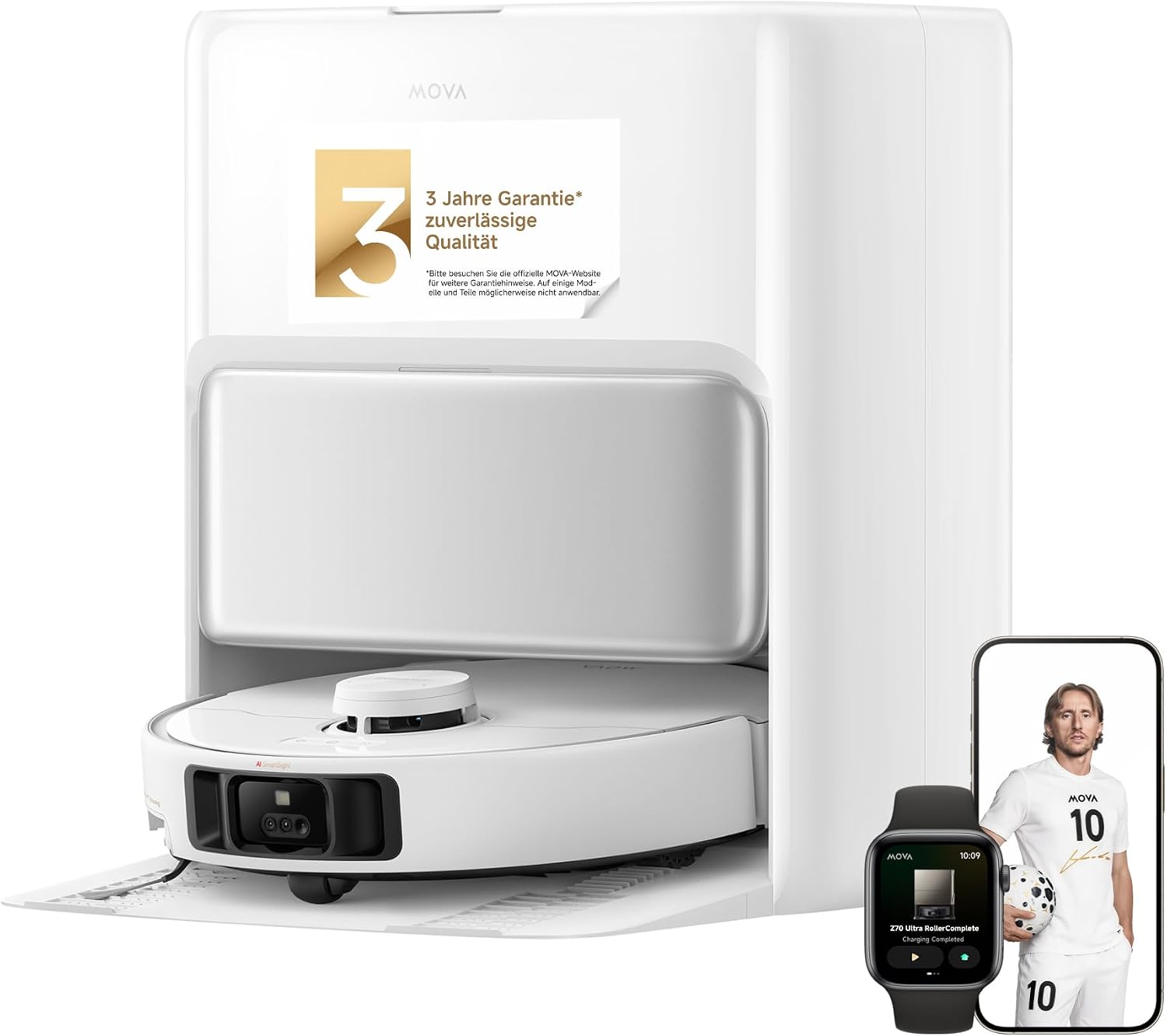
MOVA P50 Pro Ultra Robot Vacuum Cleaner Flex Mop 75°C Dock Self Cleaning White
ASIN: B0DPZTS99T
- ✓Station collects dust for up to 75 days, washes the mops at 75 °C and dries them
- ✓CleanChop brush stops hair winding itself around the roller
- ✓Extendable side brush and mop reach into corners and along skirting boards
- ✓RGB camera and dirt detection raise the suction where the floor needs it
- Suction power
- 19,000 Pa
- Mop washing
- 75 °C hot water
- Battery life
- 300 minutes
- Cleaning path width
- 24 cm
- Noise level
- 74 dB
- Height
- 10.4 cm
The P50 Pro Ultra is the one robot here with an eye on the floor. It pulls dust, crumbs and hair off hard floors and carpets at 19,000 Pa, and the CleanChop brush is shaped so long hair is cut and drawn in instead of winding around the roller. The side brush and one mop pad swing out beyond the body, which is how this robot gets into right-angle corners and under low furniture. Its dock does the rest: it sucks the bin empty into a bag that lasts up to 75 days, washes the pads in 75 °C water, refills the tank and dries everything afterwards. An RGB camera with dirt detection watches the floor and turns the power up over a patch of spilled coffee or a scatter of crumbs.
Among these robots it suits a busy household with pets and a mix of hard floor and rugs, where the floor needs attention every single day. Skip this robot if your home is mostly carpet, because that is where it is least sure of itself, and skip it if you want something you can service yourself.
Owners keep returning to the same two strengths. The first is navigation: the robot works through the rooms in an order that makes sense, does not bounce off the furniture and, in several households with cats and a dog, visibly slows down and steers around the animal instead of chasing it. The second is the station. People describe going a whole season without touching the dust bag, and the hot-water wash means the pads never develop the damp smell that ruins a cheap mopping robot.
The complaints are just as consistent, and they matter. Carpet recognition is the weak spot: small rugs are sometimes not seen at all, and one owner found the robot refusing to enter a room because a rug lay in the doorway. Obstacle detection works most of the time rather than always. Away from the dock the battery drains faster than expected while the robot stands idle. The most serious report is mechanical — several owners in different countries describe the small front caster wheel cracking after a few months of ordinary use, with repair possible only through an authorised service centre abroad.
Pros
- Systematic, calm navigation that avoids furniture and pets
- Reliable on hair and pet hair, including corners and edges
- Station empties, washes and dries with almost no attention from you
- Clear app, quick setup, several robots managed from one account
- Quiet enough in the standard mode to run while you are at home
Cons
- Carpet detection misses small rugs and can block off a room
- Front caster wheel has broken for several owners after a few months
- Spare parts and repair go through a service centre in another country
- Noticeable battery drain when the robot stands away from the dock
- Obstacle detection is good but not dependable every time
What a self-cleaning dock adds to a robot vacuum
The dock is the reason robots of this class cost what they do, so it is worth knowing what the money buys. Three jobs used to fall to you after every run of older robots: emptying the bin, rinsing the mop and refilling the water. A full station does all three. The dust goes into a sealed bag you change every few weeks or months, while cheaper robots leave you a small box to empty daily. Hot water mop washing followed by drying is the part that keeps the robot from smelling. The tank is topped up on its own, so the robot can leave the dock, run out of water, come back, refill and carry on from the spot where it stopped.
Temperature is the detail that separates these docks. Warm water loosens grease; 75 °C is enough for everyday floors, while 100 °C, which the newest robot in this group uses, deals better with a kitchen floor that sees cooking oil. Tank size matters just as much, and these four robots differ widely on it: a small fresh-water tank means more trips back to the dock and a longer cleaning run. None of this makes the mopping equal to a bucket and a brush, and owners say so plainly — these robots keep the floor at a good level between the deep cleans you still do yourself.
MOVA P50 Ultra — the simpler robot of the same family
The P50 Ultra is the robot the Pro is based on, and the gap between them is narrower than the names suggest. Suction stays at 19,000 Pa, the dock still washes the pads at 75 °C and still empties the bin into a bag, and the side brush and mop still extend for edges. What you lose is the camera and the dirt detection, half the battery life, and the CleanChop brush, which here is an accessory sold separately. Its CleanLift system raises the mop before the robot reaches a rug, and it builds maps for a house with more than one floor.
Owners are unusually positive about the noise, which is rare for robots with a self-emptying dock: in quiet and standard modes several of them run this robot at night without waking up. Setup took about twelve minutes for one buyer, and the mapping went through on the first attempt. The criticism is honest too. Cleaning is good rather than best in class, the fresh-water tank could be larger, the detergent container is not in the box, and the same front wheel failure appears in these reviews as well. It is the right choice for a flat of moderate size where you would rather have the station than the camera.
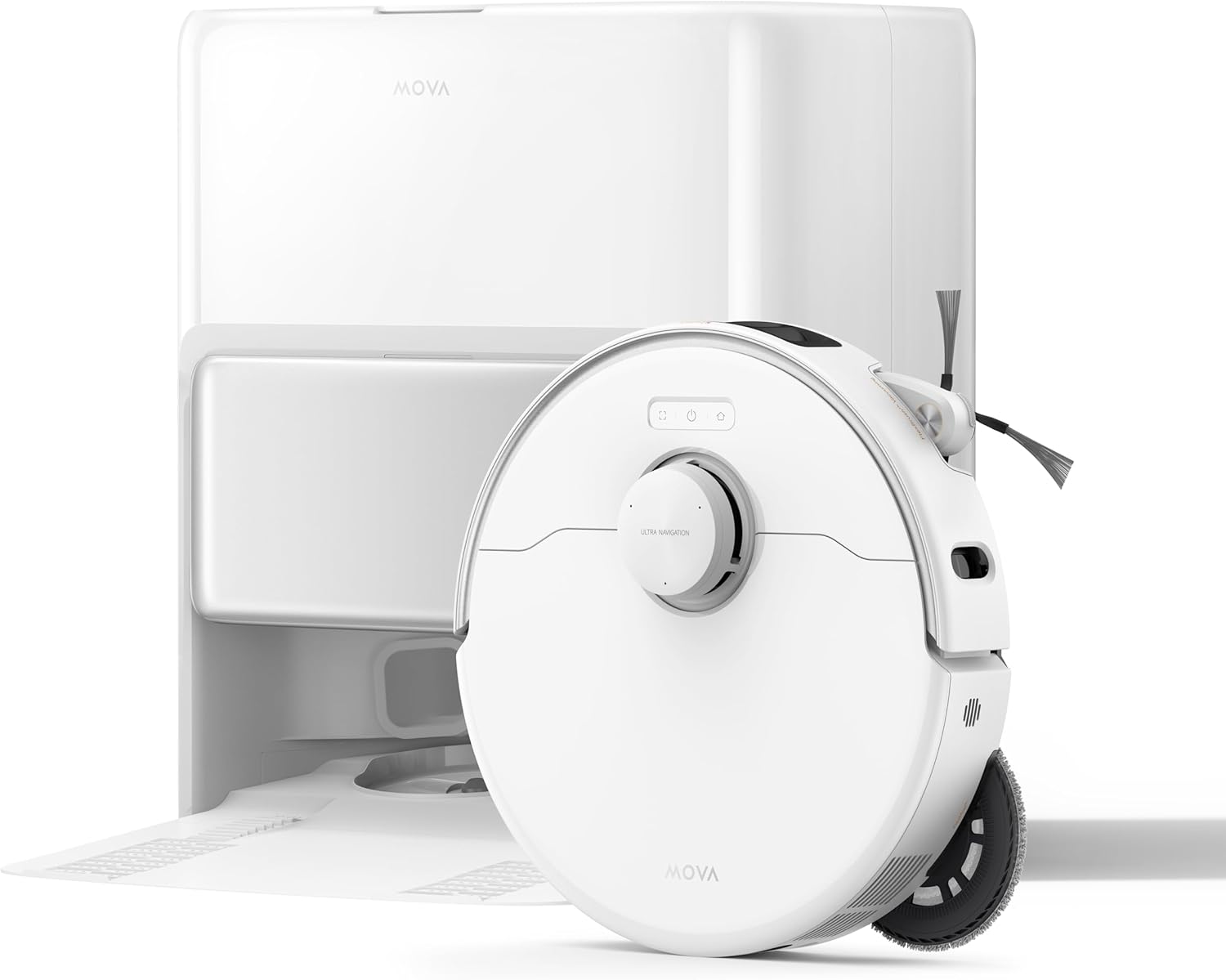
Mova P50 Ultra Robot Vacuum Cleaner with Flexible Mop, 19,000 Pa Suction Power, Corner and Edge Cleaning, Automatic Cleaning of Mop and Washboard at 75°C, Automatic Emptying & Refill
ASIN: B0DTJSFC1Z
- ✓Same 19,000 Pa suction and 75 °C mop washing as the Pro version
- ✓CleanLift raises the mop before the robot drives onto a carpet
- ✓Extendable side brush and mop for edges, corners and skirting boards
- ✓Multi-level maps for a home with more than one floor
- Suction power
- 19,000 Pa
- Mop washing
- 75 °C hot water
- Battery life
- 150 minutes
- Water levels
- 32
- Filter
- HEPA
- Control
- App, Amazon Echo, Google Home
Pros
- Quiet in silent and standard modes, quiet enough for a night run
- Setup and the first map took about twelve minutes for one owner
- Picks up dust, crumbs and pet hair reliably at 19,000 Pa
- Climbs door thresholds of around 22 mm without help
- One owner got three to four months out of the first dust bag
Cons
- Cleaning is good rather than best in class, owners say plainly
- Fresh-water tank could be larger, and damp patches are left behind
- Detergent container and the CleanChop brush are sold separately
- The same front caster wheel failure appears here after eight months
- Spare parts and repairs run through a service centre abroad
MOVA E50 Pro Ultra — the newest robot vacuum, and the strongest
The E50 Pro Ultra is the most recent robot in this group, and on paper it beats the P50 Pro Ultra on nearly every line that matters. Suction climbs to 30,000 Pa. The pads are washed at 100 °C rather than 75. TurboScrub presses the mop into the floor with 12 N of force and spins it at up to 260 rpm, adjusting as the robot moves between zones. The MaxiReach mop slides outwards along walls, the fresh-water tank grows to five litres for roughly 700 square feet in one pass, and three separate measures — side brush, V-shaped rubber brush and the wheel design — work against tangled hair. At 9.7 cm this is also the flattest of the four robots.
Early owners confirm the suction on carpets and pet hair, praise the streak-free mopping over spills, and say it runs quieter than the robots they replaced. Two cautions apply. It has very few ratings so far, so its 4.5 average rests on a handful of opinions rather than a crowd. And its own owners add that no robot replaces a proper manual clean, and that cables and very narrow gaps still need clearing first. If you want the newer generation rather than the safer one, this is the robot to look at, and the cards show what each store asks for it.
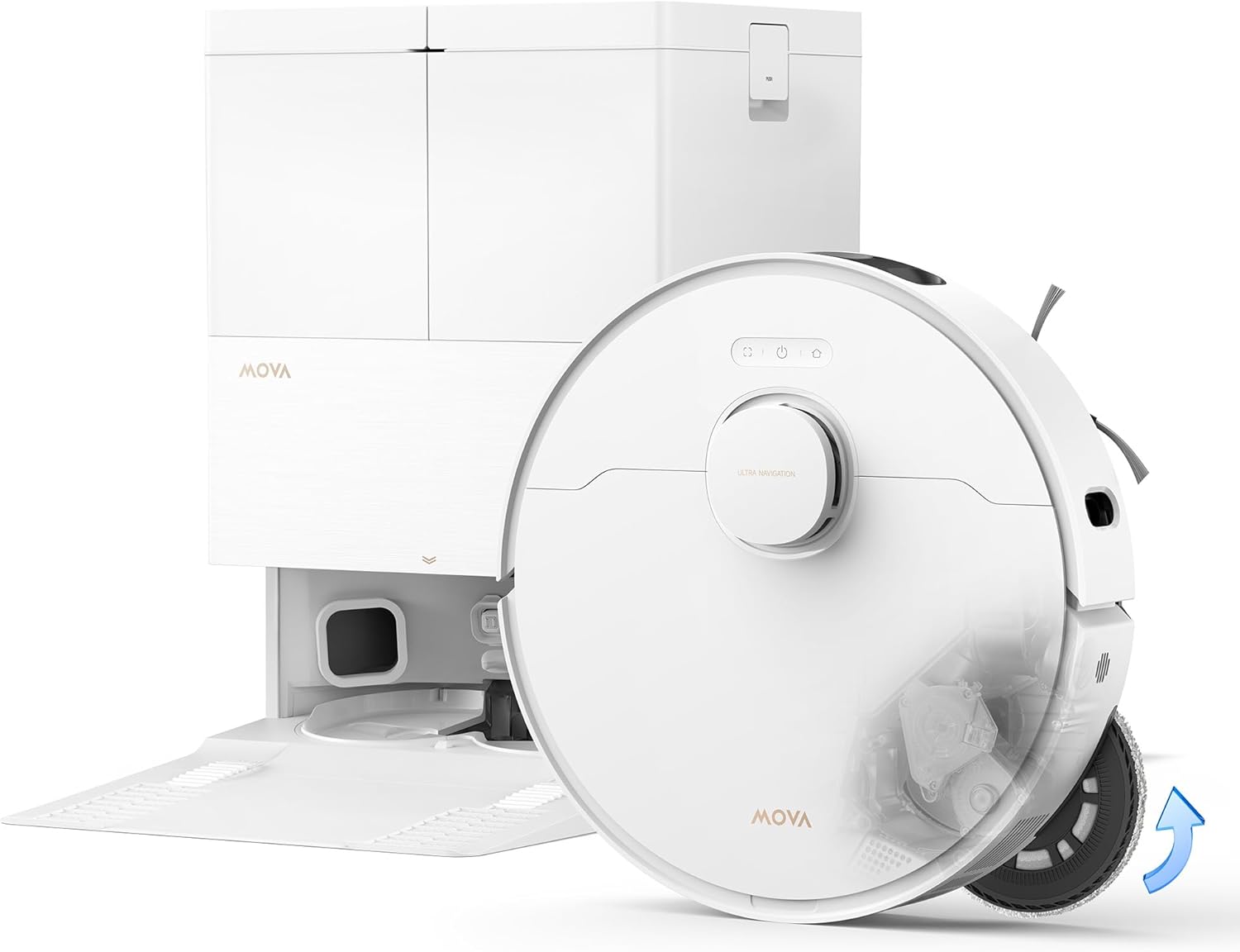
MOVA E50 Pro Ultra Robot Vacuum Cleaner, 30,000Pa, 100°C Water Mop Cleaning, White
ASIN: B0H2JP5WVY
- ✓30,000 Pa suction, the highest figure among these robots
- ✓Mop pads washed at 100 °C against grease and bacteria
- ✓TurboScrub presses the mop with 12 N and spins it up to 260 rpm
- ✓MaxiReach mop slides out along walls for edges and hidden dirt
- ✓Five-litre tank covers a larger flat in a single pass
- Suction power
- 30,000 Pa
- Mop washing
- 100 °C hot water
- Mop pressure
- 12 N
- Water tank
- 5 litres
- Height
- 9.7 cm
- Filter
- HEPA
Open this product on Amazon
Amazon prices change all the time, so check the current one on the store page. To compare every Amazon store at once, use our browser extension.
Pros
- Early owners report strong pick-up on carpets and on pet hair
- Wipes spilled food streak-free and leaves rugs dry
- Extendable mop reaches wall edges, so corners need no rework
- Hot wash and drying of the pads leaves little upkeep to you
- Vacuum first, then mop: owners like the order of the two passes
Cons
- Only sixteen ratings so far, so the average rests on few opinions
- Cables and very narrow gaps still have to be cleared by hand
- It does not replace a deep clean, as its own owners point out
- Controlled from the app alone; no voice assistant in the specifications
Lefant M210 PRO Omni — a compact robot vacuum with a roller mop
The Lefant takes a different route to a clean floor. Instead of two spinning pads this robot carries a roller that works in four stages: it sprays the floor, softens the dirt, scrubs at 230 rpm under pressure and then scrapes the dirty water back off with a blade. That is closer to what your arm does with a cloth, and it is why the robot handles a greasy kitchen tile better than its size suggests. The body is 28 cm across and 10 cm tall, so it slips under beds and sofas that stop wider robots, while the brush is a wide 20 cm. LiDAR handles navigation, mapping and no-go zones, the onboard container holds 800 ml, and the base empties it into a sealed bag. Most robots this small drop the mop entirely; here it is the main feature.
Buyers with small flats are the happiest owners among these robots: they describe a nimble robot that reaches into tight corners, finds its dock every time and sets up over Wi-Fi in minutes. The warnings are worth reading before you commit. The app is the weak part, awkward to learn and without per-room cleaning modes. With full suction and wet mopping switched on, one owner covered only about 50 square metres per charge, which is not much for a large home. A few units arrived with a dirty-water tank the software refused to recognise, and one reviewer reported the robot wiping a carpet it should have avoided. This robot suits a small, mostly hard-floor home and struggles in a big one.
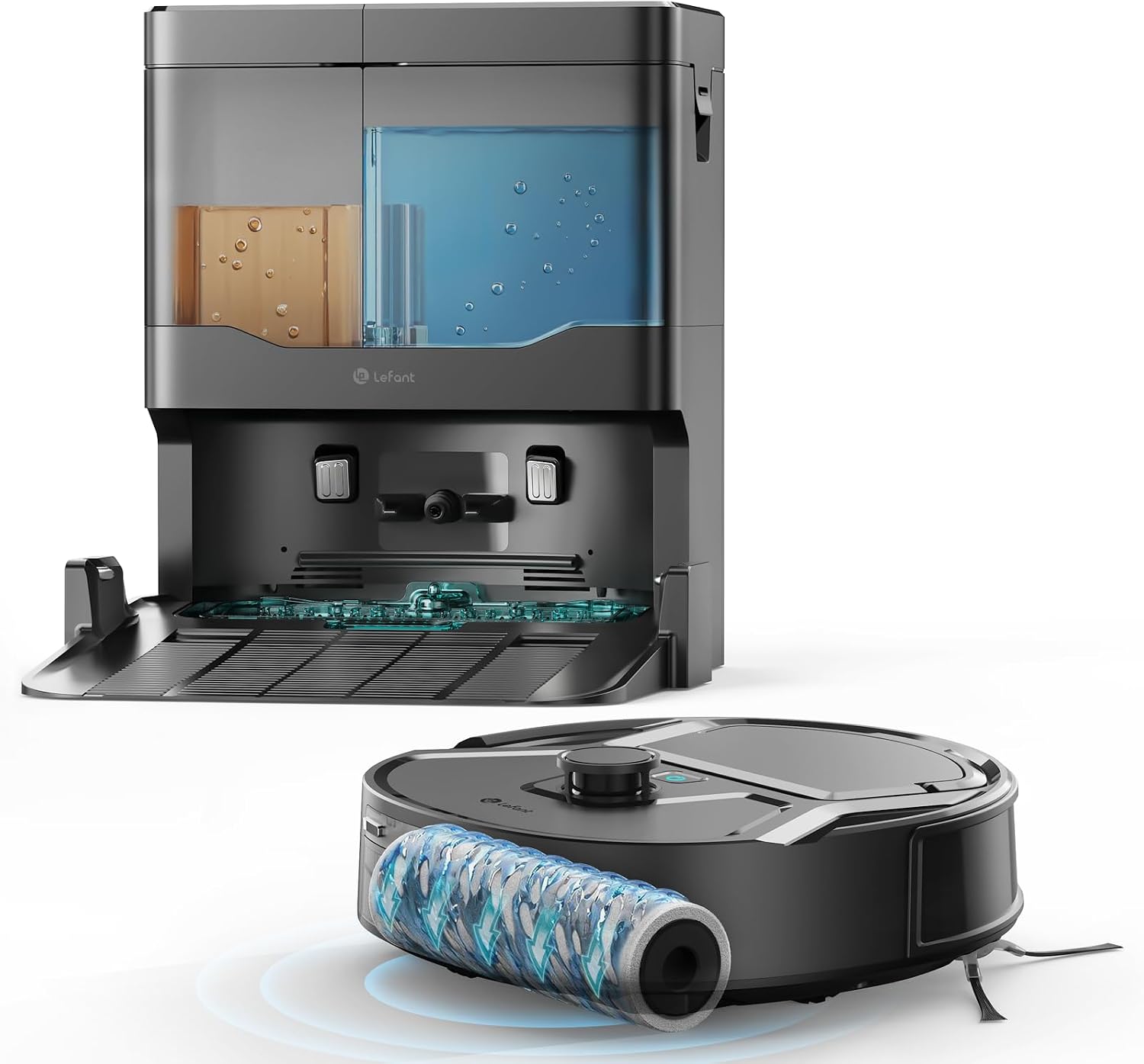
Lefant M210 PRO Omni Robot Vacuum Cleaner with Scooter Wiping Function
ASIN: B0G7TKZS21
- ✓Roller mop sprays, scrubs at 230 rpm and scrapes the dirty water away
- ✓Slim 28 cm body only 10 cm tall slips under beds and sofas
- ✓LiDAR navigation with multi-floor maps and no-go zones
- ✓Base station empties the 800 ml container into a sealed bag
- Suction power
- 20,000 Pa
- Battery life
- 140 minutes
- Height
- 10 cm
- Brush width
- 20 cm
- Dust container
- 800 ml
- Navigation
- LiDAR
Open this product on Amazon
Amazon prices change all the time, so check the current one on the store page. To compare every Amazon store at once, use our browser extension.
Pros
- Nimble in a small flat and reaches into the tightest corners
- Finds its base every time and cleans itself there
- Wi-Fi setup and the first map take a few minutes
- Roller mop scrubs a greasy kitchen floor instead of smearing it
- Sealed 800 ml container empties into a bag at the base station
Cons
- The app is hard to learn and has no per-room cleaning modes
- About 50 square metres per charge at full suction with wet mopping
- Some units arrived with a dirty-water tank the software would not accept
- One owner reports it wiping a carpet it should have driven around
- Poor reports mention hair spread over the floor and a lost dock
Robot vacuum comparison by the specifications
The numbers behind the four robots sit in one table, so the trade-offs are visible at a glance.
| Parameter | MOVA P50 Pro Ultra | MOVA P50 Ultra | MOVA E50 Pro Ultra | Lefant M210 PRO |
|---|---|---|---|---|
| Suction power | 19,000 Pa | 19,000 Pa | 30,000 Pa | 20,000 Pa |
| Mop washing | 75 °C hot water | 75 °C hot water | 100 °C hot water | Roller with scraper |
| Battery life | 300 min | 150 min | — | 140 min |
| Height | 10.4 cm | — | 9.7 cm | 10 cm |
| Listed capacity | 4 l | 300 ml | 5 l | 800 ml |
| Filter | HEPA | HEPA | HEPA | — |
| Voice control | Amazon Echo, Google Home | Amazon Echo, Google Home | App only | Google Home |
| Rating | 4.3 (1,095) | 4.4 (258) | 4.5 (16) | 4.6 (190) |
Read the table together with the number of ratings, because that changes the weight of every score. Two of these robots are judged by hundreds of buyers and one by a handful. The P50 Pro Ultra carries over a thousand opinions behind its 4.3, a far more solid basis than the 4.5 of a robot rated by sixteen people. The Lefant leads on average score with a respectable 190 ratings, yet the reviews behind it split sharply between small flats, where it does well, and large ones, where it does not.
How to choose a robot vacuum for your home
Robots of this class differ in ways the box does not print, so weigh several things at once rather than reading down to the biggest suction number.
- Floor type. A home of hard floor with a few rugs is the easy case, and any of these four robots will manage it. A robot vacuum on carpet is the hard case: check how the mop is lifted or removed, and read the carpet complaints before you buy.
- Area per charge. Battery life on the box is measured in the gentlest mode. Full suction with wet mopping can halve the covered area, so a large flat needs either a long runtime or robots that recharge and resume.
- The station. Decide whether you want it to empty the bin, wash the pads in hot water and refill the tank, or only some of that. This is where most of the convenience is, where robots differ most, and where most of the money goes.
- Height and width. Measure the gap under your sofa and your bed. Robots of 9.7 or 10 cm get under furniture that stops a taller robot, and a narrow body turns more easily in a small bathroom.
- Hair. In a robot vacuum for pet hair, or for a house with long human hair, the anti-tangle design of the brush matters more than the suction rating. Cutting brushes and rubber rollers both work; a plain bristle roller does not.
- The app. You will use it every week. A clumsy app with no per-room settings turns a good robot into an annoying one, and buyers mention it more often than any specification.
The common mistake is treating pascals as a score. The second is forgetting spare parts, because robots wear out in small pieces: a wheel or a brush is cheap, but only if you can order it and fit it yourself. The third is buying a tall robot for a home full of low furniture, and then finding that the dust you wanted removed sits exactly where it cannot reach.
Frequently asked questions
- Does a robot vacuum really replace normal cleaning?
- These robots replace the daily round of vacuuming and light mopping, which is most of the work. Owners of all four robots here agree that a thorough clean by hand is still needed from time to time, especially in the bathroom and along the tops of skirting boards.
- Is 30,000 Pa twice as good as 15,000 Pa?
- No. Suction is one factor among several, and the brush shape, the mop pressure and the navigation decide as much of the result. A higher figure helps most on thick carpet and with coarse dirt, and robots with a lower one but a better brush often finish cleaner.
- How often do you empty the station of a robot vacuum?
- With robots that empty themselves the bag holds several weeks of dust, and buyers report anything from a few weeks to three or four months depending on the size of the home and whether there are pets. The dirty-water tank needs emptying far more often, otherwise it starts to smell.
- Will these robots cope with long hair and pet hair?
- The ones with an anti-tangle brush do. The MOVA robots use a cutting brush and the Lefant a wide roller with a special intake; owners with cats and dogs report very little winding around the roller.
- What happens when the battery runs out mid-clean?
- All four robots return to the dock, recharge and continue from the point where they stopped. They do the same when the water runs out, and the app sends a notification.
Verdict
Every model on the same criteria
Score against price
- MOVA P50 Pro Ultra4.3 at about €499
- MOVA P50 Ultra4.3 at about €349
- MOVA E50 Pro Ultra4.4 at about €469
- Lefant M210 PRO Omni4.2 at about €650
The overall score divided by the typical price, with the best in the group as the full bar. A rough guide, not a verdict — a cheap model that misses the feature you need is no bargain.
Read the bars as trade-offs rather than as a ranking. The two P50 robots are the same robot with and without the camera, so the gap between them is small and sits mostly in the battery. The E50 Pro Ultra leads on the numbers — more suction, hotter water, more mop pressure — and trails only on the number of people who have tried it. The Lefant wins the small-room line and loses the app one, which is exactly how its owners describe it. None of these robots is weak: their averages run from 4.3 to 4.6, and the differences that matter are about your flat rather than about quality.
Pick a robot around your floors and your furniture, not the pascal count on the box, and check that a broken wheel or a worn brush is something you can order and fit at home. Robots like these earn their keep slowly, and that single question separates one that serves you for years from one that stops working after a few months. A robot vacuum price comparison is worth doing only after that, because the same model costs very different sums from one Amazon store to the next, and the cards above show what each store asks today.