What a 4K dash cam really records: four front and rear models compared
Dash cams under €150
A dash cam earns its place in about ten seconds — the ten after somebody pulls out of a side road without looking — and spends the rest of the year behind the mirror, quietly overwriting yesterday. You are paying for footage you hope never to watch, so only one question matters: would the recording stand up on the day it becomes the only evidence you have?
Every cam on this shelf prints the same words on the box: 4K, super night vision, WDR, a G-sensor, loop recording and 24/7 parking monitoring, and all four cams compared here do exactly that. The differences sit lower down the page: whether the rear cams film at 1080p or at the same 4K as the front, whether the lens covers 155 degrees or 170, and how many gigabytes arrive in the box. Then there is the line most buyers skip — the parking mode advertised on all these listings needs a hardwire kit that none of these cams include.
This dash cam comparison lines up four front and rear cams: the GKU D600, a Navycrest cam built around a Sony sensor, a Veement that writes GPS coordinates into the file, and a second Veement filming 4K at both ends. None of them is the reference point for the others — in most stores each one stays under $150, and the group sits near $80, so the choice is about coverage, storage and night footage rather than about budget classes. Specifications come from the listings, impressions from owners who have driven a winter with these cams.
Models in this comparison
Typical price across these models: about €85. Rough figures from store prices converted at fixed rates: what you pay also depends on the store and the region you order from. With our browser extension you can compare every Amazon store at once, right on the product page.
GKU D600: the widest front and rear dash cam here
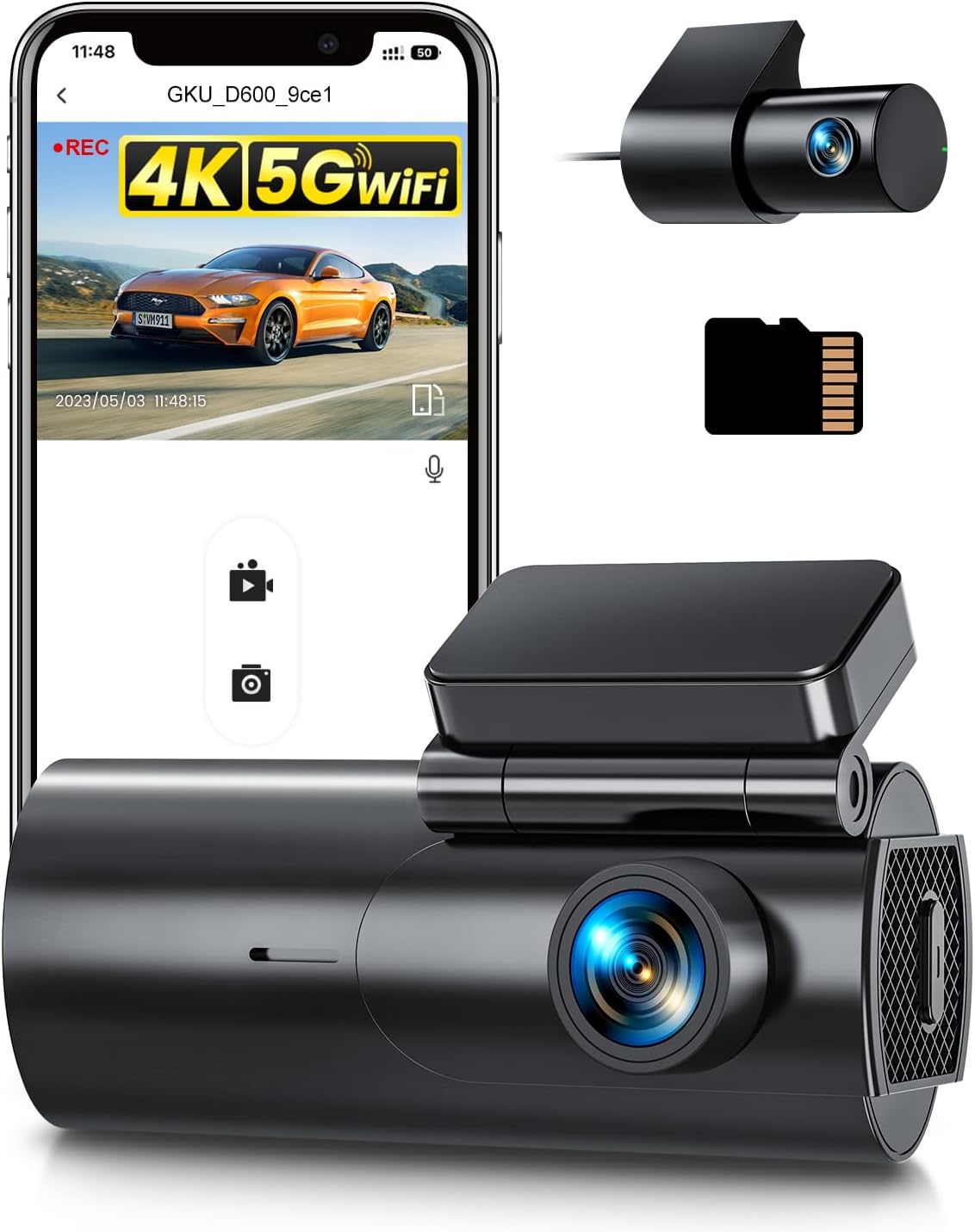
GKU Dashcam Car Front Rear 4K + 1080P, 5GHz WiFi Dash Cam with 64GB SD Card
ASIN: B0C33RDGY8
- ✓4K front camera and 1080p rear, with the rear unit unpluggable if you only want one
- ✓170-degree lens with an f/1.8 aperture and WDR for night driving
- ✓5.8 GHz Wi-Fi, so clips reach the phone faster than on 2.4 GHz models
- ✓A 64 GB card, a car charger and a 6-metre rear cable are in the box
- Front video
- 4K 3840x2160, 30 fps
- Rear video
- 1080p
- Field of view
- 170 degrees, f/1.8
- Screen
- 1.47-inch LCD
- Wi-Fi
- 5.8 and 2.4 GHz, GKU GO app
- Card
- 64 GB supplied, 256 GB maximum
- Size
- 8.9 x 4.6 x 3.6 cm
- Warranty
- 1 year
Open this product on Amazon
Amazon prices change all the time, so check the current one on the store page. To compare every Amazon store at once, use our browser extension.
The D600 is the shape most people picture: a black block hidden behind the rear-view mirror, a 1.47-inch screen you look at twice a year, and a second cam on a six-metre cable for the rear window. GKU makes that rear camera optional, so unplugging it leaves the front cam recording alone in 4K. The lens covers 170 degrees at f/1.8 with WDR, the mount swings through 120 degrees and the rear housing turns a full circle — useful when a hatchback and an estate need the same cam aimed differently. Wi-Fi runs on 5.8 GHz as well as 2.4 GHz, though the GKU GO application only reaches the cam from three to five metres away.
Two limitations belong here rather than in the small print. This cam has no usable battery, because the cell inside keeps the settings and nothing else, so the cam records only while it is fed power. The 24-hour parking mode, in both its shock-triggered and time-lapse forms, additionally requires a hardwire kit that GKU sells separately and warns against substituting.
Daylight footage from the D600 is the first thing buyers mention, and they agree about it. A German owner driving city and country routes daily calls the front cam sharp enough to read number plates at a distance, with natural colour and no fisheye bending at the edges. A driver in the Netherlands covered 1,500 kilometres in her first week and was surprised by what these cams produce for the money. After dark the same owners are more measured: the f/1.8 lens and WDR keep the image usable, one reviewer sees noise in complete darkness, and nobody claims the night frames match the daylight ones.
The second theme is what happens when something goes wrong. One owner had to fit his cam to the dashboard of a motorhome, and the picture came out mirrored. GKU support answered with fresh firmware within a day, and the cam came right. Another buyer wanted German voice prompts and could not have them: the messages stay in English whatever you do. A third discovered something no listing mentions: his van has no switched 12-volt socket, and leaving the cam connected flattened the battery in 24 to 36 hours.
The lower scores are worth reading. One owner had thirteen good months before the cigarette lighter plug broke, leaving a rattle inside the adapter and nothing else. A more sympathetic reviewer lists trade-offs rather than faults: the telephone joins the cam's own network every time, which cuts off mobile data and clashes with Android Auto and CarPlay, and the rear feed lags about a second, so these dash cams cannot double as a parking aid. He also did the storage arithmetic: front and rear 4K fill the supplied 64 GB card in two to three hours of loop recording, enough for a commute and not for a holiday drive.
Pros
- Sharp daytime 4K, with number plates readable at a distance
- Fast transfers over 5.8 GHz Wi-Fi and an app owners call stable
- Support that solved a mirrored-image problem with new firmware in one day
- A 64 GB card, adhesive pads that hold and a rear cable long enough for an estate
- Small and discreet enough that owners forget it is there
Cons
- High current draw flattened one owner's van battery in a day and a half
- One unit's cigarette lighter plug failed after thirteen months
- Voice prompts stay in English and cannot be switched
- Joining its Wi-Fi blocks mobile data and upsets CarPlay
- The rear feed lags about a second, so it cannot help you park
- 64 GB holds only two to three hours of front and rear 4K
This cam suits a driver who wants the widest front view here, a memory card in the box and a name with ten thousand ratings behind it. Anyone expecting overnight monitoring from the first day should budget for the hardwire kit, and anyone whose 12-volt socket stays live with the engine off should think hard about that battery.
Parking mode is the line every listing blurs
All four cams advertise 24-hour parking monitoring, and none of them delivers it out of the box. A dash cam with parking mode printed on the listing is really a cam that can watch a parked car once you wire it in. The reason is straightforward: a dash cam carries no meaningful battery, so watching a parked vehicle means drawing current from the vehicle itself. That means a hardwire kit wired into the fuse box, with a cut-off that stops before the starter battery is too flat to crank. Each manufacturer sells its own kit, and GKU warns against fitting anybody else's.
Owners who wired their cams in are content with the result, and a Navycrest buyer who fitted the matching kit reports parking mode working without fault. Owners who skipped it meet the opposite problem: a first-time buyer of the GPS cam described below left it on the lighter socket, forgot to unplug the cam and returned to a car that would not start. Two modes are normal once these cams are wired in — recording only when the G-sensor feels a knock, or a low-frame time-lapse that sips power. The first suits a locked garage, the second a street where somebody may lean on your wing and walk away.
What these cams do after dark
Night is where a dash cam either earns its money or wastes it, because most disputes about who moved first happen in poor light. All four cams attack the problem identically, with a bright aperture and WDR to hold detail in a frame containing both headlights and shadow: the GKU cam and the GPS Veement open to f/1.8, the Navycrest to f/1.6, and the Veement adds a six-layer lens credited with 60 per cent more light.
Owner reports on these cams suggest those figures only take you so far. The strongest night praise goes to the Navycrest cam, where several German buyers describe clear, detailed frames in low light and one reads number plates at speed. The GKU sits just behind it: good, but noisy in genuine darkness. The sharpest criticism lands on the GPS cam, where one owner says the night image resembles 2K rather than 4K, while another reads plates only from close range late in the evening. A four-star buyer of the same cam is happy day and night, so opinion divides rather than settles. Treat dash cam night footage as the specification most likely to fall short of the box, and judge these cams by what owners saw at midnight.
Navycrest Q7: the brightest sensor of these 4K dash cams
The Q7 films 4K at the front and 1080p behind, but its sensor is a Sony IMX unit behind six glass elements and an f/1.6 aperture, the brightest of these four dash cams. Its 5 GHz Wi-Fi claims transfers up to four times faster than 2.4 GHz equipment, around 8 MB per second, and the listing quotes 30 and 60 frames per second. The trade-off is the view: 155 degrees on paper, 160 in the real-angle figure, both narrower than the GKU cam. Twelve months of warranty become 24 if you register within a week. One footnote matters: the bundled card dropped from 64 GB to 32 GB in June 2026, so older reviews praising the bigger card describe a package you will not receive.
Owners describe these cams in similar words: quick installation, a mount that sits firm, clear frames day and night, and an application that pulls clips off without touching the card. The complaints are specific rather than vague. A four-star buyer had the supplied card die after a few months, and a three-star owner fought the adhesive pad, found glue residue on the glass afterwards and received a manual only in English. A buyer in Spain got a cam whose rear connector was faulty out of the box. The one-star review is the one to weigh, describing a power button that sticks, a cam that shuts down mid-drive and reboots, and unreliable behaviour above 34 degrees. Buy the Q7 for the brightest sensor here and the longer cover; skip it if you want the widest frame.
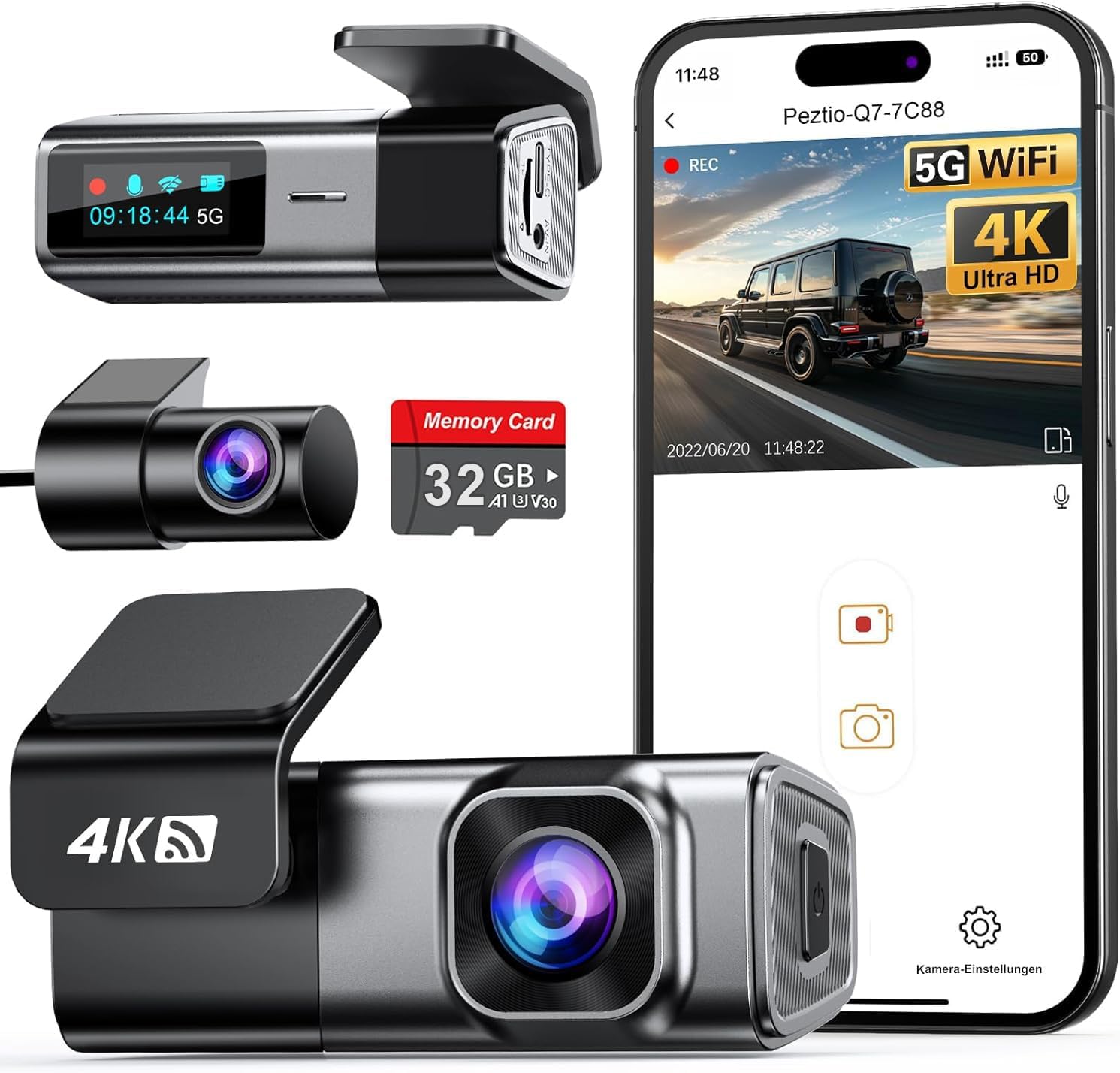
Dashcam Car Front Rear 4K + 1080P, Navycrest 5GHz WiFi Dash Cam with 32GB SD Card
ASIN: B0DF7PNNY3
- ✓Sony IMX sensor behind six glass elements and the brightest aperture here
- ✓5 GHz Wi-Fi rated at up to 8 MB per second for downloads
- ✓Warranty stretches to 24 months if you register within a week
- ✓Records at 30 or 60 frames per second
- Front video
- 2160p, also 1440p
- Rear video
- 1080p
- Field of view
- 155 degrees, f/1.6
- Frame rate
- 30 or 60 fps
- Screen
- 1.5-inch LCD
- Card
- 32 GB supplied, 256 GB maximum
- Weight
- 300 g
- Warranty
- 12 months, 24 with registration
Open this product on Amazon
Amazon prices change all the time, so check the current one on the store page. To compare every Amazon store at once, use our browser extension.
Veement with GPS: route and speed written into the file
This is the only cam of the four that records where you were as well as what you saw. As a dash cam with GPS it logs position and speed, then replays the route on a map in the VeeCar application. That turns a clip into a statement: not merely a car crossing a line, but the speed you were travelling when it did. The cam films 4K at the front through a 170-degree lens at f/1.8, with a 160-degree rear unit at 1080p. Its 2.4-inch screen is easier to aim than the tiny panels on the two cams above, a 32 GB card and a 360-degree suction mount come in the box, and the cover runs 24 months.
The reviews split more sharply than the 4.1 average suggests. A German buyer of several weeks calls installation uncomplicated and the picture sharp, while an American owner has run this cam for over a year without a problem and rates the cable length exactly right. Against them stand the night complaints above, plus an owner who found the controls difficult and his cam scratched out of the box. A buyer in the Emirates says the listing photographs show an AV port for a second camera and a fuse-box connection his cam did not have. Take this Veement if the GPS track is the feature you want; avoid them if most of your driving happens after dark.
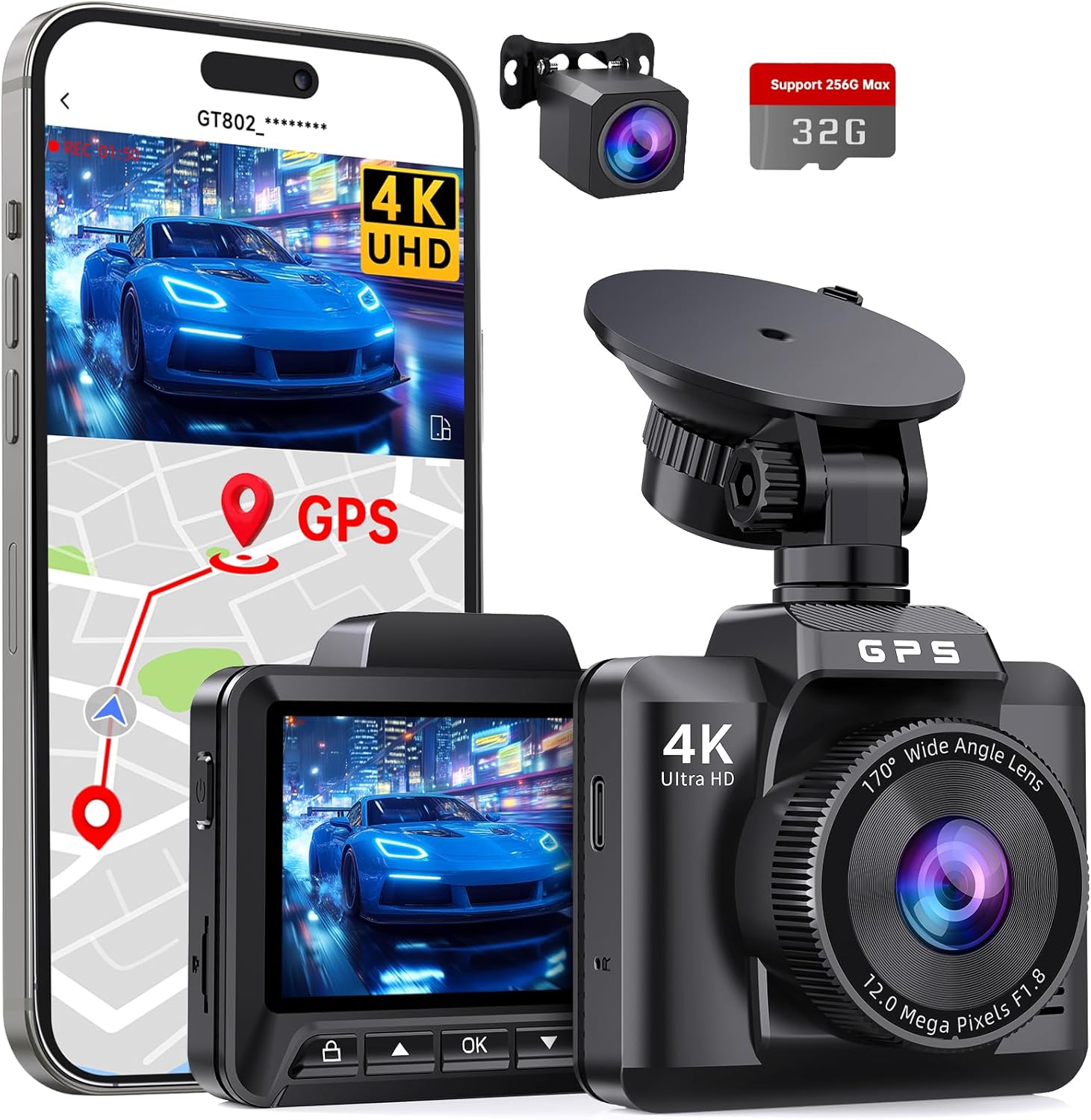
Dash Cam Car Front Rear 4K + 1080P, Dash Cam Car with GPS, Parking Monitoring
ASIN: B0FXWZ9CJK
- ✓Built-in GPS logs speed and position, with route playback in the VeeCar app
- ✓170-degree front lens and a 160-degree rear unit
- ✓2.4-inch screen, easier to aim than the smaller panels here
- ✓24-month warranty and a 360-degree suction mount in the box
- Front video
- 4K 3840x2160, 30 fps
- Rear video
- 1080p, 160 degrees
- Field of view
- 170 degrees, f/1.8
- GPS
- Yes, route and speed
- Screen
- 2.4-inch LCD
- Card
- 32 GB supplied
- Mount
- 360-degree suction cup
- Warranty
- 24 months
Open this product on Amazon
Amazon prices change all the time, so check the current one on the store page. To compare every Amazon store at once, use our browser extension.
Veement GT870: a dual 4K dash cam with almost no history
The GT870 is the only cam here filming 4K behind as well as in front, and that single change alters what the rear unit is for. At 1080p a rear frame tells you a car hit you; at 2160p it stands a much better chance of telling you which car. The screen measures 3.2 inches, more than twice the diagonal of the GKU cam, and a 64 GB card is supplied. The body mounts behind the mirror and starts with the ignition, cover runs two years with lifetime technical support, and parking mode again waits on a Type-C hardwire kit sold separately.
Read the reviews on this cam with your eyes open. Five people have written about it, four of those on the same day in June, and none of the four is marked as a verified purchase — a pattern worth naming rather than ignoring. What they say is positive: an application better than others they have used, compression that keeps plenty of history on the 64 GB card, plate detail their previous cams missed, and good night detail. One owner notes that 4K at both ends fills a card quickly. The single verified review, from an American owner, calls the picture high-resolution. Five stars across sixteen ratings tells you considerably less than 4.2 across ten thousand, so choose it only if rear detail is the reason you are buying at all.
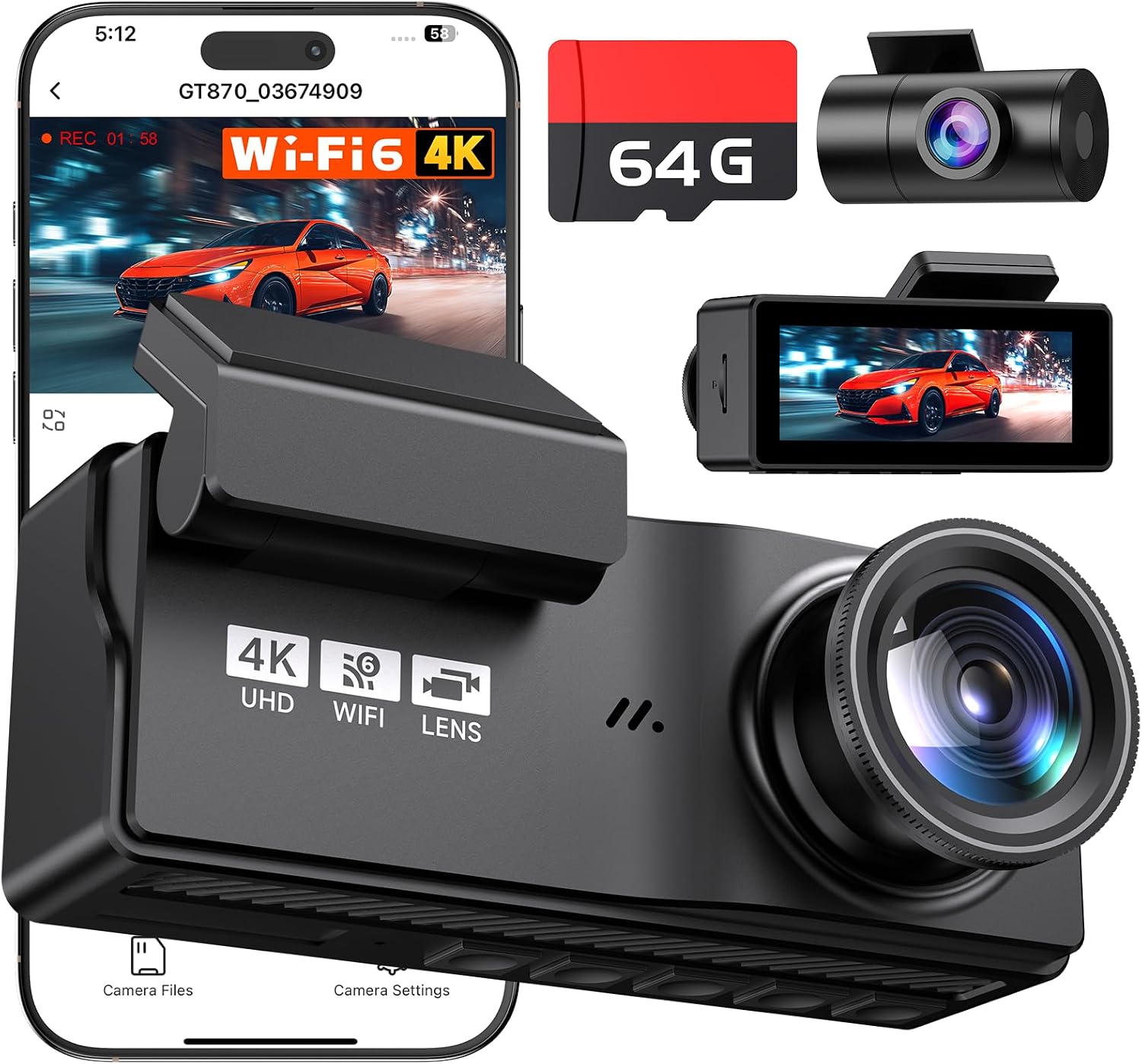
Dash Cam Car Front Rear 4K + 4K, WiFi Dash Cam with 64GB SD Card 3.2 Inch Screen
ASIN: B0GGRVQZV4
- ✓The only model here recording 4K at the rear as well as the front
- ✓3.2-inch screen, the largest in this group
- ✓64 GB card supplied and 256 GB cards supported
- ✓Two-year warranty with lifetime technical support
- Front video
- 4K 2160p
- Rear video
- 4K 2160p
- Screen
- 3.2-inch LCD
- Card
- 64 GB supplied, 256 GB maximum
- Mount
- Windshield, behind the mirror
- Size
- 3 x 10 x 4 cm
- In the box
- Front and rear units, charger, tool
- Warranty
- 2 years
Open this product on Amazon
Amazon prices change all the time, so check the current one on the store page. To compare every Amazon store at once, use our browser extension.
Dash cam comparison by the specifications
Side by side, the figures from these four cams show where each manufacturer spent the money.
| Parameter | GKU D600 | Navycrest Q7 | Veement GPS | Veement GT870 |
|---|---|---|---|---|
| Front video | 4K/30 | 2160p, 30 or 60 fps | 4K/30 | 4K 2160p |
| Rear video | 1080p | 1080p | 1080p, 160° | 4K 2160p |
| Field of view | 170° | 155° | 170° | Ultra-wide, not stated |
| Aperture | f/1.8 | f/1.6 | f/1.8 | — |
| Screen | 1.47 in | 1.5 in | 2.4 in | 3.2 in |
| GPS | — | — | Route and speed | — |
| Card in the box | 64 GB | 32 GB | 32 GB | 64 GB |
| Maximum card | 256 GB | 256 GB | — | 256 GB |
| Mount | Rear-view mirror | Windshield | 360° suction cup | Windshield |
| Parking mode | Hardwire kit needed | Hardwire kit needed | Hardwire kit needed | Hardwire kit needed |
| Warranty | 1 year | 1 year, 2 on registration | 2 years | 2 years |
| Customer rating | 4.2 (10,831) | 4.2 (2,076) | 4.1 (2,663) | 5.0 (16) |
The bottom row deserves as much attention as the top one. Ten thousand ratings at 4.2 describe cams whose failures have had time to surface: the broken plug, the drained battery and the English-only prompts are things you learn from a crowd, not from a launch week. Sixteen ratings at a flat five describe a cam nobody has owned long enough to break. Neither number is dishonest — they answer different questions, and the older cams answer the more useful one.
How to choose a front and rear dash cam
Five things separate a cam you forget about from one you argue with, and none of them is the resolution printed on the box.
- Decide about parking before you buy. If you want the car watched while you are away from it, add the manufacturer's hardwire kit to the same order and set aside an hour with the fuse box. Without that kit, every 24/7 claim in this category describes cams that are switched off.
- Match the card to the resolution. A 64 GB card holds two to three hours of front and rear 4K, a 32 GB card half of that. Loop recording means these cams never run out of space, only out of history — and history is what you need three days later, when a letter arrives. A 128 GB or 256 GB U3 card is the cheapest useful upgrade.
- Field of view against sensor. A 170-degree lens catches the car cutting in from the next lane; a brighter sensor catches the number plate. Among these dash cams, city traffic argues for the wider frame and unlit roads for the better glass.
- The rear unit is a witness, not a mirror. Every owner who expected a reversing aid was disappointed, and the one-second lag explains why. Judge a rear cam by what it records, not by what it shows you live.
- Count the ratings, not only the stars. Two of these cams carry thousands of opinions and one carries sixteen, and a run of same-day reviews deserves caution.
Frequently asked questions
- Can these dash cams record while the car is parked?
- Only with a hardwire kit, which none of the four include. Each maker names its own kit, and GKU explicitly warns against using another brand's. Wired in, the cameras offer a shock-triggered mode and a low-frame time-lapse mode.
- Will a dash cam drain my car battery?
- It can, if the 12-volt socket stays live with the engine off. One GKU owner emptied the battery of his van in 24 to 36 hours by leaving the camera plugged in, and a Veement owner came back to a car that would not start. A proper hardwire kit includes a voltage cut-off; a lighter socket does not.
- How long does the supplied dash cam memory card last?
- Front and rear 4K fills a 64 GB card in about two to three hours of loop recording, according to a GKU owner who measured it. The two models that ship with 32 GB give you roughly half of that. Both figures cover a commute and neither covers a long trip, so a larger U3 card is worth budgeting for.
- Do I need 4K at the rear as well as the front?
- It depends on what you fear. A 1080p rear frame shows that a car hit you and roughly how; 4K gives you a better chance of reading the plate of the car behind. Only the GT870 in this group records 4K at both ends, and it fills its card faster because of it.
- Is the rear camera useful for reversing?
- No. The live rear feed on the GKU lags around a second, which one owner found far too imprecise for tight parking spaces. Every rear unit here is meant as evidence of what happened behind the car, not as a parking aid.
- Do these models work with a phone over Wi-Fi?
- Yes, all four connect to their own app. Be aware that your phone joins the camera's own network, so mobile data pauses while you are connected, and one GKU owner reports conflicts with Android Auto and CarPlay that mean switching one of them off.
Verdict
Every model on the same criteria
Score against price
- GKU D6004.2 at about €70
- Navycrest Q74.2 at about €70
- Veement with GPS3.9 at about €70
- Veement GT8703.8 at about €130
The overall score divided by the typical price, with the best in the group as the full bar. A rough guide, not a verdict — a cheap model that misses the feature you need is no bargain.
Read the bars as trade-offs, not as a ranking, because no cam in this group leads everywhere. The widest front view comes with a rear unit at 1080p and a plug that failed on one unit after thirteen months. The brightest sensor comes with the narrowest frame of the four. The only satellite tracking here sits on the cam with the weakest night reports, and the only cam recording 4K in both directions has sixteen ratings behind it, four of them written on one day. Their averages run from 4.1 to 4.2 on the three cams that have been owned long enough to judge, so the quality gap between them is smaller than the feature gap.
Pick by the two situations you actually fear. If it is city traffic in daylight, buy the wide lens and the big card. If it is an unlit road, or a parked car at three in the morning, buy the better sensor, add the hardwire kit and treat the resolution on the box as the least interesting number on the page.