Beginner camera drone under 250 grams: which one flies home on its own
Camera drones under €200
An aerial photograph used to need a helicopter. Now it needs a camera drone that folds into a coat pocket, a controller with a small screen on it, and twenty minutes of battery. Beginner camera drones are cheap enough to risk over a field, light enough to carry on a walk, and clever enough to fly themselves home when the signal drops.
The listings make the choice harder than it should be. Open four camera drones in four tabs and the same words come up — 4K, GPS, brushless, foldable — above the same grey plastic body. The differences sit further down the page: how many batteries the box holds, whether the camera drone keeps its line in a breeze, whether anything on board watches for a tree, and how close the recorded file gets to the resolution on the label.
This camera drone comparison takes four models a first-time pilot would shortlist: the Tolatoyus TL16LCD with an LCD remote, the TOPBLASTERBOX G9 and H11 that each carry a spare battery, and a 179-gram SJsharp that drops GPS for obstacle sensors. They sit in the same bracket — in most stores each one stays under $180, and the group sits near $140 — so no drone here is a step up in class, only a different way of spending the same money. Customer scores run from 3.8 to 4.2, so none of these drones is a crowd favourite, and the useful part is where each one disappoints its owners. Figures come from the listings, opinions from buyers in six countries.
Models in this comparison
Typical price across these models: about €127. Rough figures from store prices converted at fixed rates: what you pay also depends on the store and the region you order from. With our browser extension you can compare every Amazon store at once, right on the product page.
Tolatoyus TL16LCD — a GPS camera drone with an LCD remote
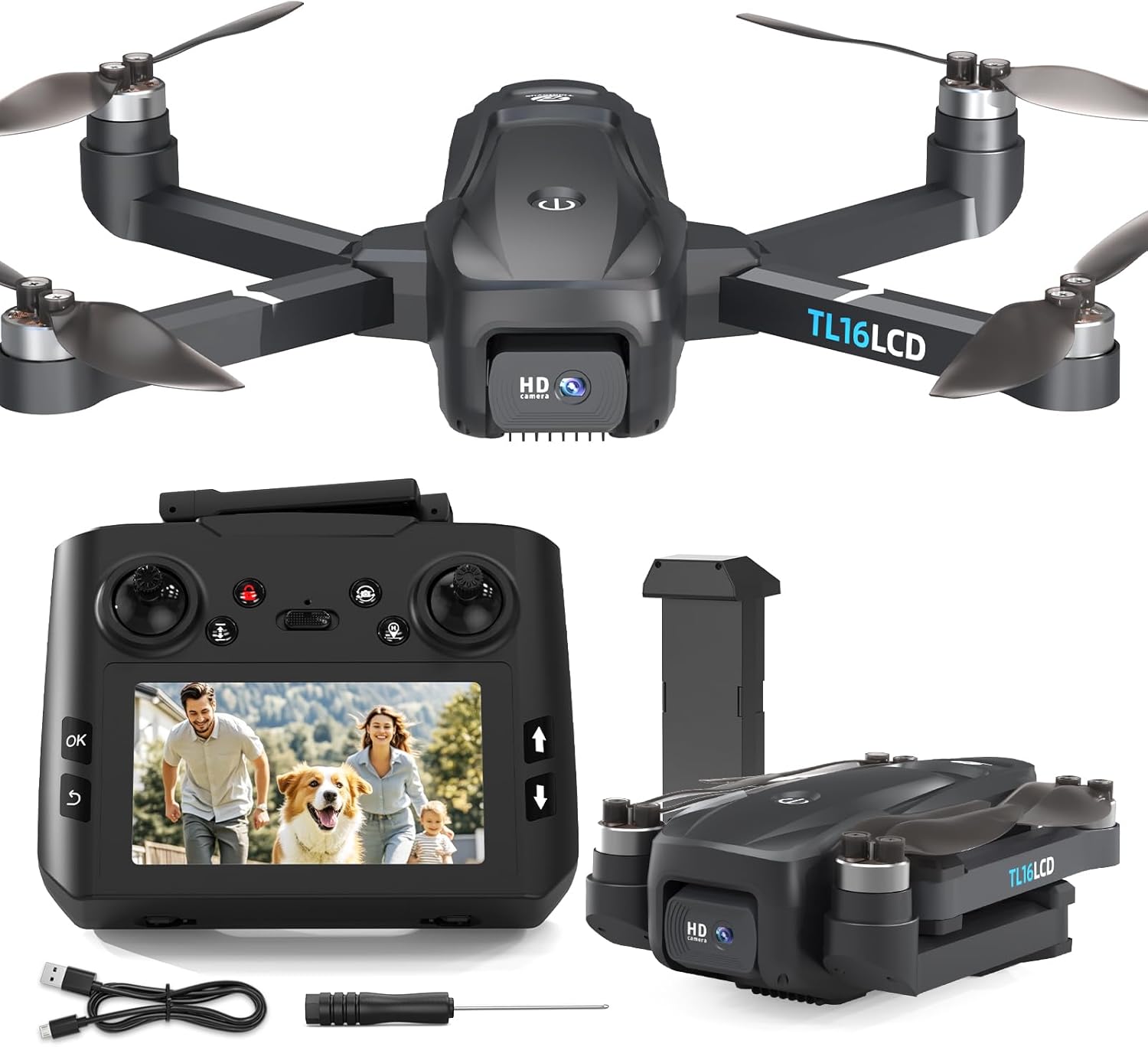
TL16LCD Drone with Camera 4K, GPS Drone for Beginners with LCD Remote Control Auto Return Follow Me Real Time Transmission 5G FPV Drones for Adults
ASIN: B0FGXKSDJ8
- ✓LCD screen built into the remote, so the phone can stay in a pocket
- ✓GPS position lock with automatic return on low battery or lost signal
- ✓Brushless motors and a camera that tilts 45 degrees by remote
- ✓Folds into the supplied bag; 2200 mAh gives up to 20 minutes in the air
- Video
- 4K, MP4
- Camera tilt
- 45° by remote
- Positioning
- GPS lock, return to home
- Battery
- 2200 mAh, up to 20 min
- Storage
- Expandable to 32 GB
- Folded size
- 22.5 x 18.5 x 5.5 cm
Open this product on Amazon
Amazon prices change all the time, so check the current one on the store page. To compare every Amazon store at once, use our browser extension.
The TL16LCD is the shape most people picture as a first camera drone: four folding arms, a camera on a tilting mount, a remote with a screen in the middle. One button takes off, one lands, one brings the drone back to the take-off point, and three speed settings let a nervous pilot start slowly. GPS holds the position when the sticks are released and triggers the return when the battery runs low or the link breaks. Follow Me, waypoints and circular flight are on the menu, and the brushless motors are quieter than the geared ones in toy drones.
This camera drone suits someone who wants to learn to fly and is content for the video to be a souvenir. Anyone buying mainly for footage should read the next section first.
Two things earn this drone its praise, and neither is the camera. The first is the screen on the remote: owner after owner mentions not having to clip a phone to the controller. A French owner describes the picture as clear and smooth from take-off, another says the readable display makes the drone easy to hand to a child, and an American buyer calls the phone-free setup the most convenient part of the package. One owner tried the phone link instead, lost the signal at around thirty metres, and went back to the remote.
The second is confidence. A French buyer who wanted practice before spending serious money says the automatic return and the GPS hold made his first flights feel safe, and that the drone survived the crashes a first week produces. A Spanish owner finds these drones less noisy than other cheap models, and a French owner notes that it falls into class 0, which in his country needs no pilot licence.
The complaints land on one target: the 4K on the label is not what comes off the card. One French buyer measured the files at 1280 x 720 and calls the advertising dishonest. A second, who rates the flying highly, says the pixels show even on a four-inch screen and calls the drone a toy in photographic terms. Two more owners recommend the drone while saying plainly that photos and video are poor. The same reviewers report inconsistent stabilisation, an unconvincing Follow Me mode, and a frame light enough for wind to push around.
Pros
- The LCD remote removes the phone from the flying process entirely
- GPS hold and automatic return make the first flights forgiving
- Simple controls: one-key take-off, landing and three speed steps
- Survives beginner crashes, and the battery refills over USB-C
- Quieter in the air than other drones in this bracket
Cons
- Video falls far short of the 4K claim — one owner measured 720p
- Stabilisation is inconsistent, so stills often come out soft
- Too light for wind; owners warn against flying on a breezy day
- Follow Me works, but not well enough to trust with a moving subject
- Control over the phone drops out at around thirty metres
What 4K means on cheap camera drones
Every one of these is sold as a 4K camera drone, and the honest reading of that number is the most useful thing here. Three of these drones are contradicted by their own owners. The Tolatoyus was measured at 720p by a buyer who checked the file. A Spanish pilot who tested the G9 says the real output looks like upscaled 1080p. An Italian owner of the H11, otherwise delighted with it, lists the maximum as 2048 x 1080 among his reservations. Only the SJsharp escapes this criticism, and its owners praise the picture without naming a resolution.
Two things cause the gap. A sensor this small behind a fixed plastic lens has little detail to give, whatever the file says afterwards. And none of these drones carries a mechanical gimbal — the camera hangs on a mount that tilts by remote, so every vibration from the arms reaches it. Software smoothing helps a slow flight and gives up on a windy one. Judge these camera drones by whether the footage is worth watching on a phone, which owners say it is.
Flight time, weight and the drone rules
The battery arithmetic across these camera drones is more honest. The Tolatoyus drone carries one 2200 mAh pack and claims up to twenty minutes. Both TOPBLASTERBOX drones ship with two batteries and claim forty-five minutes in total, which owners confirm at around twenty minutes a pack — a Spanish owner puts the real figure at fifteen to twenty depending on wind. The SJsharp uses one modular 1500 mAh pack and states no running time at all. Two packs are the difference between a session and a demonstration.
Weight decides the paperwork. The G9 and the H11 are both declared under 250 grams in class C0, and the SJsharp weighs 179 grams. Under 250 grams generally means no pilot licence, which is why the makers of these camera drones fight to stay below the line. It does not mean no rules. A Spanish G9 owner spells it out: because his drone carries a camera, he still had to register as an operator with the national aviation authority, hold liability insurance and check the map of restricted zones. Much of Europe works that way, and the details change from one country to the next, so look them up before the first take-off.
TOPBLASTERBOX G9 — two batteries and a wide lens
The G9 is the endurance drone. Two smart batteries totalling 4400 mAh come with a bag and a USB cable, and the listing claims forty-five minutes across both. The camera records 3840 x 2160 through a 120-degree wide-angle lens, with 12-megapixel stills and a 90-degree remote tilt — a wider view than the TL16LCD offers. Positioning combines GPS return with optical flow, so it also holds a hover by reading the ground below, which matters indoors where GPS cannot help. Automatic tracking, preset routes and target circling are built in, and the remote shows battery, distance and speed.
Owners are warm about it, with specific reservations. An Italian buyer calls the folding body and the bag more useful than he expected, and the GPS return reliable in light wind. A French owner disappointed by a cheaper drone elsewhere found this one stable with impressive endurance. Against that, two owners find the photographs weak, one had stuttering video, and one lost his drone to a gust, found it two months later and could not get it airborne again — he also reports it overheating. Two owners note that these camera drones need calibrating first, that GPS mode must be switched off indoors or the drone will refuse to take off, and that it needs a minute outdoors to find satellites. Choose the G9 for long sessions and travel; skip it if you want a drone that works straight out of the bag.
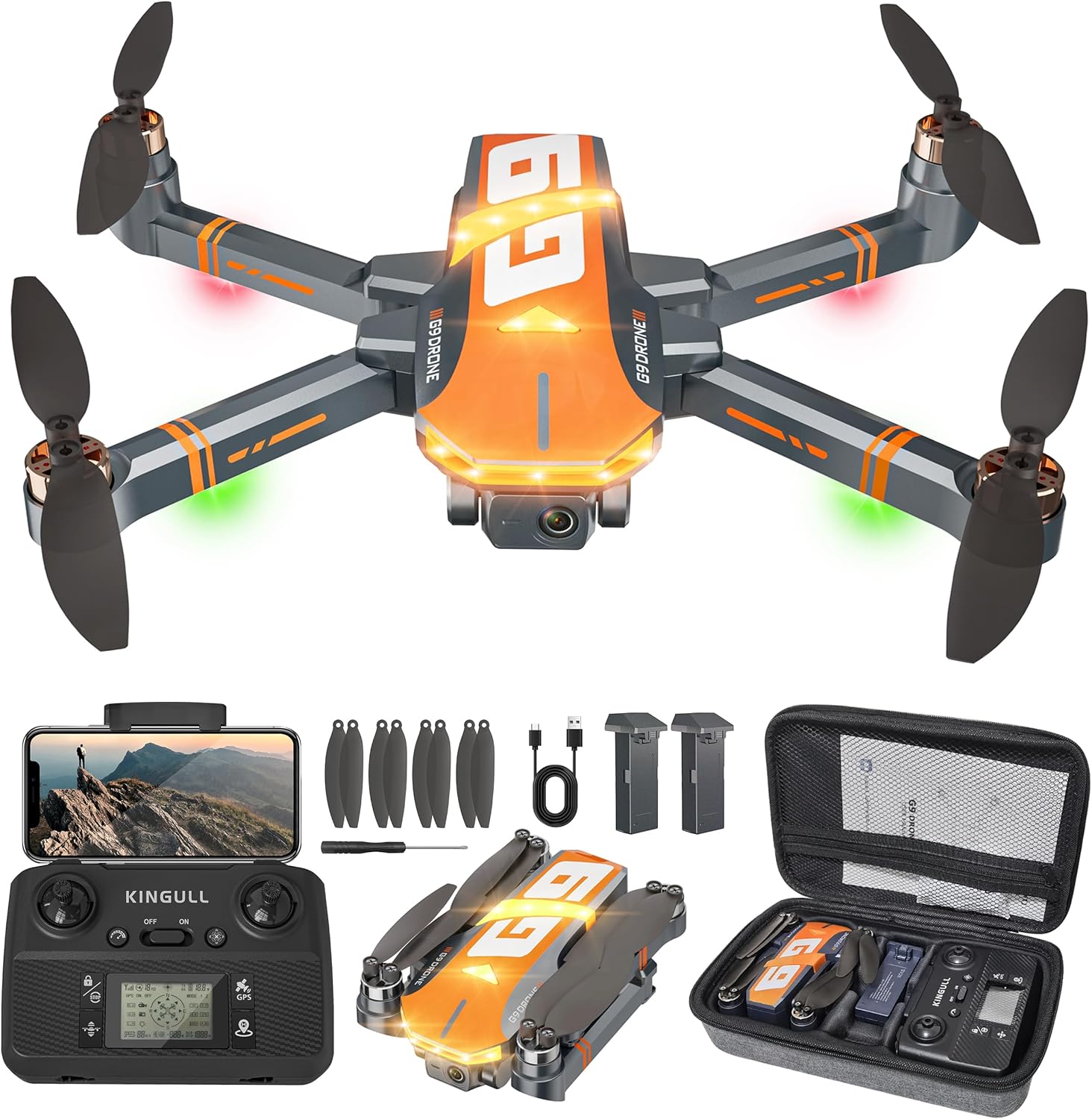
G9 Professional 4K EIS GPS Drones with Camera for Children and Adults, 45 Mins of Flight, Brushless Motor, Wind Resistance, Auto Return, Auto Tracking, 5G Transmission, Less than 249g, C0
ASIN: B0FC2HWYKY
- ✓Two batteries, 4400 mAh in total, for up to 45 minutes of flying
- ✓120-degree wide-angle lens with 12 MP stills and 90-degree tilt
- ✓GPS return plus optical flow, so it also holds a hover indoors
- ✓Automatic tracking, preset routes and orbit modes for video
- Video
- 3840 x 2160
- Stills
- 12 MP
- Field of view
- 120°
- Batteries
- 2 packs, 4400 mAh, up to 45 min
- Positioning
- GPS return, optical flow
- Weight class
- Under 250 g, class C0
Open this product on Amazon
Amazon prices change all the time, so check the current one on the store page. To compare every Amazon store at once, use our browser extension.
TOPBLASTERBOX H11 — a camera drone with a screen on the remote
The H11 puts a 4.5-inch screen on the remote, the largest in this camera drone comparison. It is not a touchscreen and does not need to be: the buttons around it change settings, preview clips and format the card. Video is again 4K through a 120-degree lens with 90-degree electric tilt, stills are 8 megapixels, and two batteries give the same claimed forty-five minutes. Return to home fires on low battery, weak signal or a button press, and the flight modes cover Follow Me, waypoints, point of interest, altitude hold and headless mode. The drone weighs under 249 grams and travels in a supplied handbag.
The H11 collects the most affectionate reviews of the four and the most alarming ones. An Italian owner lists sharp video, a wide adjustable lens, accurate GPS and stable brushless motors, then volunteers his own criticisms: no collision sensors, a screen that is not touch-sensitive, a real resolution below the label. A French buyer flew his drone to 101 metres and liked the automatic landing, the spare propellers and the 8 GB card in the box. A German buyer tested it with a ten-year-old and calls it excellent as a toy and unsuitable for professional work — a fair summary of these drones as a class.
Two failures deserve attention. One French owner's drone stopped responding in flight, the propellers stopped, and it fell into a pond. Another was carried 800 metres by wind, ended in a tree and broke an arm. Several owners also hit a design flaw: the battery in the remote runs down faster than the one in the camera drone. One measured fifteen minutes against the sixty in the manual and now flies with an external battery plugged in. Take the H11 for the big screen and the flight time; avoid it if you cannot live with the small chance of a fly-away.
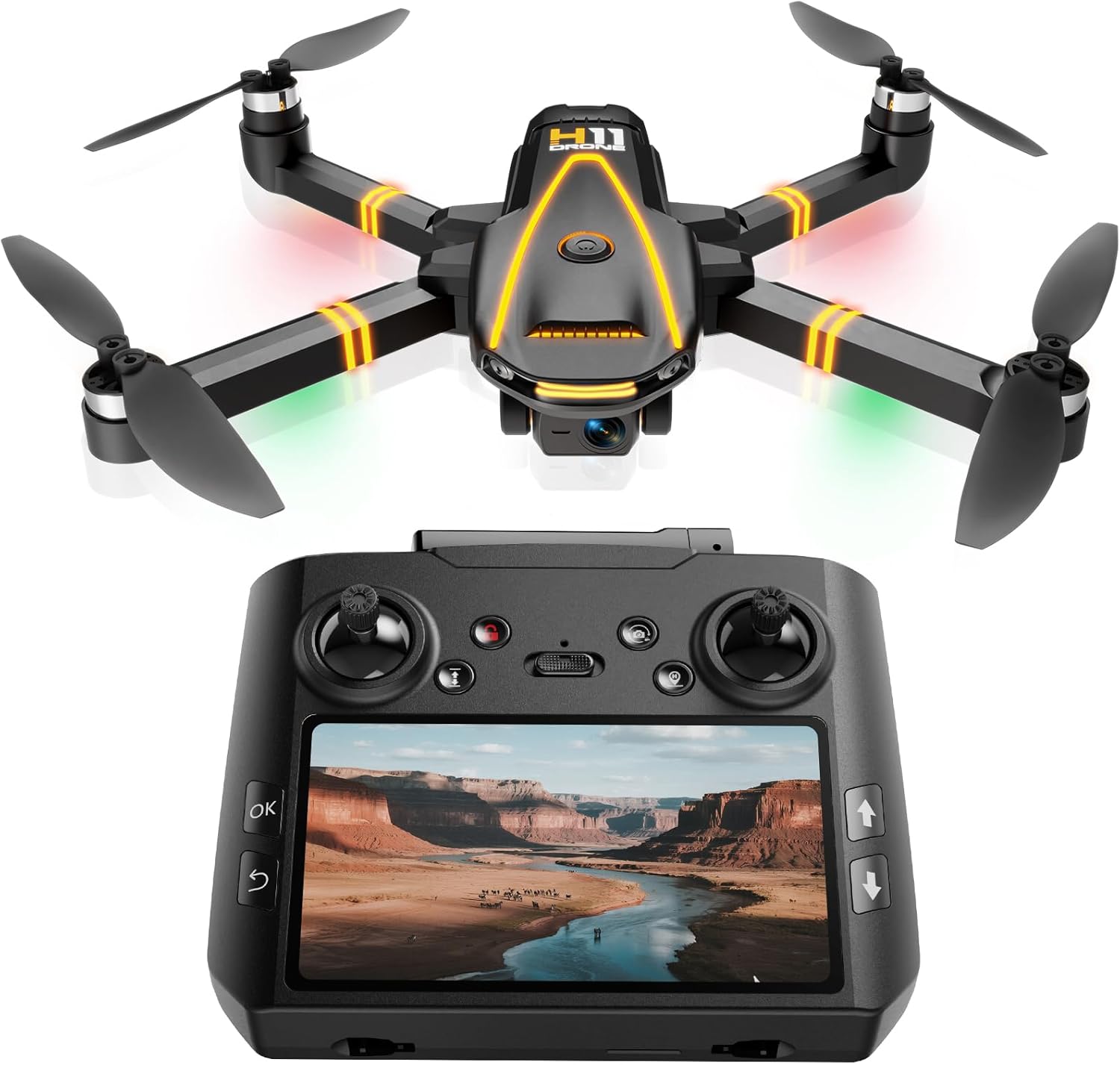
H11 GPS Drones with Camera Professional 4K for Adults (Radio Control with Screen) RC Drones FPV Foldable with Brushless Motor, QuickShots, Long Flight Time, Less than 249g, C0
ASIN: B0FDBCMVC8
- ✓4.5-inch screen on the remote — the biggest here, and no phone needed
- ✓Two batteries for up to 45 minutes, and a carrying case included
- ✓120-degree lens with 90-degree electric tilt, 8 MP stills
- ✓Follow Me, waypoints, point of interest and one-key return
- Video
- 3840 x 2160
- Stills
- 8 MP
- Remote screen
- 4.5 in, not touch
- Batteries
- 2 packs, up to 45 min
- Radio
- 2.4 GHz
- Weight class
- Under 249 g, class C0
Open this product on Amazon
Amazon prices change all the time, so check the current one on the store page. To compare every Amazon store at once, use our browser extension.
SJsharp TT19LCD — a drone with obstacle avoidance instead of GPS
Here the least expensive drone is also the best liked, at 4.2 stars against 3.8 for the other three. The trade shows quickly: the TT19LCD has no GPS and no return-to-home. Instead a second, downward-facing optical-flow camera holds the hover, and a 270-degree obstacle avoidance system keeps the drone off walls and branches. Four propeller guards are fitted, the drone weighs 179 grams, the modular battery slides out for a swap, and a 2.8-inch screen sits on the remote. The camera tilts 90 degrees and records 4K to an SD card of up to 32 GB, which is not supplied.
Owners describe the easiest first afternoon of any of these drones. A French buyer praises detailed images and realistic colour, and says the light frame held its line in wind better than expected. A British owner values the obstacle detection as a beginner and the simple battery swap. A Spanish reviewer calls the 270-degree avoidance the feature that prevents beginners' accidents — then contradicts the French review, because drones this light struggle against moderate gusts. One owner had a serious failure: his drone stopped responding beyond twenty metres and only the emergency stop answered, which without GPS return is the situation to fear.
Pick this camera drone if the flying itself is the point, if most of it happens close by, and if guards and sensors matter more than a rescue function. Anyone planning to send one of these drones out over a valley should stay with GPS.
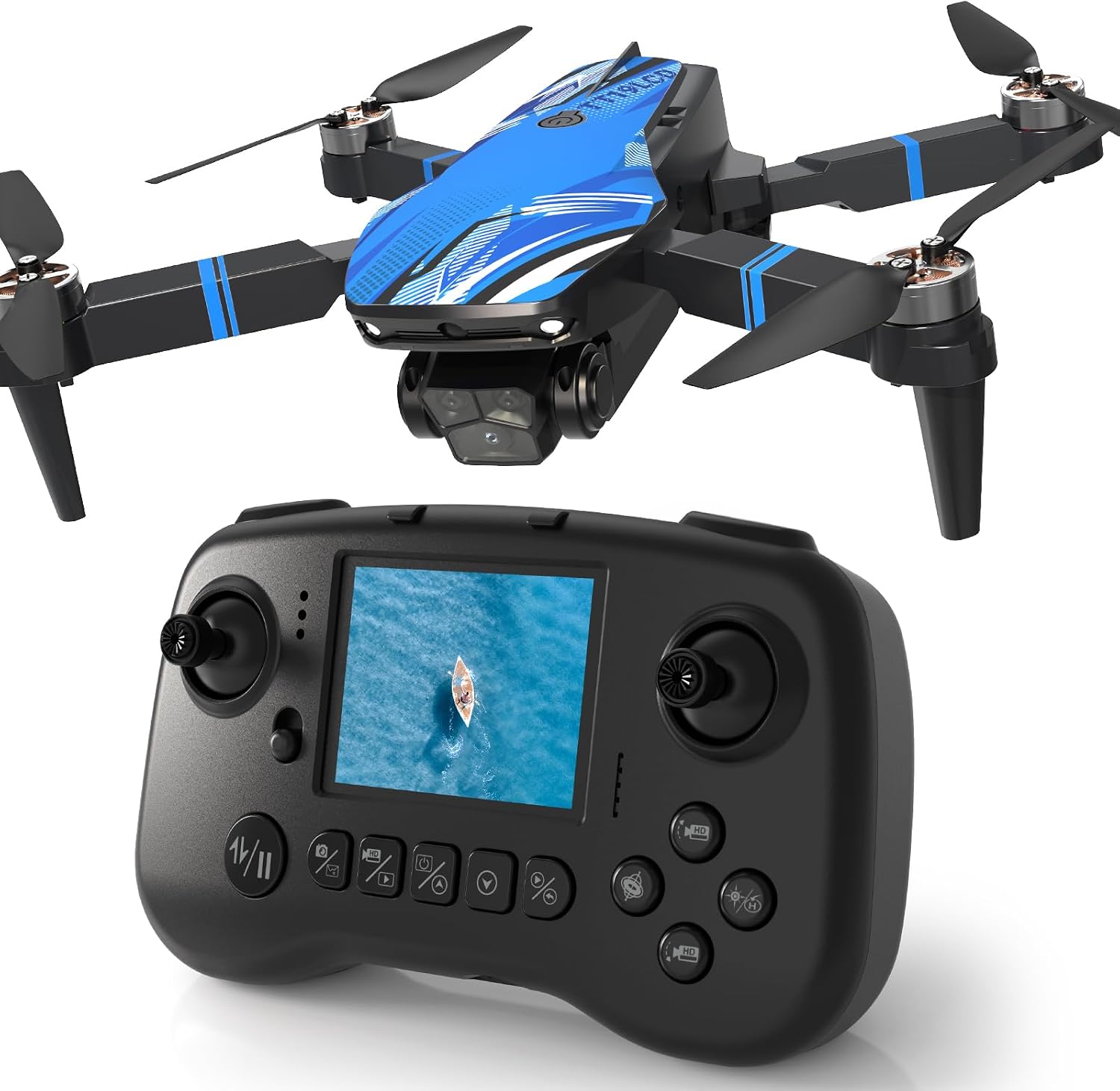
Drone with Camera Mini Drone for Adults 4K LCD Screen Remote Control FPV Video Brushless Motor, 270° Obstacle Avoidance 3D Figures, RC Quadcopter Foldable for Beginners SD Card Up to 32GB
ASIN: B0GRVZMCRS
- ✓270-degree obstacle avoidance and four propeller guards
- ✓Optical flow camera underneath for steady hovering, indoors too
- ✓179 grams, folding arms and a modular battery that swaps in seconds
- ✓2.8-inch screen on the remote and 3D flips from a button
- Video
- 4K, MP4
- Obstacle sensors
- 270°
- Remote screen
- 2.8 in
- Battery
- 1500 mAh, modular
- Weight
- 179 g
- Storage
- SD card up to 32 GB, not included
Open this product on Amazon
Amazon prices change all the time, so check the current one on the store page. To compare every Amazon store at once, use our browser extension.
Camera drone comparison by the numbers
Side by side, the four drones show where each maker spent the budget.
| Parameter | TL16LCD | G9 | H11 | TT19LCD |
|---|---|---|---|---|
| Video on the label | 4K | 3840 x 2160 | 3840 x 2160 | 4K |
| Stills | — | 12 MP | 8 MP | — |
| Camera tilt | 45° | 90° | 90° | 90° |
| Field of view | — | 120° | 120° | — |
| Remote screen | LCD | Built-in display | 4.5 in, not touch | 2.8 in |
| Positioning | GPS, return home | GPS + optical flow | GPS, return home | Optical flow only |
| Obstacle sensors | — | — | — | 270° |
| Batteries supplied | 1 x 2200 mAh | 2, 4400 mAh total | 2 | 1 x 1500 mAh |
| Claimed flight time | Up to 20 min | Up to 45 min | Up to 45 min | — |
| Weight | — | Under 250 g, C0 | Under 249 g, C0 | 179 g |
| Customer rating | 3.8 (168) | 3.8 (183) | 3.8 (260) | 4.2 (129) |
Read the last row against the rest. All four camera drones have a few hundred ratings at most, which is little history for a drone that flies away when it fails. The 4.2 belongs to the newest and lightest of these drones and to the shortest record; the three 3.8 scores come from more owners and include the crashes. A middling average on a fuller listing tells you how often these drones go wrong.
How to choose a beginner camera drone
The specifications that sell these drones are rarely the ones that decide whether you enjoy the first month. Weigh these instead.
- GPS or obstacle sensors. Three of these drones find their way home; one sees what is in front of it. Over open ground, GPS return is what brings a camera drone back; in a garden or a hall, obstacle detection and propeller guards save more repairs.
- Count the batteries, not the minutes. Twenty minutes a pack is the honest number for drones of this size, whatever the box says. Two packs mean an afternoon; one pack means a flight and then a wait.
- Check the remote's own battery. Nobody looks at it, and H11 owners found theirs empty long before the drone's.
- Assume you will buy a memory card. Only one owner here reports a card in the box, and all four drones take a card of up to 32 GB.
- Decide what the video is for. For a holiday clip on a phone screen, any camera drone here is enough. For anything published, none of them is, and no amount of 4K in the title changes that.
- Read the rules where you live. Under 250 grams usually means no licence, and never means no responsibility: operator registration and liability insurance apply in many countries because of the camera on the drone, not its weight.
Frequently asked questions
- Do I need a licence for a camera drone under 250 grams?
- Usually not for the flying itself — the G9 and the H11 are both declared under 250 grams in class C0, and one French owner confirms that class 0 needs no licence in his country. The camera is the complication. A Spanish owner of the G9 had to register as an operator with his national aviation authority, take out liability insurance and check the restricted zones before flying. Rules differ by country, so check yours before the first flight.
- Is the 4K on these drones real?
- Not in the way the listings imply. One owner of the TL16LCD measured the recorded files at 1280 x 720. A Spanish reviewer says the G9 output looks like upscaled 1080p. An Italian owner of the H11 lists its real maximum as 2048 x 1080. The footage is fine on a phone and disappointing on a television.
- Can I fly these drones without a smartphone?
- Yes. All four drones come with a remote that carries its own screen, from 2.8 inches on the SJsharp to 4.5 inches on the H11, and owners rate that as the best feature of the group. One buyer who tried the phone link on the TL16LCD lost the signal at about thirty metres and went back to the remote.
- How do these drones cope with wind?
- All four use brushless motors, which helps, and all four are light enough for a gust to matter. H11 owners report stable flight in a breeze, but one drone was carried 800 metres and broke an arm in a tree. A G9 owner aborted a windy flight deliberately, and another lost his drone to a gust. Owners of the TL16LCD and the TT19LCD disagree about their own models, which tells you the margin is thin.
- What happens if the signal drops?
- On the three GPS drones, return to home starts automatically on lost signal or low battery, and owners say it works — with the warning from one G9 pilot that the route back must be clear of obstacles. The TT19LCD has no GPS and no return function, so a lost link there means flying on sight or using the emergency stop.
Verdict
Every model on the same criteria
Score against price
- Tolatoyus TL16LCD3.6 at about €160
- TOPBLASTERBOX G93.8 at about €94
- TOPBLASTERBOX H113.7 at about €165
- SJsharp TT19LCD3.9 at about €90
The overall score divided by the typical price, with the best in the group as the full bar. A rough guide, not a verdict — a cheap model that misses the feature you need is no bargain.
The bars separate along one line: endurance against everything else. The two TOPBLASTERBOX drones own the flight-time row because they arrive with a spare pack, and they give ground on ease of flying, since both want calibration and a clear sky before the first take-off. The other two are simpler to start and shorter in the air. No drone here scores well on picture, and the gaps between the four are small enough that no buyer should pick a camera drone on that row alone.
The TL16LCD is the safe entry point in this camera drone comparison: forgiving, quiet, quick to understand, and honest about everything except its camera. The G9 is the drone for a long walk, with two batteries and a wider lens, provided you accept a start-up routine. The H11 has the biggest screen and the fullest set of flight modes, and its owners are both the most enthusiastic and the most badly burned. The SJsharp is the outsider of these four drones — better rated, cheaper, safer near obstacles, and without the GPS rescue the other three rely on.
Choose between these camera drones by how you intend to fly rather than by the resolution on the box. Two batteries, a remote that stays charged and a return function you trust decide whether the camera drone comes back; the pixel count only decides how the memory looks.