Cuff first, app second: four home blood pressure monitors compared
Blood pressure monitors under €50
A blood pressure monitor is rarely an impulse buy. Something prompts it: a doctor asks for two weeks of readings taken at home, a parent turns seventy and the family wants a record, a repeat prescription starts. Then the search results arrive and every blood pressure monitor looks the same — a cuff, a plastic case, a screen with three figures on it.
The differences are real, but they hide where the photographs do not reach. How wide an arm the cuff will close around. How many readings the monitor's memory keeps, and whether two people can share one without mixing their records. Whether the figures travel to a phone by themselves or have to be copied by hand. And how large the digits are for someone reading them without glasses.
This blood pressure monitor comparison puts four upper arm blood pressure monitors side by side. The Beurer BM 48 sends its figures to a phone by itself. The Beurer BM 27 is the plainest and by far the most reviewed home blood pressure monitor of the family, and the closest of the Beurer BM 48 alternatives here. The A&D Medical UA-611 is the smallest of these monitors and the one guaranteed for five years. The Aidisy U81CH is built around a four-inch backlit screen, the largest display of the four monitors. All four are inexpensive devices — in most stores each one stays under $60, and the group sits near $40 — so the choice is about fit, memory and screen rather than about budget classes. Every specification comes from the listings and every opinion from owners. Nothing here explains what a reading means — that conversation belongs with a doctor, and none of these monitors diagnoses anything.
Models in this comparison
Typical price across these models: about €35. Rough figures from store prices converted at fixed rates: what you pay also depends on the store and the region you order from. With our browser extension you can compare every Amazon store at once, right on the product page.
Beurer BM 48 — the blood pressure monitor with app transfer
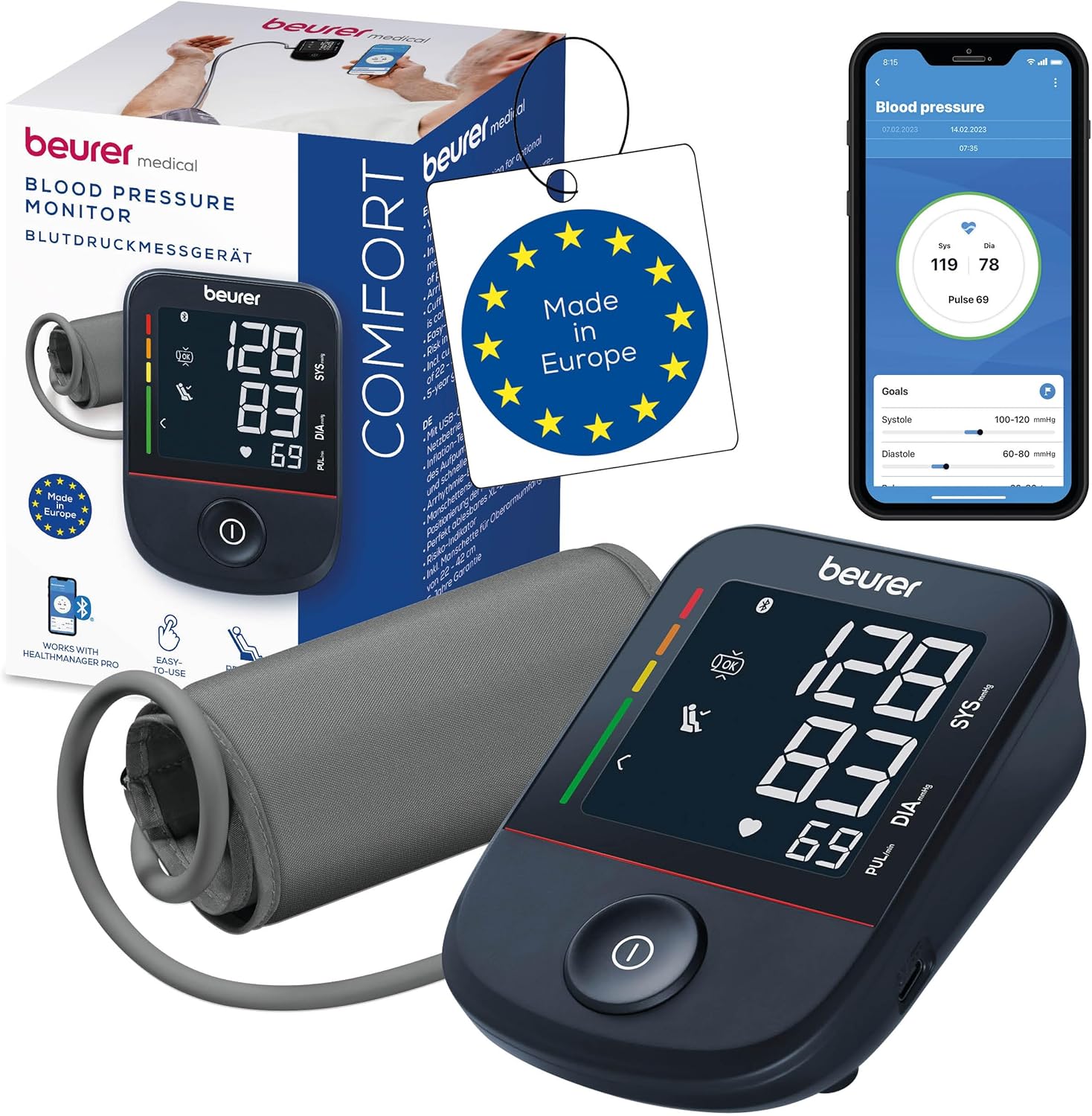
Beurer BM 48 Arm Blood Pressure Monitor, Simple One Button Operation, Gentle and Fast Measurement, Arrhythmia Detection, Cuff 22-42cm, with App, Apple Health Data Transfer
ASIN: B0DPMP7HDX
- ✓One button starts everything: no menus to learn before the first reading
- ✓Bluetooth sends the figures to the Beurer HealthManager Pro app on their own
- ✓That app syncs on to Apple Health, Samsung Health and Health Connect
- ✓Cuff position control and a rest indicator, both meant to catch a bad setup
- ✓Cuff closes on arms from 22 to 42 cm, the widest range in this group
- Worn on
- Upper arm
- Cuff range
- 22-42 cm
- Phone link
- Bluetooth, automatic transfer
- Heart rhythm
- Arrhythmia detection
- Power
- 4 AAA batteries, included
- Weight
- 500 g
- Menu languages
- Dutch, French, German, Italian, Spanish
- Made in
- Hungary
The selling idea of the BM 48 is that you never write anything down. One large button wakes the monitor, inflates the cuff and finishes the job; the reading goes over Bluetooth into Beurer's HealthManager Pro app, which passes it on to Apple Health, Samsung Health or Health Connect. Two features target the part people get wrong, which is the setup rather than the monitor: a cuff position control that objects when the band sits badly, and a rest indicator. The maker also says the reading is taken while the cuff is still inflating.
The band covers arms from 22 to 42 cm, the widest range among these monitors. Four AAA batteries come in the box, the monitor weighs 500 g, and its menus are offered in five languages.
The praise from owners is consistent, and it is about convenience. Several Italian owners of this monitor describe the same routine: press once, watch the reading appear, then find it already filed on the phone. One owner calls the inflation of this monitor gentle rather than uncomfortable. Another values the arrhythmia warning and the position sensor together, saying the blood pressure monitor tells her when the band is on wrong before it wastes a measurement. A German owner who uses it regularly gives four stars for the large, readable display and the speed; his reservation is that the cuff has to sit precisely, which takes practice, and that the build feels functional rather than expensive. Short reviews from Sweden and Belgium say the same in fewer words: easy, quick, works.
Two Italian owners describe a USB-C port on their monitors and treat it as the biggest improvement over older monitors. The listing quotes four AAA batteries and nothing else, so check the package before you throw the cells away.
The complaints are the reason this is not a five-star blood pressure monitor, and they cluster on one thing. A three-star review says this monitor's readings are not trustworthy. A one-star owner from Italy reports errors on roughly half his attempts and, on the readings that did complete, differences of up to forty points between one and the next; he gave up after four days. A two-star review describes a low-battery symbol that appeared with the supplied cells, stayed with a fresh set and stayed again after a USB charge, and separately found the pairing confusing: the one-button design means the cuff starts inflating the moment you press, which interrupts the attempt to connect. These are accounts of individual units rather than a verdict on the monitor, but they are specific enough to keep the receipt for a fortnight.
Pros
- One button from start to finish, which suits an owner who dislikes menus
- Readings reach the phone with no typing, then pass on to Apple or Samsung health apps
- Cuff position control and arrhythmia detection both named by owners as useful
- Large digits, called clearly readable by a German owner
- Cuff spans 22 to 42 cm, so large arms are covered
Cons
- Several owners question the consistency of the figures they get
- One owner reports frequent errors and readings far apart from each other
- A two-star report of a battery warning that no new cells would clear
- Pairing is awkward because pressing the only button starts a measurement
- The band needs a precise position, which one owner says takes practice
Take this monitor if the phone record is the point of buying one at all — if a doctor wants a fortnight of readings and you would rather not keep a paper diary. Skip it if you want the simplest of these monitors, with no app near it, or if the reports above make you want a longer track record than 616 ratings.
Cuff range: the specification that rules monitors out fastest
Nothing else on the box matters if the band will not close properly, and this is where these monitors genuinely part company. Three of them are a blood pressure monitor with a large cuff, taking arms from 22 to 42 cm. The A&D Medical stops at 32 cm, which is a normal adult arm.
Owners feel that difference straight away. An Italian buyer of the BM 27 says he replaced an older monitor because he thought it was broken, and the real problem was the band: his arms are heavy, the new cuff wraps almost twice round, and the readings became repeatable. From the other side, an owner in India who has used the UA-611 for six months warns that the monitor's cuff feels small and that anyone with larger arms may find it uncomfortable or get an unreliable figure. He is describing the specification, not a fault.
Measure the arm before choosing anything else. A tape around the bare upper arm, halfway between shoulder and elbow, settles which of these monitors are even candidates. The second question is who else will use the monitor. The BM 27 keeps 30 readings each for four people, the Aidisy keeps 199 each for two, and the UA-611 keeps 30 in total with no user split, which is fine for one person and awkward for a couple.
Beurer BM 27 — the plain monitor that 31,000 people have rated
The BM 27 is the Beurer monitor without the automatic Bluetooth transfer: the app records readings through a "Scan and Save" function, which means holding the phone up to the display rather than pairing anything. Everything else on this monitor is present and in places better. The memory holds 4 x 30 readings across four users, so a household does not share one list. The universal cuff covers 22 to 42 cm. A position check signals when the band is too loose or too tight. Arrhythmia detection is there, alongside a colour-coded scale that the listing describes as a help in sorting readings — the maker also prints the instruction to rest for five minutes before the first measurement, or figures may drift. Beurer calls this a clinically validated medical device and quotes a three-year warranty; four AA cells, the cuff and a case are in the box.
Owners are the strongest argument for this blood pressure monitor. A Spanish buyer using it daily for weeks praises the large, clear screen, the adjustable band and the arrhythmia alert, and reports that the transfer into Apple Health makes results easy to share with her doctor. An Italian owner says the position check is the feature that changed things for him, because it flags a bad fit immediately, and adds that his figures line up with those his own doctor takes. Another describes the blood pressure monitor as simple, quiet, quick and repeatable, with an Italian manual in the box. A Swedish owner sums it up as easy to use with a good display.
The reservations are small and worth knowing. A three-star review calls this monitor basic — accurate, well made, CE marked, but minimal in features — and names one genuine annoyance: rechargeable cells are slightly larger than alkalines and do not fit the battery slot properly. If you were planning to run it on rechargeables, plan again.
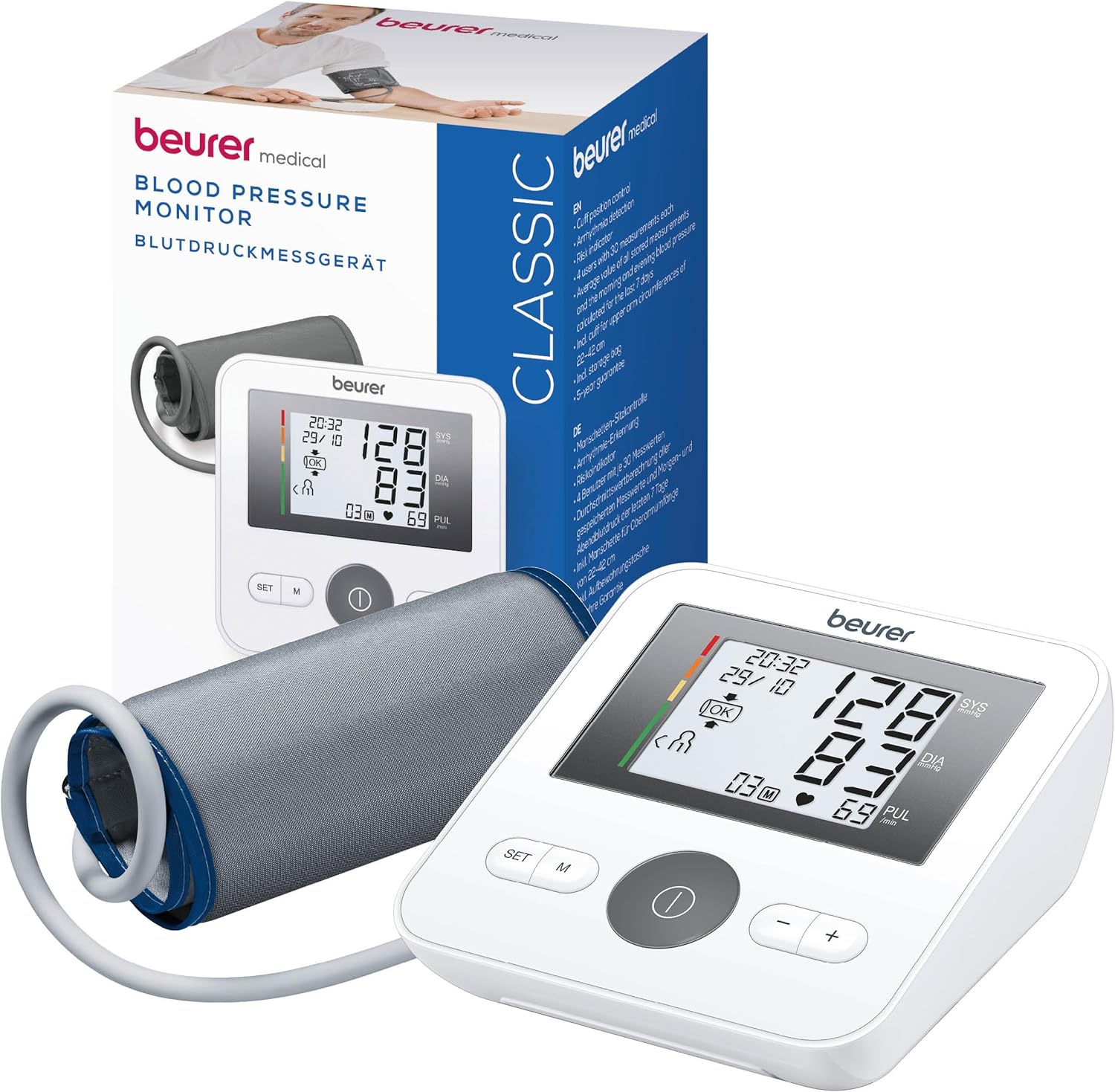
Beurer BM 27 Arm Blood Pressure Monitor with Cuff Position Control, Clinically Validated, Armband 22-42cm, Risk Indicator, Arrhythmia Detection, Apple Health Data Transfer
ASIN: B01B4PKQL2
- ✓4 x 30 memory slots, so four people keep separate records
- ✓Universal cuff for arms from 22 to 42 cm
- ✓Position check warns when the band sits too loose or too tight
- ✓Described by the maker as a clinically validated medical device
- ✓Readings copied into the app by scanning the screen, no pairing needed
- Worn on
- Upper arm
- Cuff range
- 22-42 cm
- Memory
- 4 users x 30 readings
- Display
- LCD
- Phone link
- Scan and Save into the maker's app
- Power
- 4 AA batteries, included
- Warranty
- 3 years
- In the box
- Monitor, cuff, case, batteries, manual
Open this product on Amazon
Amazon prices change all the time, so check the current one on the store page. To compare every Amazon store at once, use our browser extension.
A&D Medical UA-611 — the small monitor guaranteed for five years
Fifty thousand ratings and a 4.5 average make this the most tested blood pressure monitor here, and its shape differs from the rest: small, 300 g, latex-free and supplied with a protective case. The listing keeps the feature list short — an irregular heartbeat sensor, an average calculated across measurements, memory for 30 readings, and a claim of clinical validation after testing by healthcare organisations. The guarantee runs five years, the longest here by two. This monitor has no Bluetooth and no app; the numbers stay on the screen until someone writes them down.
Owners like this monitor for exactly that plainness. An Italian reviewer lists the strengths and the weaknesses in one breath: one-button operation, a clear display showing all three figures, an irregular-beat warning, the built-in scale he calls a WHO indicator, 30 slots of memory, batteries included and five years of cover — against no Bluetooth, so everything is logged by hand, and a standard-size band. Buyers in Ireland, Australia and the United Arab Emirates describe the monitor as compact, easy and exactly what they needed. A Swedish owner offers the most concrete comparison in the whole group: he calls an ambulance from time to time, and says the figures on his own monitor match the ones the crew takes.
Two owner reports pull the other way. An Italian three-star review says readings from this blood pressure monitor were 30 to 40 lower than a measurement taken in a pharmacy minutes afterwards. The Indian owner quoted earlier gets quick, consistent readings but finds the plastic body less solid than pricier brands and returns to the cuff: check it fits before buying. Those are individual experiences, not a test result, and both point at the same step: compare home monitors against a professional reading once, early, and mention any difference to your doctor.
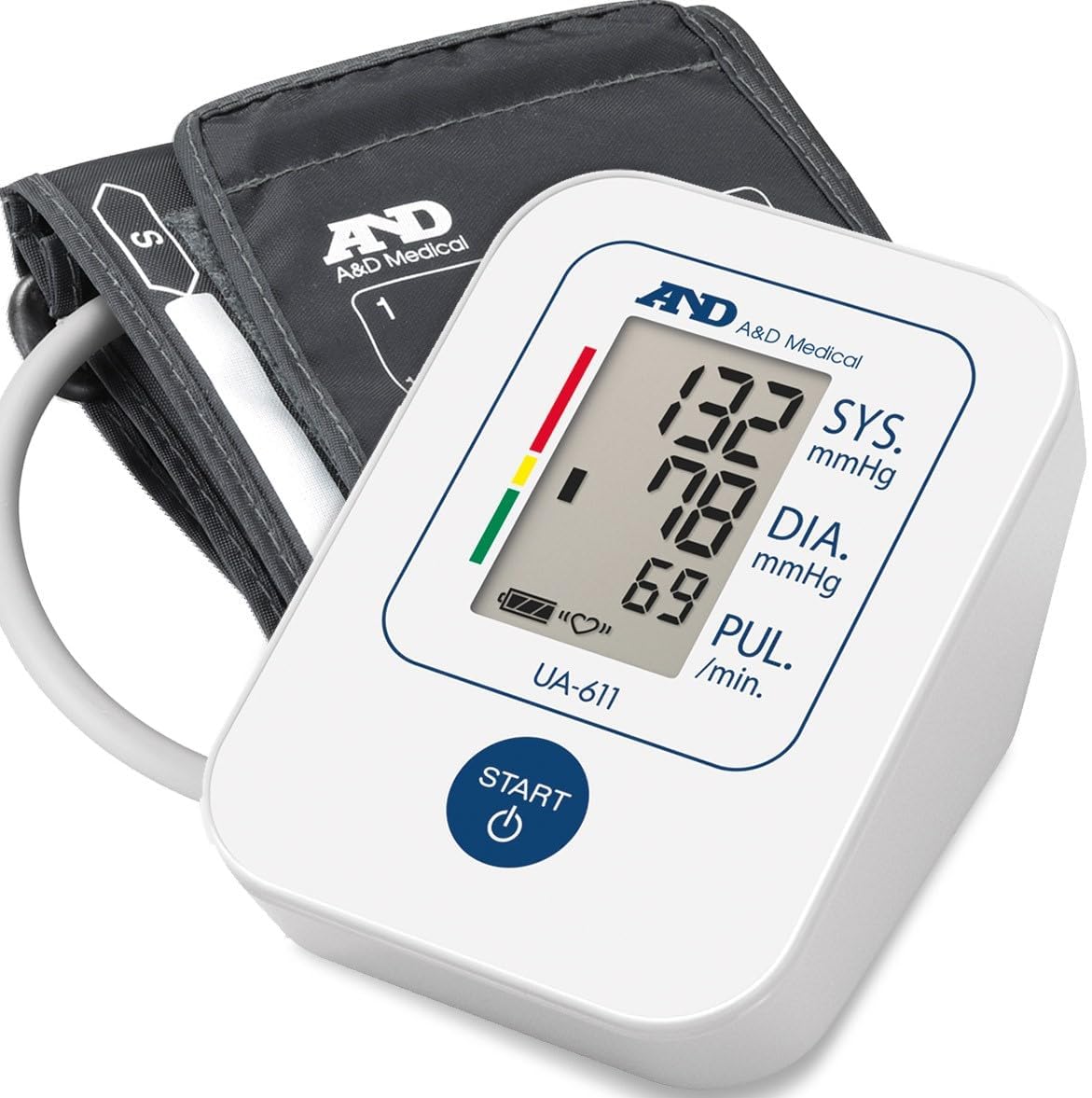
A&D Medical UA-611 Digital Arm Blood Pressure Monitor – Clinically Validated Automatic Pressure Monitor
ASIN: B00JQ7SZLO
- ✓Five-year product guarantee, the longest cover in this group
- ✓Averages several measurements instead of showing only the last one
- ✓Irregular heartbeat sensor and a listing claim of clinical validation
- ✓Compact and light, with a protective case in the box
- ✓No app and no pairing: readings stay on the screen
- Worn on
- Upper arm
- Cuff range
- 22-32 cm
- Memory
- 30 readings
- Display
- Digital, latex-free cuff
- Phone link
- None
- Weight
- 300 g
- Warranty
- 5 years
- In the box
- Monitor, cuff, batteries, manual
Open this product on Amazon
Amazon prices change all the time, so check the current one on the store page. To compare every Amazon store at once, use our browser extension.
Aidisy U81CH — the blood pressure monitor with a large display
The Aidisy answers a question the other monitors barely address: what if the person using it cannot read small figures? The screen is a four-inch backlit LED panel with large digits and a six-colour display, and the listing says an anti-glare layer keeps the numbers legible at night as well as in daylight. Memory runs to 398 readings, split as 199 each for two users, which is more storage than the rest of these monitors put together. The band on this monitor covers 22 to 42 cm, and the maker describes a compression system meant to reduce the discomfort of over-inflation. Power is the other difference: four AA cells or the supplied Type-C cable, so this monitor can run from a laptop socket, a car charger or a power bank rather than needing a wall socket.
The reviews back the screen claim more than anything else. An Italian owner says the display reads perfectly without glasses. Another calls the backlit panel clear in a dimly lit room and the two-user memory genuinely useful. A French owner reports comparing this blood pressure monitor against his doctor's and finding the values reliable; another Italian owner says the same about readings taken at a surgery. Owners in Germany, Belgium and Spain add short confirmations, and one Spanish buyer reports the monitor still working properly after a year. Several say one button is all their older relatives need to manage.
This monitor's gaps are the ones you would expect at the price. No app and no Bluetooth, so nothing is transferred anywhere. No claim of clinical validation in the listing, unlike both Beurer monitors and the A&D. And one owner's only complaint is that no protective case is included, which for a monitor this size is fair — the other three monitors all travel better.
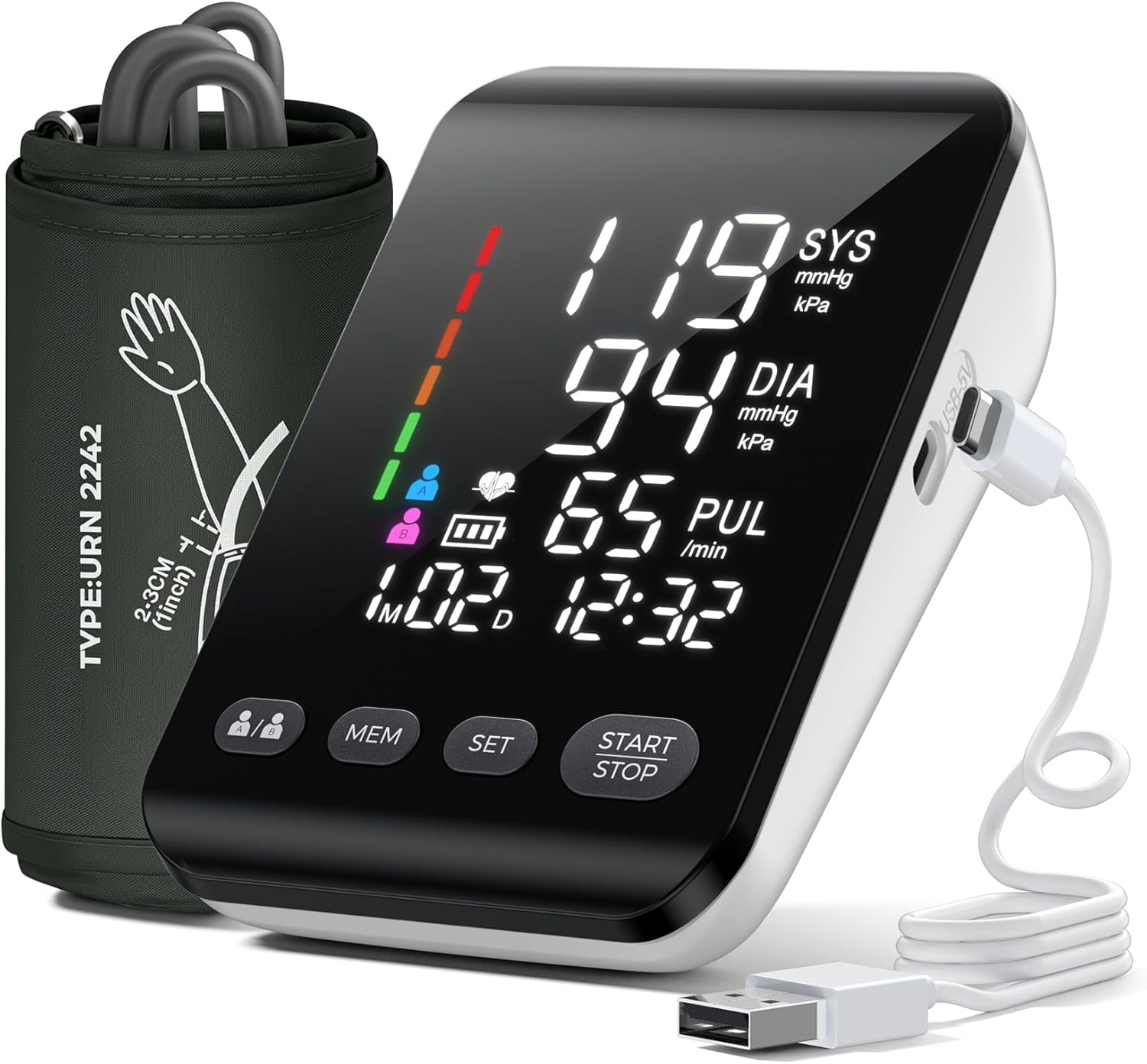
Blood Pressure Monitor Arm Blood Pressure Monitor with High Resolution LED Backlit Screen, for Arm Circumference 22 to 42 cm, Memory of Two Users 2 x 199
ASIN: B0CYSHRKHY
- ✓Four-inch backlit LED screen with large digits and a six-colour display
- ✓398 stored readings, 199 each for two separate users
- ✓Runs from four AA cells or the supplied USB-C cable
- ✓Cuff fits arms from 22 to 42 cm
- ✓Maker quotes a compression system to soften the inflation
- Worn on
- Upper arm
- Cuff range
- 22-42 cm
- Memory
- 2 users x 199 readings
- Display
- 4-inch backlit LED, six colours
- Phone link
- None
- Power
- 4 AA batteries or USB-C cable
- Weight
- 470 g
- In the box
- Monitor, cuff, USB-C cable, manual
Open this product on Amazon
Amazon prices change all the time, so check the current one on the store page. To compare every Amazon store at once, use our browser extension.
Blood pressure monitor comparison by the specifications
Four blood pressure monitors are hard to hold in your head at once. In one table the pattern across these monitors shows.
| Parameter | Beurer BM 48 | Beurer BM 27 | A&D UA-611 | Aidisy U81CH |
|---|---|---|---|---|
| Cuff range | 22-42 cm | 22-42 cm | 22-32 cm | 22-42 cm |
| Memory | — | 4 users x 30 | 30 readings | 2 users x 199 |
| Display | — | LCD | Digital | 4-inch backlit LED |
| Phone link | Bluetooth, automatic | Scan and Save | None | None |
| Arrhythmia alert | Yes | Yes | Yes | — |
| Cuff position check | Yes | Yes | — | — |
| Validation claimed | — | Clinically validated | Clinically validated | — |
| Power | 4 AAA cells | 4 AA cells | Batteries included | 4 AA cells or USB-C |
| Warranty | — | 3 years | 5 years | — |
| Case included | — | Yes | Yes | — |
| Customer rating | 4.2 (616) | 4.5 (31,137) | 4.5 (50,001) | 4.4 (2,140) |
Two rows of these monitors deserve a second look. The validation row is not a quality ranking — it records which listings make the claim and which stay silent, and silence may only mean the seller never wrote it down. The rating column has to be read with the count beside it: 4.2 from 616 people and 4.5 from 50,001 are not the same kind of evidence, and the youngest of these monitors is also the one with the sharpest complaints against it.
How to choose a blood pressure monitor for your household
Five questions separate these monitors faster than any specification sheet.
- Measure the arm first. It is the only figure that can disqualify one of these monitors outright, and the gap between a 32 cm limit and a 42 cm one is the gap between a usable purchase and a returned parcel.
- Decide whether the numbers must reach a phone. Automatic Bluetooth transfer is a real convenience if a doctor asked for two weeks of records, and dead weight if nobody in the house will open the app. Two of these monitors offer nothing of the kind and their owners do not seem to miss it.
- Count the users of these monitors. One person with 30 slots is fine. Two people sharing 30 slots is a mess. Four separate lists, or 199 each, remove an argument that otherwise happens every evening.
- Look at the screen the way the actual user will. A four-inch backlit panel exists because somebody's mother could not read the alternative. If the person taking the readings wears glasses to read, that row of the table matters more than the app row.
- Read the guarantee, not the brand. Five years is meaningfully different from three, and two of these monitors quote no warranty at all, which leaves you with the shop's return window and nothing else.
One thing worth saying plainly: a wrist wearable is not a substitute for a blood pressure monitor. It tracks a pulse, but it does not put a cuff on your arm, and the cuff is what a doctor asked for.
Frequently asked questions
- What does 'clinically validated' mean on these listings?
- It is a claim made by the seller, not a figure you can compare. Beurer describes the BM 27 as a clinically validated medical device and A&D Medical says the UA-611 passed testing by healthcare organisations. The other two listings do not use the phrase. If validation matters to you, ask the maker which protocol they mean before buying.
- Why does my reading differ from the one at the surgery?
- Owners report it in both directions. One Italian buyer measured 30 to 40 lower at home than in a pharmacy minutes later, while owners of the BM 27 and the Aidisy say their figures match what their doctor records. Take the monitor to an appointment once, compare the two readings side by side, and let your doctor tell you what the difference means.
- Do any of these monitors run without batteries?
- The Aidisy takes four AA cells or the USB-C cable supplied with it, so it can be powered from a laptop or a car charger. The three others are battery monitors with cells in the box. Note that one Beurer BM 27 owner found rechargeable cells slightly too large for the compartment.
- Which of these monitors suits an older relative living alone?
- The specifications point at the Aidisy for its four-inch screen and one-button operation, and several owners bought it for that reason. The Beurer BM 27 is the alternative with the longer record behind it and a cuff position check that objects when the band is on wrong.
- Can two people share one blood pressure monitor?
- The BM 27 keeps four separate lists of 30 readings and the Aidisy keeps two lists of 199, so both handle a couple without confusion. The UA-611 keeps 30 readings with no user split, which means one person's figures sitting among another's.
- Is the widest cuff always the better choice?
- Not automatically — a band sized 22 to 42 cm still has to sit correctly on a slim arm, and owners of the BM 48 mention that the position needs care. But a 32 cm limit is a hard ceiling, so if the arm measures anywhere near it, the wider band removes the risk.
Verdict
Every model on the same criteria
Score against price
- Beurer BM 483.8 at about €45
- Beurer BM 274.5 at about €29
- A&D UA-6114.4 at about €25
- Aidisy U81CH4.2 at about €40
The overall score divided by the typical price, with the best in the group as the full bar. A rough guide, not a verdict — a cheap model that misses the feature you need is no bargain.
Read the bars as trade-offs, not as a ranking. No monitor here leads everywhere: the one that sends readings to a phone by itself carries the shortest record and the sharpest complaints, the two monitors with tens of thousands of ratings do the least with a phone, and the monitor with the largest digits makes no validation claim at all. Three of the four take arms up to 42 cm, so the cuff separates only one monitor from the rest — after that the differences are about memory, screen and guarantee, and each of those matters to a different household.
Measure the arm, count the people who will use the monitor, and decide whether the figures need to leave it. Those three answers pick your blood pressure monitor; everything else on these listings is detail.