Air purifier for allergies: does a 3-in-1 tower beat a quiet HEPA box?
Air purifiers under €800
People rarely buy an air purifier out of curiosity. Something changes first: a cat moves in, a child starts sneezing every morning, the road outside gets busier, or a pollen season drags on for six weeks. The idea behind these purifiers is simple — a fan draws room air through a filter and pushes it back out — yet they run from a two-kilogram box to a tower that also heats the flat in January.
The listings make the decision harder than it should be. The purifiers all print HEPA, a filtration percentage and a room size in square metres, and those numbers are not measured the same way from one brand to the next. Only one purifier in this group states a CADR figure, the volume of clean air delivered per hour, which is the number that genuinely ties a purifier to a room. The other purifiers ask you to trust the square metres.
This air purifier comparison lines up four purifiers that answer four different questions, taken in the order their prices put them. First a small Philips that does nothing but clean air and does it on twelve watts, then a three-in-one purifier from Rowenta, then a Dreame built around cat and dog hair, and last the Dyson Purifier Hot+Cool HP1, which tries to be a filter, a fan and a heater at once. The spread between them is wide, though in most stores each one stays under $820, and the group sits near $510. Every specification comes from the listings, every opinion from people who own these purifiers, and the cards hold the full parameters along with the per-store Amazon prices.
Models in this comparison
Typical price across these models: about €448. Rough figures from store prices converted at fixed rates: what you pay also depends on the store and the region you order from. With our browser extension you can compare every Amazon store at once, right on the product page.
Philips 600 Series, a quiet air purifier for a bedroom
The Philips is the cheapest purifier of the four and the only one that does a single job. The numbers behind that job are the strongest here: 44 m² of coverage, a CADR of 170 m³ per hour, and NanoProtect HEPA filtration rated at 99.97% of particles as small as 0.003 microns, which Philips says moves up to twice the air of a conventional H13 filter. This purifier draws at most 12 watts, runs at 19 dB in sleep mode with the display dimmed, weighs 2.2 kg and stands 34 cm tall — a compact air purifier light enough to carry from a bedroom to a study. The Air+ app switches it on, changes speed and reports filter status, and the model is Energy Star certified, carries a two-year warranty and sits third in Amazon's air purifier bestseller list.
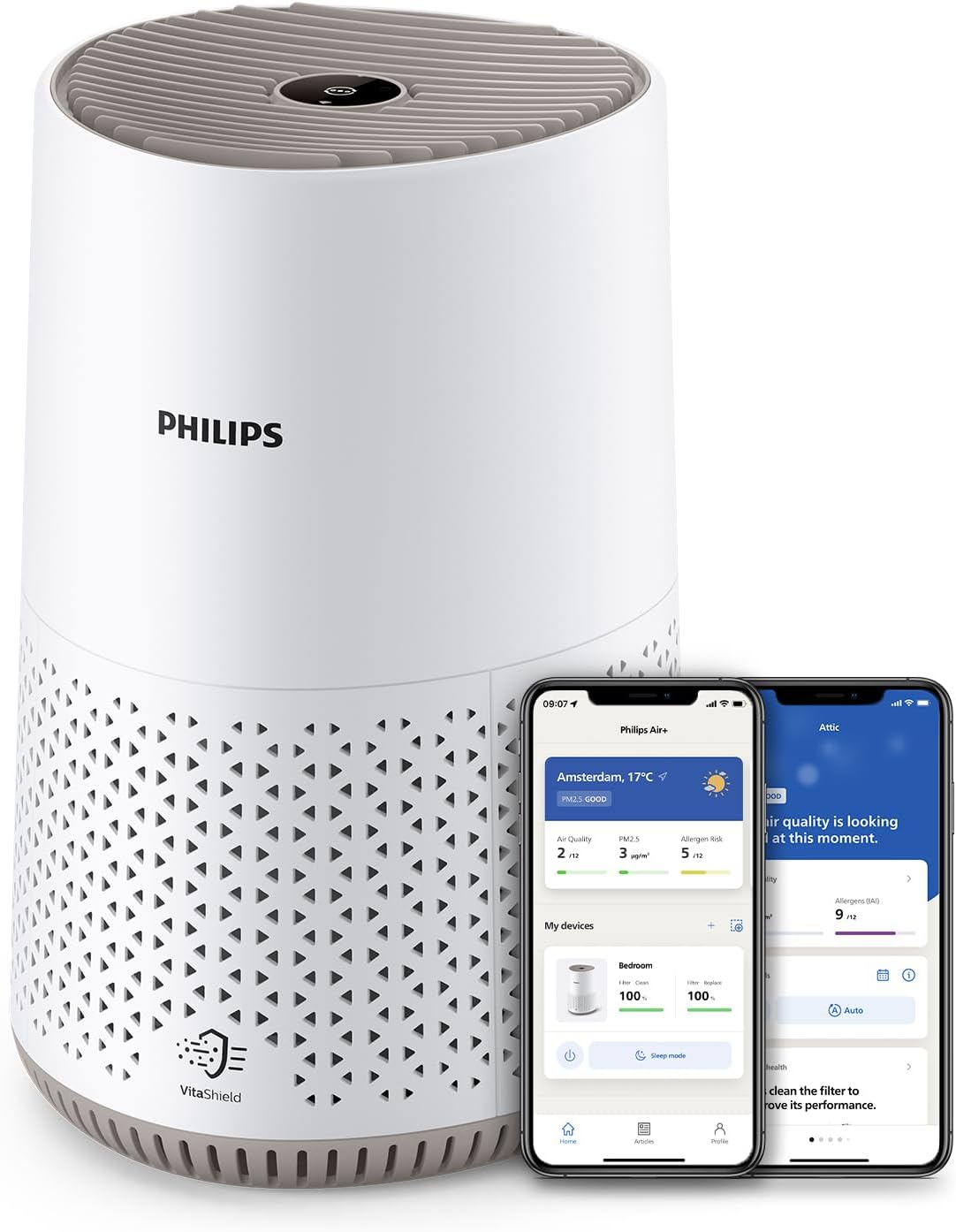
Philips Air Purifier 600 Series, HEPA Filter, App-Controlled, White (AC0650/10)
ASIN: B0BX49FQF8
- ✓Covers rooms up to 44 m² with a CADR of 170 m³ per hour
- ✓NanoProtect HEPA rated at 99.97% of particles down to 0.003 microns
- ✓Runs on 12 watts at most and carries Energy Star certification
- ✓19 dB in sleep mode with the display dimmed for a dark bedroom
- ✓Compact at 34 cm tall and 2.2 kg, with Air+ app control
- Room size
- 44 m²
- CADR
- 170 m³/h
- Particle size
- 0.003 micron
- Noise level
- 19 dB, sleep mode
- Power
- 12 W maximum
- Size
- 24.3 × 23.7 × 34.1 cm
- Weight
- 2.2 kg
- Warranty
- 2 years
With 3,590 ratings at 4.3, this is by far the most tested purifier here, and the reviews are unusually consistent, with silence leading them: one German owner runs the purifier around the clock and reports no coil whine at all, while another calls the sleep mode inaudible. The most useful review comes from parents of a son with a dust mite allergy: they schedule turbo before bedtime, whisper mode overnight and medium before waking, and report that his morning sneezing has clearly eased. An asthmatic buyer describes a severe pollen year in which this purifier made indoor rooms bearable, then bought a second one for work. An owner two months in says the dust in her flat is visibly reduced. A French owner praises the sensor that raises and lowers fan speed on its own, and an Italian owner calls the purifier a sound alternative to better-known brands.
Pros
- Covers the most floor of these purifiers, and backs the figure with a CADR
- Silent in sleep mode: owners run it all night without hearing it
- Twelve watts at most, so leaving it on costs almost nothing
- Light and small enough to move from room to room
- Thousands of ratings behind its average, not dozens
Cons
- Filtering only: no heating and no fan mode
- The 44 m² figure assumes one room with the door shut
- Replacement filters are a running cost, as on all four purifiers
Rowenta Eclipse QU5062, a 3-in-1 air purifier and heater
The Rowenta chases three jobs at once — filtering, moving air and warming a room — with different engineering from the Dyson at the end of this list. Filtration is rated at 99.9% of particles down to 0.1 microns, with an external laboratory test from 2022 behind a claim of up to 99% of H1N1 viruses. Heating comes from a 2,100-watt ceramic element that lifts a room to 35 °C and cuts out if it overheats. The fan is the strongest on paper of all four purifiers, pushing 358 litres a second at 2.2 m/s with a stated reach of eight metres, across twelve speeds and an oscillation you set at 30, 60 or 90 degrees. A thermostat runs the automatic day and night mode, and Rowenta promises fifteen years of spare part availability, the only such commitment here.
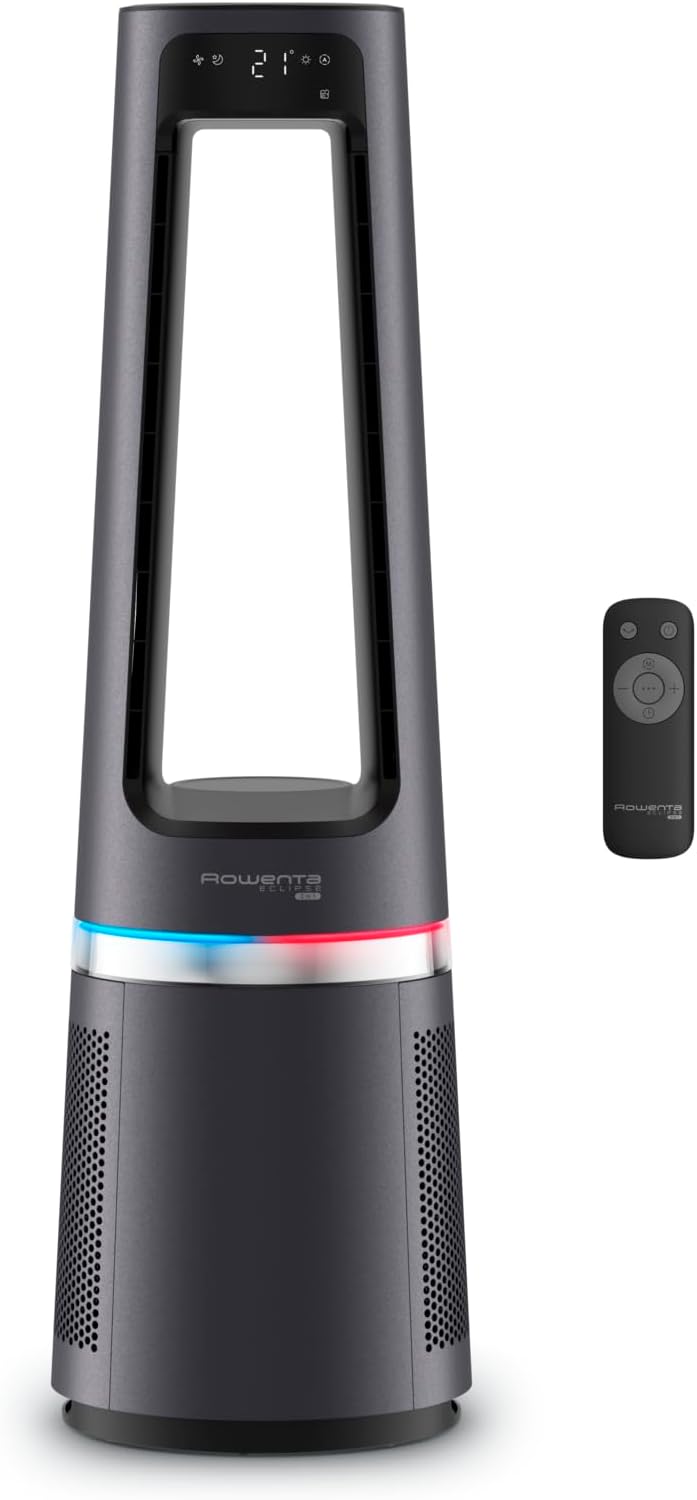
Rowenta Eclipse 3-in-1 Air Purifier, Fan and Heater QU5062
ASIN: B0B9HMMPKV
- ✓Filters 99.9% of particles to 0.1 microns and up to 99% of H1N1 viruses in lab testing
- ✓Ceramic heating of 2,100 W reaches 35 °C with automatic overheat cut-off
- ✓358 litres a second at 2.2 m/s, with a stated reach of eight metres
- ✓Twelve speeds, oscillation at 30, 60 or 90 degrees and an optional ambient light
- ✓Fifteen years of spare part availability stated for the EU
- Room size
- 30 m²
- Particle size
- 0.1 micron
- Heating
- Ceramic, 2,100 W, up to 35 °C
- Airflow
- 358 l/s, oscillation to 90°
- Noise level
- 31 dB(A) at minimum
- Speeds
- 12
- Size
- 25.5 × 25.5 × 85.1 cm
- Weight
- 7.24 kg
Open this product on Amazon
Amazon prices change all the time, so check the current one on the store page. To compare every Amazon store at once, use our browser extension.
Owner reports are the weak part of the package, and a 3.8 average from 236 ratings says so before you read a word. A German owner likes the compact shape and the choice of oscillation arcs, but reports a clear whistle at speeds nine and ten. A second German buyer lists a faint hum even at the lowest speed, fifteen to twenty seconds of run-on after switching off, a remote that gives no clue which mode is running, and an oscillation limited to 90 degrees where a rival purifier sweeps 350. A Belgian owner calls it a two-in-one at best, since it heats and probably purifies but produces almost no perceptible draught. The French review is the kindest: pleasant design, loud at full power, no real cooling, but enough moving air to make a hot day easier.
Pros
- The strongest fan of these purifiers on paper, with an eight-metre reach
- Ceramic heating to 35 °C with an automatic overheat cut-off
- Twelve speeds and an oscillation arc you set at 30, 60 or 90 degrees
- Fifteen years of spare part availability, stated by no other brand here
Cons
- A clear whistle at the top speeds and a faint hum at the lowest
- Runs on for fifteen to twenty seconds after it is switched off
- The remote shows nothing about which mode is running
- Lowest average rating of the four, and the draught is weak for the wattage
Dreame FP10, an air purifier for pet hair
The Dreame answers a question the other purifiers ignore. A self-cleaning roller turns the brush and the filter through 360 degrees to lift matted animal hair off the intake and stop it clogging, with a sensor deciding how often that happens. Behind the roller sit six stages: a pre-filter for hair, a HEPA layer rated above 99.97% for particles and allergens, a CataFresh carbon and metal combination for odours, and UVC with negative ions. Dreame claims its LoopBoost airflow raises cleaning efficiency by 19%. The shape is a 62 cm side table in gold, with a light ring that changes colour with air quality, app control with live sensor readings and a mode that slows the fan when a cat walks up.
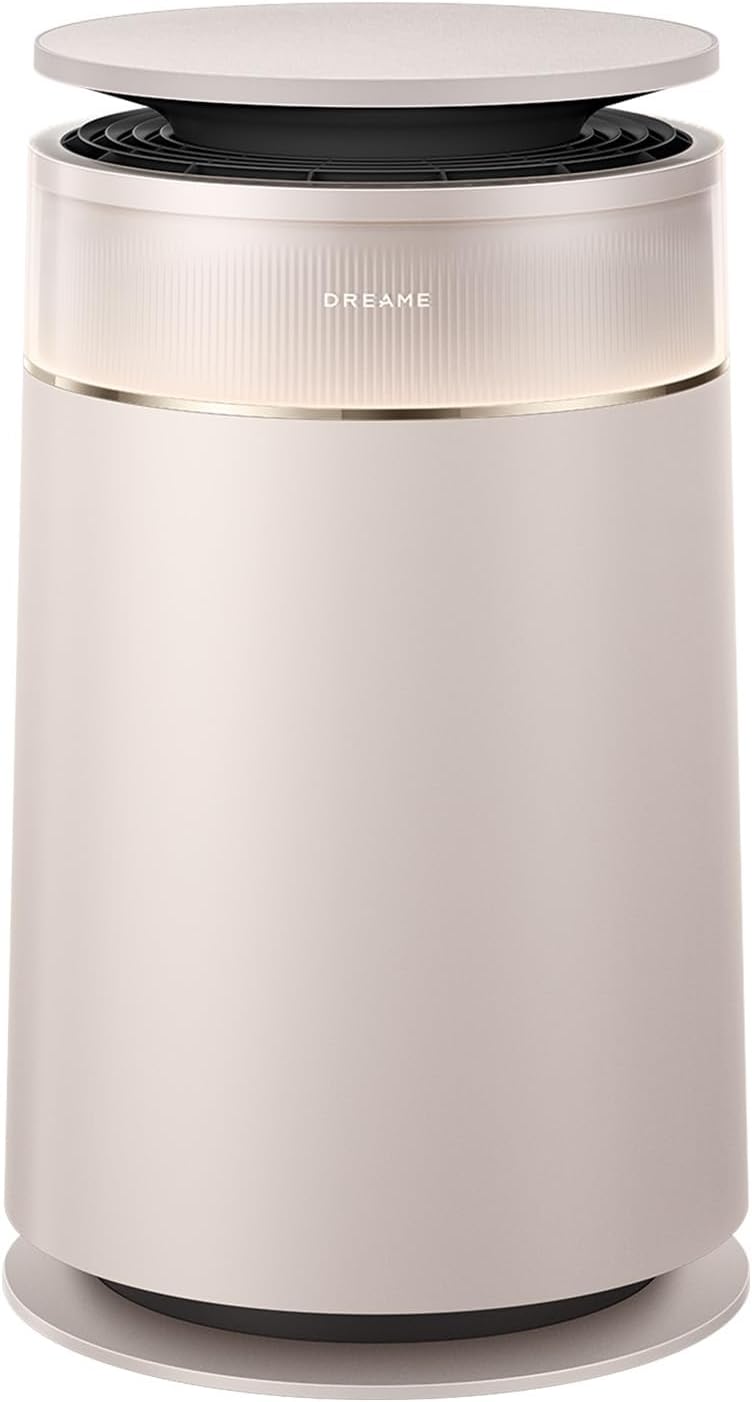
DREAME FP10 Air Purifier with Self-Cleaning Active Roller Brush, LoopBoost Airflow, CataFresh Odour Removal
ASIN: B0GT5KVWRG
- ✓Self-cleaning roller turns brush and filter 360 degrees to lift matted pet hair
- ✓Six stages: pre-filter, HEPA above 99.97%, carbon, metal layer, UVC and negative ions
- ✓Pet mode slows the fan when an animal comes close
- ✓Side-table shape with a light ring that changes colour with air quality
- ✓Dreamehome app shows live sensor data and filter reminders
- Filter type
- HEPA with activated carbon
- Stages
- Six, including UVC and ions
- Particle capture
- Over 99.97%
- Control
- App, touch and voice
- Size
- 37 × 37 × 62 cm
- Colour
- Gold
- Model
- CVF16A
Open this product on Amazon
Amazon prices change all the time, so check the current one on the store page. To compare every Amazon store at once, use our browser extension.
Cat owners write the warmest reviews here, and one German owner with two cats says the roller catches hair so effectively that the filter barely needs cleaning, and that CataFresh handles litter tray odours better than the purifier it replaced. Another, with three cats and a dust mite allergy, watched the air quality reading climb after a few hours on turbo and reports the smells gone. A third noticed fewer allergy symptoms after a single night and praises the quiet lowest setting, with one reservation: the confirmation beep is shrill. An Italian owner recommends the purifier for animals with a long moult.
The 4.4 average rests on 18 ratings, though, and the dissenting reviews are specific. An owner in the Netherlands says it does little for animal odour. An Italian two-star review is the sharpest: bulky, with hair collection that works only at full power and only when the hair lies very close to the purifier, filtration and cooking-smell removal below what Dreame promises, and a firmware update that never completed even with support on the case. This is the least proven of these purifiers.
Pros
- The only purifier here that goes after pet hair before it reaches the filter
- Six stages, including carbon that owners credit with clearing litter tray odours
- Cat owners report fewer allergy symptoms within days
- Quiet on its lowest setting, and it doubles as a side table
Cons
- Eighteen ratings behind the average, so the score is far from settled
- One owner reports hair is caught only at full power and very close to the unit
- No stated room size and no CADR figure to check the claims against
- Bulky at 62 cm, with a shrill confirmation beep
Dyson Purifier Hot+Cool HP1, the sealed HEPA air purifier
The Dyson is the dearest purifier of the four and the one asked to do the most. The seal is the part worth understanding: the whole body meets HEPA H13, so air cannot slip past the cartridge on the way out — a different promise from a purifier that merely holds a certified filter. Around that sits the fan, moving more than 250 litres a second in a 350-degree arc, and a heating element that warms the whole room rather than the carpet in front of it. Control runs three ways: the app, a voice assistant and a curved remote held on top by a magnet. At 76.5 cm tall and 7.44 kg this purifier is furniture, and its stated coverage of 27 m² is the smallest here.
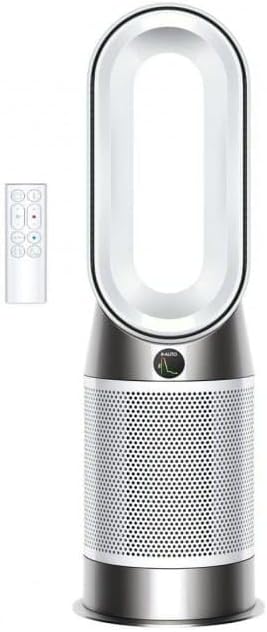
Dyson Purifier Hot+Cool HP1 Fan, Air Purifier and Fan Heater, White/White
ASIN: B0F7RPDTJ5
- ✓Captures 99.95% of allergens and pollutants down to 0.1 microns
- ✓Whole body sealed to HEPA H13, not only the filter cartridge
- ✓Air Multiplier moves over 250 litres a second and spreads it 350 degrees
- ✓Heats the room in winter and moves air through it in summer
- ✓MyDyson app and voice control, with a magnetic remote that parks on top
- Filter class
- HEPA H13, sealed
- Particle size
- 0.1 micron
- Room size
- 27 m²
- Airflow
- 250 l/s, 350° distribution
- Noise level
- 61 dB
- Power
- 40 W
- Size
- 13.1 × 20.5 × 76.5 cm
- Weight
- 7.44 kg
Open this product on Amazon
Amazon prices change all the time, so check the current one on the store page. To compare every Amazon store at once, use our browser extension.
Filtering draws the calmest praise, which is usually the most reliable kind. A German owner says that since the purifier arrived there are no bad smells left in the flat, cigarette smoke included. A French owner with 30 m² of open space reports that dust and odours both disappear, and adds that filter status reads better in the app than on the small display. Noise comes up almost as often, and as a compliment: the French review puts night mode at level four out of ten and says the purifier is nearly forgotten there, a Belgian owner writes that it works in silence, and an owner in the Netherlands calls it quiet and good-looking enough to be an eye-catcher.
The complaints all land on one function: this purifier does not cool. A one-star reviewer in Germany says it behaves like an ordinary fan and nothing more, and a four-star owner puts the same point politely: heating and filtering rate from good to very good, cooling loses marks, and the room temperature falls slowly or not at all. The French owner adds the reason: the airflow is gentler than a bladed fan. So this purifier suits a household that wants one appliance for winter and summer and has floor space for it, while anyone who only wants clean air in a bedroom is paying for two functions they will never switch on.
Pros
- Odours go, including cigarette smoke, according to owners several weeks in
- Quiet enough at night that owners stop noticing it
- Dust and smells cleared from an open room of around 30 m²
- App and voice control set up easily, with filter status visible remotely
- The magnetic remote stays on the machine instead of vanishing into a sofa
Cons
- Cooling is weak: room temperature barely drops, and one owner rates it one star for that alone
- Airflow is softer than a conventional bladed fan
- The smallest stated room coverage of the four models here
- Tall and heavy enough to need a permanent spot
Air purifier room size, HEPA and microns: how to read a listing
Three numbers decide most purifier purchases, and all three are easy to misread, starting with the filtration percentage: Philips states 99.97% at 0.003 microns, Dreame over 99.97%, Dyson 99.95% down to 0.1 microns and Rowenta 99.9% down to 0.1 microns. Those figures look rankable and are not, because the particle size attached to each one differs by a factor of thirty, so sorting these purifiers by percentage alone puts them in the wrong order.
Room size is the second number, and buyers lean on it hardest. The four purifiers claim 44 m² for the Philips, 30 m² for the Rowenta and 27 m² for the Dyson, while the Dreame states none at all. Only the Philips backs its claim with a CADR of 170 m³ per hour, which describes how much filtered air actually leaves it each hour. When purifiers give you square metres and nothing else, treat the figure as an upper bound rather than a working promise.
Noise is the third, and it decides whether the purifier ever runs at all: a purifier switched off because it whistles filters nothing. The listed levels run from 19 dB in the Philips sleep mode through 31 dB(A) at the Rowenta's lowest setting to 61 dB for the Dyson, and each describes one speed rather than these purifiers as a whole.
Air purifier comparison by the specifications
Set the four purifiers in one table, from the cheapest to the dearest, and the trade-offs stop hiding behind the marketing.
| Parameter | Philips 600 | Rowenta Eclipse | Dreame FP10 | Dyson HP1 |
|---|---|---|---|---|
| Room size | 44 m² | 30 m² | — | 27 m² |
| CADR | 170 m³/h | — | — | — |
| Filtration | 99.97% at 0.003 µm | 99.9% at 0.1 µm | Over 99.97% | 99.95% at 0.1 µm |
| Filter class | NanoProtect HEPA | HEPA | HEPA and carbon | HEPA H13, sealed |
| Heating | — | Ceramic, 2,100 W | — | Yes, whole room |
| Airflow | — | 358 l/s, 90° | — | 250 l/s, 350° |
| Noise | 19 dB sleep mode | 31 dB(A) minimum | — | 61 dB |
| Power draw | 12 W maximum | 2,100 W heating | — | 40 W |
| Height | 34.1 cm | 85.1 cm | 62 cm | 76.5 cm |
| Weight | 2.2 kg | 7.24 kg | — | 7.44 kg |
| Control | App | Remote, touch | App, touch, voice | App, remote, touch |
| Rating | 4.3 (3,590) | 3.8 (236) | 4.4 (18) | 4.2 (232) |
Read the ratings of these purifiers together with the crowd behind them. The Philips purifier carries 3,590 opinions, so its 4.3 is a settled fact rather than a first impression. The Dyson and the Rowenta rest on roughly 230 ratings each, and a gap between 4.2 and 3.8 for two purifiers of the same type is a real signal. The 4.4 of the Dreame comes from 18 people, which means two disappointed buyers move it further than fifty would move the Philips.
What buyers say about these air purifiers
One theme runs through the reviews of all four purifiers: the health effect is real but slow to describe, because nobody here reports a dramatic before-and-after. What they report instead is less morning sneezing in a child with a dust mite allergy, an asthma sufferer getting through a hard pollen year indoors, visibly less dust after two months, and rooms that stop smelling of cigarettes or a litter tray. That accumulation of small changes is what an air purifier really sells.
The second theme is the gap between a listing and a living room, and it belongs to the purifiers that promise something extra. Both three-in-one purifiers advertise cooling; neither cools, and their owners say so plainly. The Dreame advertises pet hair collection; it works well for some owners and barely at all for one. The plain filtering job, by contrast, is the part nobody argues about on any of these purifiers.
How to choose an air purifier
- Buy for the room, not the flat. Coverage figures assume one enclosed space with the door shut, so a purifier rated for 44 m² will not clean a two-bedroom home from the hallway. Start with the room where you sleep: the best air purifier for allergies is the one that runs through the eight uninterrupted hours you spend breathing in it.
- Treat cooling claims with suspicion. Both three-in-one purifiers here move air, and moving air feels better on a hot day, but neither lowers the temperature of a room. Every negative review of both purifiers comes from somebody who expected that it would.
- Check the noise figure at the speed you will use. Sleep mode numbers sell these purifiers; the medium setting is what runs while you read or work. Owners of quiet purifiers keep them switched on, and a purifier switched off cleans nothing.
- Work out the running cost before you buy. Twelve watts and forty watts are both trivial over a year, but a ceramic heater drawing 2,100 watts is a different kind of appliance, and so are the replacement filters that all four purifiers need.
- Weigh a small number of ratings carefully. Three of these purifiers have hundreds or thousands of owners behind their averages. One has eighteen, and its most detailed review is a two-star one.
Frequently asked questions
- Does a purifier with a heater replace an air conditioner?
- No, and this is the clearest finding in these reviews. The Dyson and the Rowenta both move air and both heat a room, but owners of both report that the temperature falls very slowly or not at all. Moving air feels cooler on the skin; it is not refrigeration.
- Which of these purifiers is quiet enough for a bedroom?
- The Philips states 19 dB in sleep mode and several owners run it all night without hearing it. Dreame owners describe the lowest setting as quiet, and Dyson owners say night mode is almost forgotten. The Rowenta is the one with noise complaints at both ends of its speed range.
- Why can I not simply compare the filtration percentages?
- Because each percentage is attached to a different particle size. Philips quotes 99.97% at 0.003 microns, Dyson 99.95% at 0.1 microns and Rowenta 99.9% at 0.1 microns. Reading the numbers without the micron figure beside them makes the machines look closer than they are.
- Will an air purifier help with allergies?
- Owners in these reviews say it helps, in modest and specific ways. Parents of a child with a dust mite allergy report less morning sneezing after adding one to his room, an asthma sufferer got through a heavy pollen season indoors, and an owner with three cats and a dust allergy noticed the difference within days.
- Do these purifiers remove pet hair from the air?
- Only the Dreame is designed for it, using a roller that sweeps hair off the intake so the pre-filter does not clog. Several cat owners say it works and saves them cleaning the filter. One Italian owner disagrees, reporting that hair is collected only at full power and only very close to the unit.
- How much electricity does an air purifier use?
- Filtering costs very little: the Philips draws at most 12 watts and the Dyson lists 40 watts. Heating is the expensive part, and the Rowenta's ceramic element is rated at 2,100 watts, so a three-in-one tower used as a heater belongs in a different bracket of running cost.
- Is app control worth having?
- Three of these four models offer it, and the owners who value it most use schedules rather than switches: turbo before bedtime, whisper mode overnight, medium in the morning. It also shows filter life without crouching in front of a small display.
Verdict
Every model on the same criteria
Score against price
- Philips 6004.6 at about €92
- Rowenta Eclipse3.7 at about €425
- Dreame FP103.9 at about €524
- Dyson HP14.2 at about €751
The overall score divided by the typical price, with the best in the group as the full bar. A rough guide, not a verdict — a cheap model that misses the feature you need is no bargain.
Read the bars as trade-offs rather than as a ranking. The cheapest purifier here is also the quietest, the thriftiest and the one that covers the most floor, and it does nothing but filter. The two tall purifiers buy heating and a strong fan with height, noise and a much larger electricity bill, and neither of them cools a room, whatever their owners hoped. The purifier built for pet hair sits between them and has the fewest owners behind it, so its average is the least settled number on this page. No purifier here filters badly; they differ only in what else they are asked to do.
So count the jobs you will actually give the machine: filtering alone, filtering plus winter heat, or filtering plus a cat that moults for four months. Each answer rules out half of these purifiers before a single price is compared. A purifier earns its keep by running quietly for months in the room where you sleep, and that is a job a small purifier does as well as a tall tower.